Reaktionsgleichung

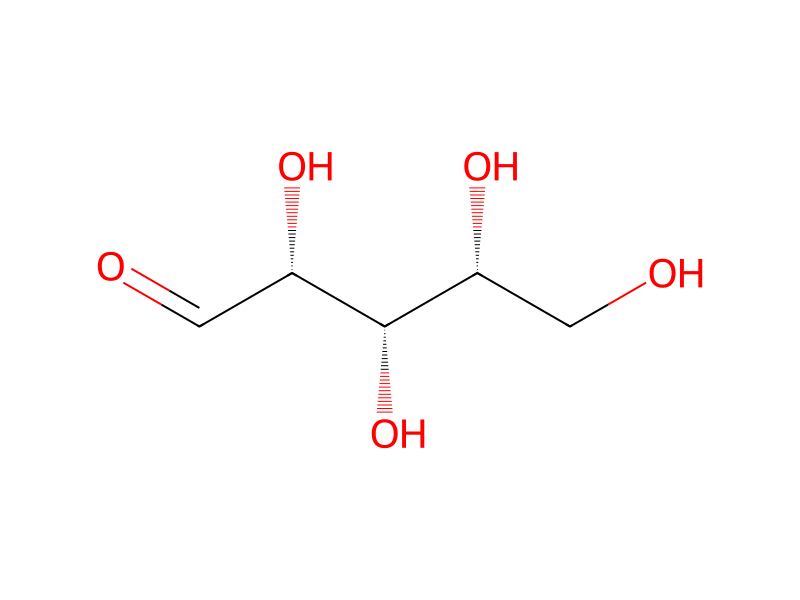
[CH2:1]([OH:10])[CH:2]([OH:9])[CH:3]([OH:8])[CH:4]([OH:7])[CH:5]=[O:6].O=C[C@@H]([C@H]([C@@H](CO)O)O)O.[O:21]=[C:22]([OH:31])[C@@H:23]([C@H:25]([C@@H:27]([CH2:29][OH:30])[OH:28])[OH:26])[OH:24].O=C[C@@H]([C@H]([C@H](CO)O)O)O>>[CH2:1]([OH:10])[C@@H:2]1[O:9][C:5](=[O:6])[C@H:4]([OH:7])[C@H:3]1[OH:8].[O:21]=[C:22]([OH:31])[C@@H:23]([C@H:25]([C@H:27]([CH2:29][OH:30])[OH:28])[OH:26])[OH:24]Komponenten
6



Versuchsvorschrift
Microbial synthesis begins with pentose oxidation using fermentor-controlled cultures (e.g., 1 L scale) of Pseudomonas fragi ATCC4973. (Buchert, J.; Viikari, L.; Linko, M.; Markkanen, P. Biotechnol. Lett. 1986, 8, 541. and Weimberg, R. J. Bio. Chem. 1961, 236, 629). D-xylose (100 g/L) is oxidized at 30° C. to D-xylonic acid and produces a 70% yield (77 g/L). L-arabinose is similarly oxidized and produces a 54% overall yield to a mixture of L-arabino-1,4-lactone (40 g/L) and L-arabinonic acid (15 g/L). The lactone is subsequently hydrolyzed to L-arabinonic acid. Escherichia coli constructs are then employed for the conversion of D-xylonic acid and L-arabinonic acid into the respective enantiomers of 1,2,4-butanetriol.
Aufarbeitung
- customMicrobial synthesis
- customproduces a 70% yield (77 g/L)
- customproduces a 54%
Quellen und Nachweise
- ORD-Eintrag
- ord-c72ab3d60a2141c6bbdf6803ff5d9f8a
- Quelldatensatz
- uspto-grants-2011_04
- Patentnummer
- US07923226B2
Verknüpfte Notizen
Wird geladen…