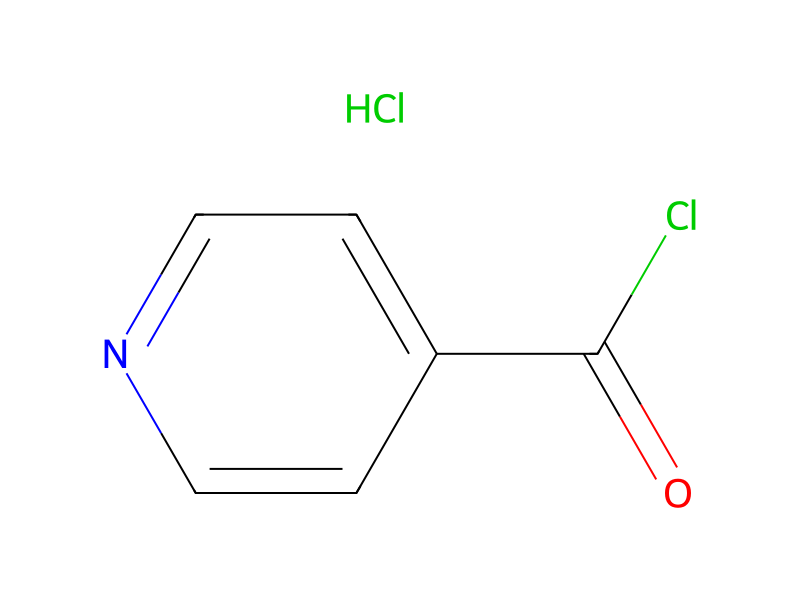
Cl.[C:2](Cl)(=[O:9])[C:3]1[CH:8]=[CH:7][N:6]=[CH:5][CH:4]=1.C(N(CC)CC)C.ClCCl.[F:21][C:22]([F:31])([F:30])[C:23]1[CH:24]=[C:25]([CH:27]=[CH:28][CH:29]=1)[NH2:26]>O>[F:21][C:22]([F:30])([F:31])[C:23]1[CH:24]=[C:25]([NH:26][C:2](=[O:9])[C:3]2[CH:8]=[CH:7][N:6]=[CH:5][CH:4]=2)[CH:27]=[CH:28][CH:29]=1Isonicotinoyl chloride hydrochloride (670 mg, 3.76 mmol, commercially available product) and triethylamine (864 μl, 6.20 mmol) were sequentially added at 0° C. to a dichloromethane (5 ml) solution of 3-(trifluoromethyl)aniline (208 mg, 1.29 mmol, commercially available product). The resulting mixture was warmed to room temperature and stirred for 23 hours. Water was added to the mixture, and the resulting mixture was extracted three times with ethyl acetate. The obtained organic layer was washed with a saturated sodium chloride solution, dried over anhydrous sodium sulfate, filtered, and concentrated under reduced pressure. The residue was purified by recrystallization (ethyl acetate). Thus, N-[3-(trifluoromethyl)phenyl]isonicotinamide (GIF-0608) (166 mg, 48.3%) was yielded as a colorless solid.
Wird geladen…