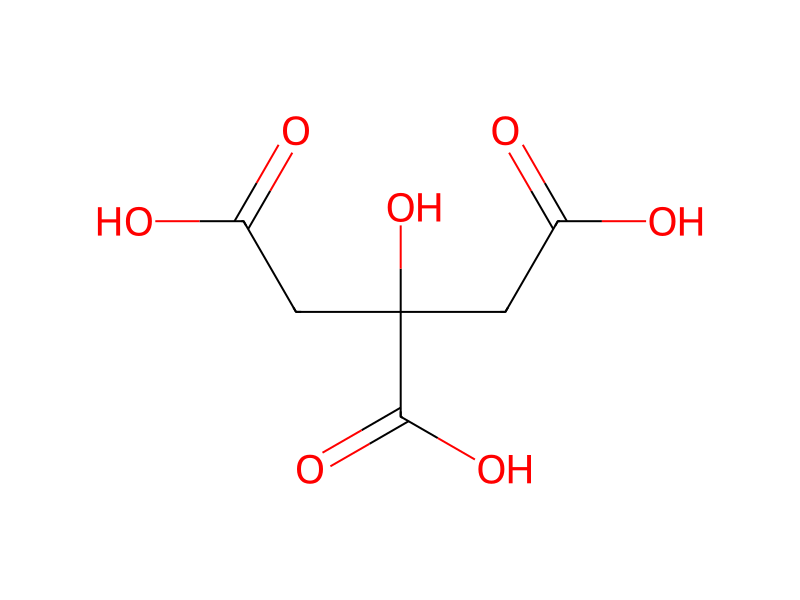
Citric Acid → 2-(Carboxymethyl)-2-hydroxybutanedioate
HRID 2194344
Reaktionsgleichung

[C:1]([OH:13])(=[O:12])[CH2:2][C:3]([CH2:8][C:9]([OH:11])=[O:10])([C:5]([OH:7])=[O:6])[OH:4]>O>[C:1]([OH:13])(=[O:12])[CH2:2][C:3]([CH2:8][C:9]([OH:11])=[O:10])([C:5]([O-:7])=[O:6])[OH:4].[C:1]([OH:13])(=[O:12])[CH2:2][C:3]([CH2:8][C:9]([O-:11])=[O:10])([C:5]([O-:7])=[O:6])[OH:4].[C:1]([O-:13])(=[O:12])[CH2:2][C:3]([CH2:8][C:9]([O-:11])=[O:10])([C:5]([O-:7])=[O:6])[OH:4]Komponenten
5
Edukt 1
Produkt 3


Reagenzien, Katalysatoren, Lösungsmittel 1

Versuchsvorschrift
Citric acid (IUPAC Name 2-hydroxypropane-1,2,3-tricarboxylic acid) is an organic acid having three carboxylic acid groups. In water, citric acid partially dissociates to form dihydrogen citrate ion, hydrogen citrate ion and citrate ion. The proportions of citric acid and its conjugate anions in a solution influence the pH of the solution, which is defined as −log10 [H3O].