Reaktionsgleichung

[C:1]([S:4][CH2:5][C@H:6]1[CH2:15][CH2:14][CH2:13][CH2:12][CH2:11][CH2:10][C@H:9]([C:16]([OH:18])=O)[NH:8][C:7]1=[O:19])(=[O:3])[CH3:2].C(N(CC)CC)C.C(Cl)(=O)C(C)(C)C.[CH2:34]([C@@H:41]1[CH2:45][O:44][C:43](=[O:46])[NH:42]1)[C:35]1[CH:40]=[CH:39][CH:38]=[CH:37][CH:36]=1.C([Li])CCC.O1CCNC1=O>O1CCCC1.CCCCCC>[C:1]([S:4][CH2:5][C@H:6]1[CH2:15][CH2:14][CH2:13][CH2:12][CH2:11][CH2:10][C@H:9]([C:16]([N:42]2[C@H:41]([CH2:34][C:35]3[CH:40]=[CH:39][CH:38]=[CH:37][CH:36]=3)[CH2:45][O:44][C:43]2=[O:46])=[O:18])[NH:8][C:7]1=[O:19])(=[O:3])[CH3:2]Komponenten
Edukt 6



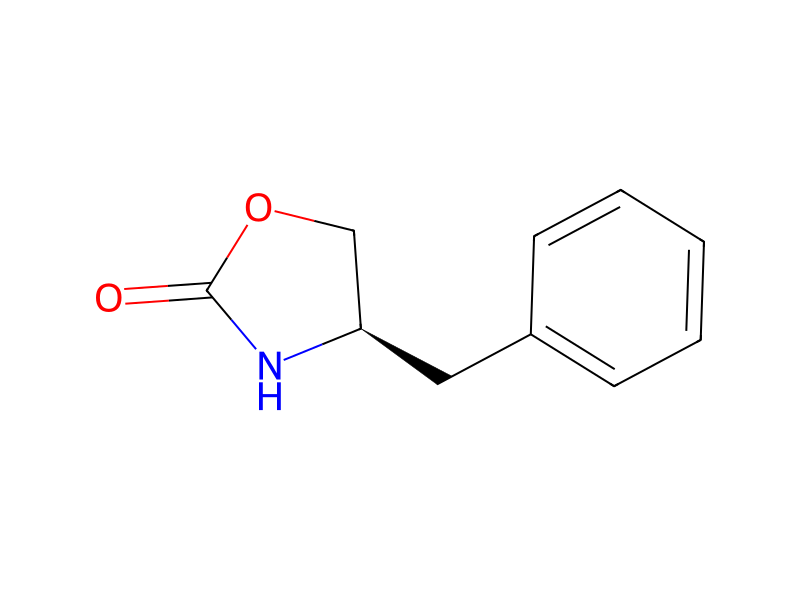


Produkt 1

Reagenzien, Katalysatoren, Lösungsmittel 2


Reaktionsbedingungen
- Temperatur
- -78 °C
Versuchsvorschrift
Trans 3-(acetylthiomethyl)-2-oxo-1-azacyclodecane-10-carboxylic acid (2.90 g, 10.1 mmol) is dissolved in tetrahydrofuran (45.0 mL), triethylamine (1.48 mL, 10.2 mmol) is added, and the reaction is cooled to -78° C. Pivaloyl chloride (1.31 mL, 10.2 mmol) is added, the reaction is warmed to 0° C., stirred for 3 hours, and then cooled down again to -78° C. Meanwhile, in a separate flask, (R)-4-benzyl-2-oxazolidinone (1.88 g, 10.2 mmol) is dissolved in tetrahydrofuran (35 mL) and cooled to -78° C.; butyl lithium (6.63 mL of a 1.6M solution in hexane, 10.2 mmol) is added and the reaction is stirred at -78° C. for 30 minutes. This oxazolidinone anion is then cannulated into the first reaction flask, which is stirred at -78° C. for an additional 1 hour, and then allowed to warm up to room temperature and stir overnight. The reaction is quenched with saturated ammonium chloride, and all of the solvent is evaporated. The product is purified by an initial silica gel chromatography (50% ethyl acetate/hexane) to give N-[[trans 3-(acetylthiomethyl)-2-oxo-1-azacyclodecan-10-yl]-carbonyl]-(R)-4-benzyl-2-oxazolidinone as a mixture of two chiral diastereomers. These diastereomers are then separated by another silica gel chromatography (15% ether/40% hexane/45% methylene chloride) to yield the less polar (minor) chiral isomer, and the more polar (major) chiral isomer, m.p. 65°-66° C., [α]D +10.97° (c=7.52 mg/ml, CH2Cl2) leading to the more active NEP inhibiting enantiomer.
Aufarbeitung
- temperaturethe reaction is warmed to 0° C.
- temperaturecooled down again to -78° C
- temperaturecooled to -78° C.
- stirringthe reaction is stirred at -78° C. for 30 minutes
- stirringis stirred at -78° C. for an additional 1 hour
- temperatureto warm up to room temperature
- stirringstir overnight
- customThe reaction is quenched with saturated ammonium chloride
- customall of the solvent is evaporated
- customThe product is purified by an initial silica gel chromatography (50% ethyl acetate/hexane)
Quellen und Nachweise
- ORD-Eintrag
- ord-2ebf45a8edb24173949e235cca7efcf1
- Quelldatensatz
- uspto-grants-1995_06
- Patentnummer
- US05426103
Verknüpfte Notizen
Wird geladen…