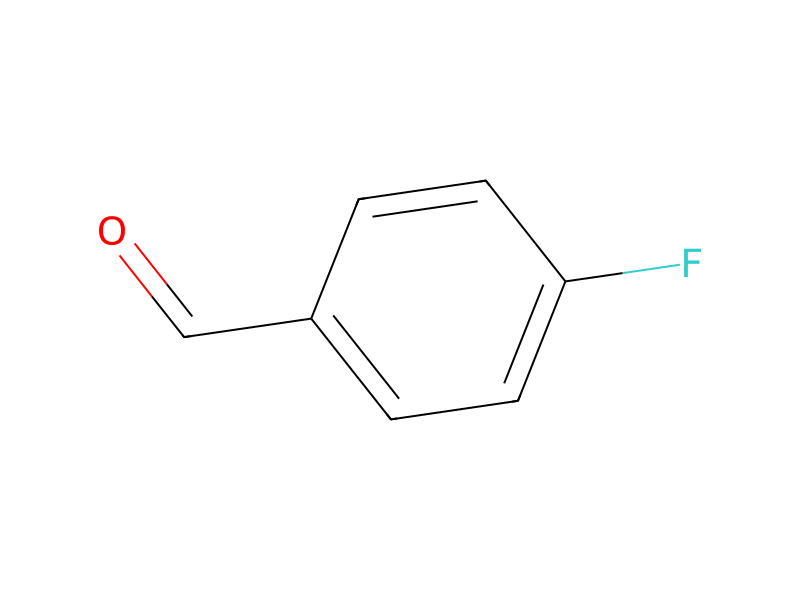
[OH:1][C:2]1[CH:7]=[CH:6][C:5]([C:8](=[CH:12][C:13]2[CH:18]=[CH:17][C:16]([CH3:19])=[CH:15][CH:14]=2)[C:9]([OH:11])=[O:10])=[CH:4][CH:3]=1.C(=O)([O-])[O-].[K+].[K+].F[C:27]1[CH:34]=[CH:33][C:30]([CH:31]=[O:32])=[CH:29][CH:28]=1.Cl>CN(C)C(=O)C.O>[CH:31]([C:30]1[CH:33]=[CH:34][C:27]([O:1][C:2]2[CH:7]=[CH:6][C:5]([C:8](=[CH:12][C:13]3[CH:14]=[CH:15][C:16]([CH3:19])=[CH:17][CH:18]=3)[C:9]([OH:11])=[O:10])=[CH:4][CH:3]=2)=[CH:28][CH:29]=1)=[O:32]To a solution of 38 (7.27 g, 28.6 mmol) and potassium carbonate (8.68 g, 62.9 mmol) in 200 mL N,N-dimethylacetamide was added 4-fluorobenzaldehyde (3.9 mL, 36.4 mmol). The reaction mixture was heated to 190° C. for 1.5 h under argon then cooled to room temperature. The addition of 5% HCl in water to pH 1 resulted in the product separating out as oil. Approximately 50 mL ethyl acetate was added to the mixture which is allowed to stir 16 h. The solid was collected and recrystallized out of toluene, rinsed with hexane and dried under vacuum to yield a white powder (8.1 g, 79.0%). 1H NMR (400 MHz, DMSO-d6) δ 12.71 (s, 1H), 9.94 (s, 1H), 7.97(d, J=8.8 Hz, 2H), 7.76 (s, 1H), 7.25 (d, J=8.4 Hz, 2H), 7.18 (d, J=6.8 Hz, 2H), 7.16 (d, J=6.4 Hz, 2H), 7.07 (d, J=8.0 Hz, 2H), 6.98 (d, J=8.4 Hz, 2H), 2.25 (s, 3H).