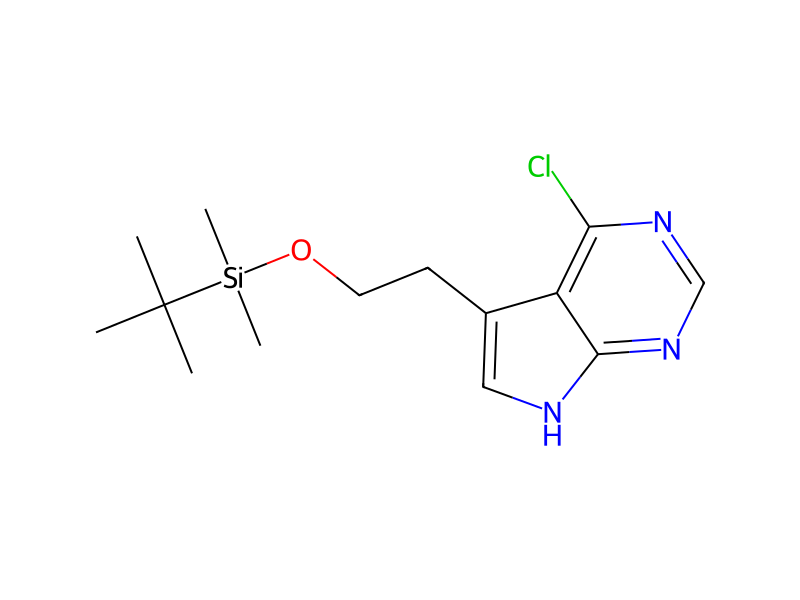
Br[C:2]1[C:10]2[C:5]([NH:6][CH:7]=[N:8][C:9]=2[Cl:11])=[N:4][CH:3]=1.[Li]CCCC.Br[CH2:18][CH2:19][O:20][Si:21]([C:24]([CH3:27])([CH3:26])[CH3:25])([CH3:23])[CH3:22].[NH4+].[Cl-]>C1COCC1.O.C(Cl)Cl>[O:20]([CH2:19][CH2:18][C:2]1[C:10]2[C:9]([Cl:11])=[N:8][CH:7]=[N:6][C:5]=2[NH:4][CH:3]=1)[Si:21]([C:24]([CH3:27])([CH3:26])[CH3:25])([CH3:23])[CH3:22]A suspension of compound 2.2 from Step A (2.0 g, 8.6 mmol) in THF (40.0 mL) was cooled to −78° C. under an argon atmosphere. n-BuLi (1.6M in hexanes, 13.4 mmol) was then added over 1.0 hr via syringe. A suspension formed and (2-bromoethoxy)-tert-butyldimethylsilane (7.4 mL, 34.4 mmol) was added via syringe while maintaining the reaction mixture at −78° C. The reaction mixture was allowed to slowly reach −30° C. and stirred for 2 h, then −30 to −10° C. for 1 h, and −10 to 0° C. for 1 hr. The reaction mixture became dark brown in color, was treated with NH4Cl, CH2Cl2 and water. The reaction mixture was extracted with CH2Cl2 and the extracts were dried over Na2SO4, filtered and evaporated. The beige residue was purified by flash column chromatography using 23% EtOAc in hexanes as eluent to give the desired compound 2.3 (1.16 g, 43%) as a white solid. (Brown, D. M. et al., J. Chem. Soc. PT-1, 3565-3570.)