StartseiteMCPWorkbenchSkills
StartseiteWorkbenchBenachrichtigungenMein Bereich
llms.txt · MCP-AnleitungDatenschutz · Nutzungsbedingungen · Supportv1.8.3
  1. Startseite
  2. /Reaktion

Sodium Carbonate → 1,2-dimethyl-2H-pyrazolo[3,4-c]quinolin-4-amine

HRID 2283765
Drucken

Reaktionsgleichung

Reaktionsgleichung von HRID 2283765
C1(P(C2C=CC=CC=2)C2C=CC=CC=2)C=CC=CC=1.Cl.[NH2:21][C:22]1[CH:27]=[CH:26][CH:25]=[CH:24][C:23]=1B(O)O.Br[C:32]1[C:33]([C:39]#[N:40])=[N:34][N:35]([CH3:38])[C:36]=1[CH3:37].C(=O)([O-])[O-].[Na+].[Na+]>C([O-])(=O)C.[Pd+2].C([O-])(=O)C.O.ClCCl.C(O)CC>[CH3:37][C:36]1[N:35]([CH3:38])[N:34]=[C:33]2[C:32]=1[C:23]1[CH:24]=[CH:25][CH:26]=[CH:27][C:22]=1[N:21]=[C:39]2[NH2:40]
KomponentenReaktionsbedingungenVersuchsvorschriftAufarbeitungQuellen und NachweiseNotizen zur Reaktion

Komponenten

9

Edukt 4

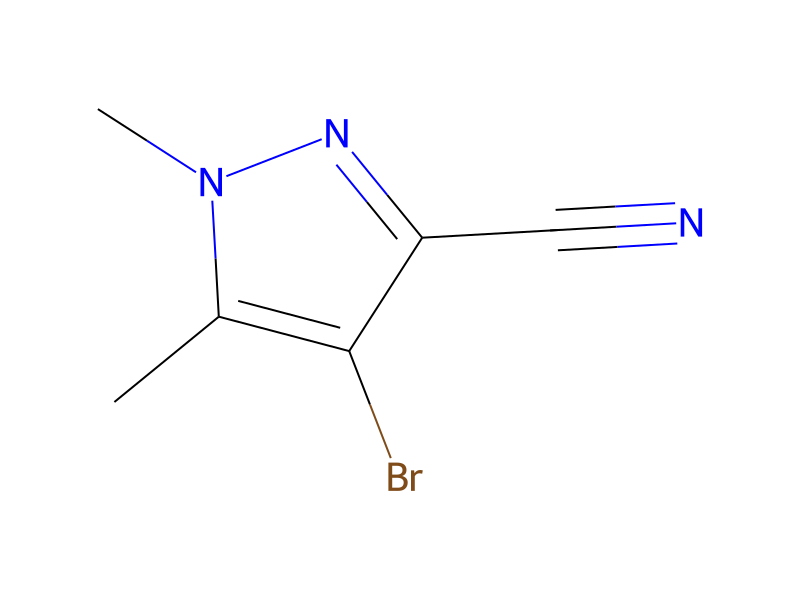
HCID 10340Sodium Carbonate2×HCID 11776TriphenylphosphineHCID 164270902-Aminophenylboronic acid hydrochloride2×HCID 669589664-bromo-1,5-dimethyl-1H-pyrazole-3-carbonitrile

Produkt 1

HCID 577175181,2-dimethyl-2H-pyrazolo[3,4-c]quinolin-4-amineAusbeute 20 %

Reagenzien, Katalysatoren, Lösungsmittel

4
HCID 167845palladium(II) acetateKatalysator2×HCID 962WaterLösungsmittel3×HCID 10311-PropanolLösungsmittelHCID 6344DichloromethaneLösungsmittel

Reaktionsbedingungen

Temperatur
100 °C

Versuchsvorschrift

Triphenylphosphine (0.10 g, 0.45 mmol), 2-aminophenylboronic acid hydrochloride (3.89 g, 22.0 mmol), and 4-bromo-1,5-dimethyl-1H-pyrazole-3-carbonitrile (prepared as described in Parts A-C of Example 5, 3.00 g, 15.0 mmol) were placed in a flask. After 1-propanol was added (22 mL), the flask was placed under vacuum and back-filled with nitrogen three times. Palladium (II) acetate (30 mg, 0.15 mmol) was added, followed by aqueous sodium carbonate (22.5 mL of 2 M) and water (4.4 mL). The reaction was heated overnight under a nitrogen atmosphere at 100° C. Additional 2-aminophenylboronic acid hydrochloride (1.0 g), palladium (II) acetate (approximately 10 mg), aqueous sodium carbonate (10 mL of 2 M), and water (5 mL) were added. The reaction was heated at 100° C. for 8 hours, then was allowed to cool to ambient temperature. The reaction mixture was pardoned between dichloromethane and water. The organic layer was concentrated under reduced pressure and the crude product was purified by chromatography on a HORIZON HPFC system (silica gel, gradient elution with 0-30% CMA in chloroform). The appropriate fractions were combined and concentrated under reduced pressure. The residue was dissolved in dichloromethane and concentrated under reduced pressure, which resulted in the formation of a solid. Hexanes were added to the solid, which was isolated by filtration and crystallized from acetonitrile to yield 0.637 g of 1,2-dimethyl-2H-pyrazolo[3,4-c]quinolin-4-amine as white needles, mp>250° C.


Aufarbeitung

  1. additionback-filled with nitrogen three times
  2. temperatureThe reaction was heated at 100° C. for 8 hours
  3. temperatureto cool to ambient temperature
  4. concentrationThe organic layer was concentrated under reduced pressure
  5. customthe crude product was purified by chromatography on a HORIZON HPFC system (silica gel, gradient elution with 0-30% CMA in chloroform)
  6. concentrationconcentrated under reduced pressure
  7. dissolutionThe residue was dissolved in dichloromethane
  8. concentrationconcentrated under reduced pressure, which
  9. customresulted in the formation of a solid
  10. customwhich was isolated by filtration
  11. customcrystallized from acetonitrile

Quellen und Nachweise

ORD-Eintrag
ord-306779bb1ae14c7da8ecf240e02b587c
Quelldatensatz
uspto-grants-2015_09
DOI
10.6084/m9.figshare.5104873.v1
Patentnummer
US09145410B2

Notizen zur Reaktion

Auf dieser SeiteKomponentenReaktionsbedingungenVersuchsvorschriftAufarbeitungQuellen und NachweiseNotizen zur Reaktion