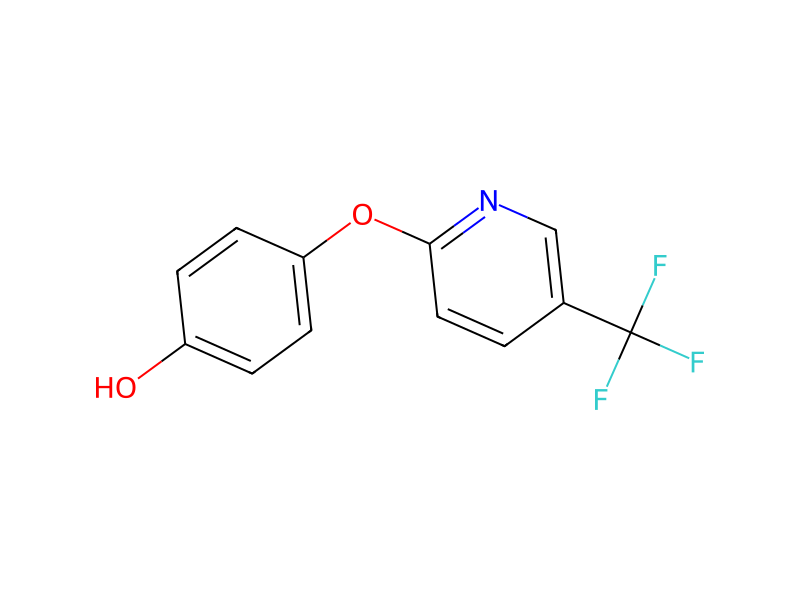
[F:1][C:2]([F:18])([F:17])[C:3]1[CH:4]=[CH:5][C:6]([O:9][C:10]2[CH:15]=[CH:14][C:13]([OH:16])=[CH:12][CH:11]=2)=[N:7][CH:8]=1.Br[CH:20]([CH3:27])[CH:21]=[CH:22][C:23]([O:25][CH3:26])=[O:24].C(=O)([O-])[O-].[K+].[K+]>C(C(C)=O)C.C(OCC)C>[F:18][C:2]([F:1])([F:17])[C:3]1[CH:4]=[CH:5][C:6]([O:9][C:10]2[CH:11]=[CH:12][C:13]([O:16][CH:20]([CH3:27])[CH:21]=[CH:22][C:23]([O:25][CH3:26])=[O:24])=[CH:14][CH:15]=2)=[N:7][CH:8]=1In 50 ml of methyl ethyl ketone, 2.0 g (0.0078 mole) of 4-[5-(trifluoromethyl)-2-pyridinyloxy]phenol, 3.2 g of methyl 4-bromo-2-pentenoate, and 2.0 g of potassium carbonate were refluxed with constant stirring for 32 hours. Upon cooling to room temperature, the suspension was filtered through celite and the insoluble material washed with 75 ml of acetone. The filtrate was concentrated under reduced pressure to give an oily residue which was dissolved in 125 ml of ethyl ether and transferred to a separatory funnel. After washing with saturated sodium bicarbonate and water, the ether layer was dried over magnesium sulfate and charcoal filtered. Under reduced pressure, the solvent was evaporated and traces of volatile impurities removed at 0.4 mm Hg. (50° for 2 hours) to yield 2.4 g (84% ) of product, ND25 1.520.