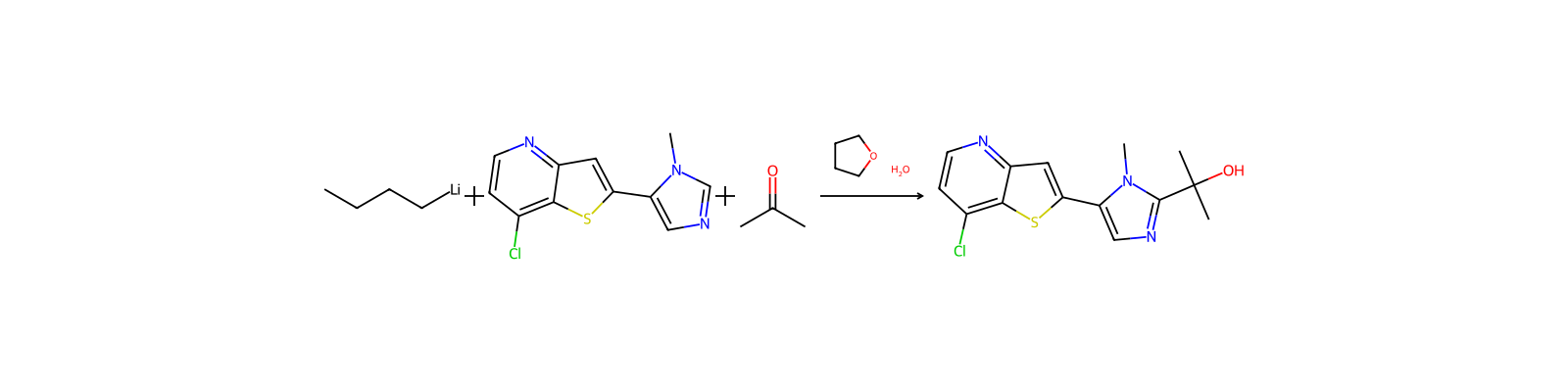
In a 50 mL round-bottomed flask 7 mL of tetrahydrofuran and n-butyllithium (0.88 mL, 2.5M in hexane) were cooled to −40° C. A suspension of 7-chloro-2-(3-methyl-3H-imidazol-4-yl)-thieno[3,2-b]pyridine (500 mg, 2.00 mmol) in 9 mL of tetrahydrofuran was added dropwise to the solution and stirred for 40 minutes. Acetone (0.79 mL, 3.00 mmol) was added to the anion and the reaction mixture was allowed to warm to room temperature overnight. The mixture was diluted with water and extracted with chloroform (3×50 mL). The combined extracts were dried over NaSO4, filtered, and concentrated. Chromatography on 50 g of silica gel with 5% methanol:methylene chloride afforded 191 mg (31%) of 2-[5-(7-chloro-thieno[3,2-b]pyridin-2-yl)-1-methyl-1H-imidazol-2-yl]-propan-2-ol. 1H NMR (400 MHz, CDCl3) δ8.58 (d, 1H), 7.51 (s, 1H), 7.28 (d, 1H), 7.24 (s, 1H), 4.02 (s, 3H), 1.77 (s, 6H). LC-MS: 308.1, 310.1 (MH+); HPLC RT: 4.18 min.