Reaktionsgleichung
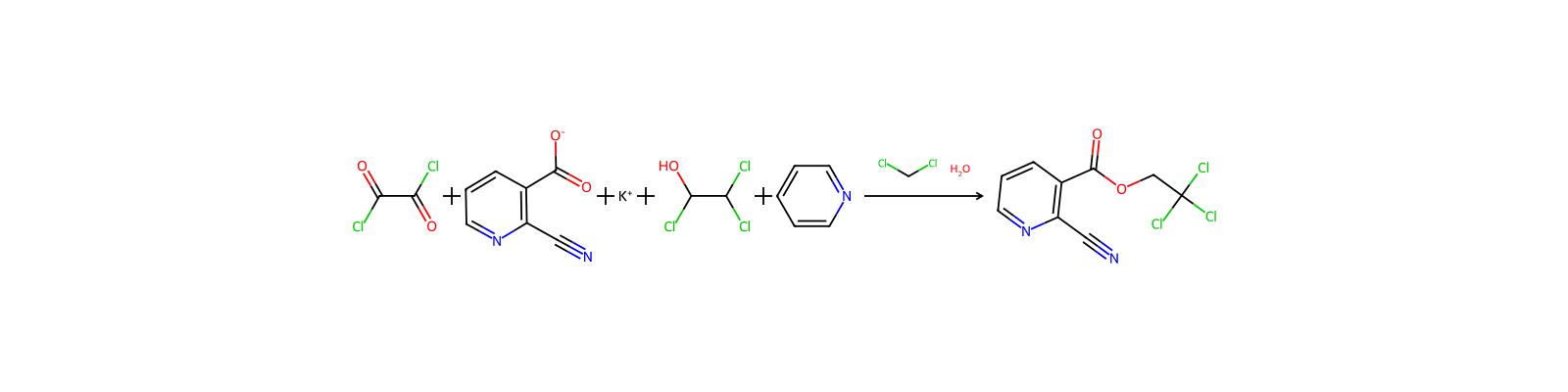
C(Cl)(=O)C([Cl:4])=O.[C:7]([C:9]1[N:17]=[CH:16][CH:15]=[CH:14][C:10]=1[C:11]([O-:13])=[O:12])#[N:8].[K+].[CH:19](Cl)(O)[CH:20]([Cl:22])[Cl:21].N1C=CC=CC=1>ClCCl.O>[C:7]([C:9]1[N:17]=[CH:16][CH:15]=[CH:14][C:10]=1[C:11]([O:13][CH2:19][C:20]([Cl:22])([Cl:4])[Cl:21])=[O:12])#[N:8]Komponenten
7
Edukt 4




Produkt 1

Reagenzien, Katalysatoren, Lösungsmittel 2


Versuchsvorschrift
Oxalyl chloride (2.8 g; 0.022 mol) is added to a suspension of compound 3 (4.1 g; 0.022 mol) in dichloromethane (50 cc). The mixture is heated under reflux until gas evolution ceases and then treated with a solution of trichloroethanol (3.3 g; 0.022 mol) and pyridine (3.5 g; 0.044 mol) in dichloromethane (30 cc). The mixture is then treated with water and then dried. After evaporation of the solvent and crystallization in pentane, 2,2,2-tri-chloroethyl 2-cyanonicotinate (4.55 g; m.p. 103° C.) is obtained (yield=78%).
Aufarbeitung
- temperatureThe mixture is heated
- temperatureunder reflux until gas evolution ceases
- customdried
- customAfter evaporation of the solvent and crystallization in pentane
Quellen und Nachweise
- ORD-Eintrag
- ord-be80054748d5446480496c5b8647d737
- Quelldatensatz
- uspto-grants-1989_07
- Patentnummer
- US04851396
Verknüpfte Notizen
Wird geladen…