Estradiol → beta-Estradiol diacetate
Reaktionsgleichung
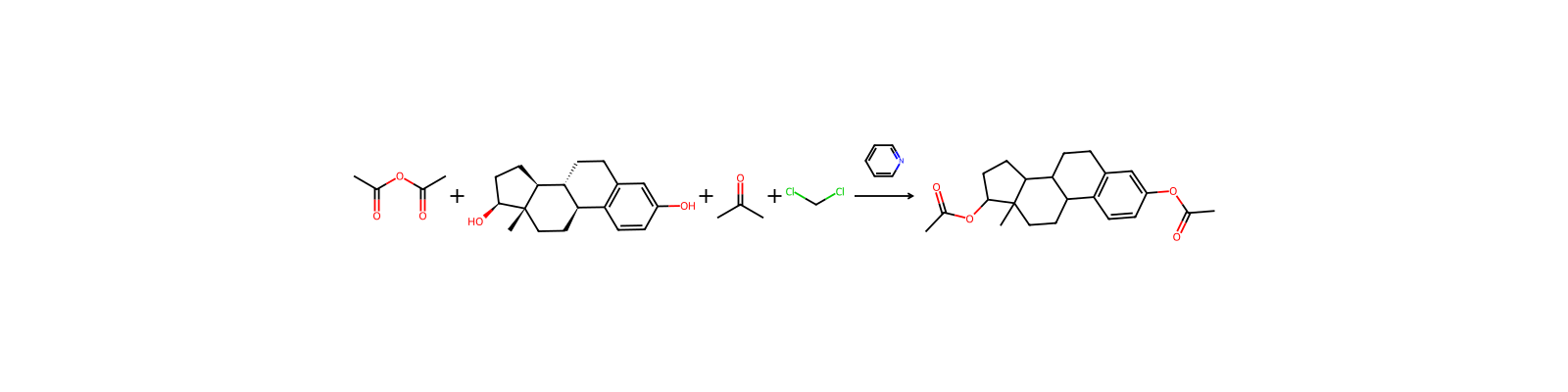
[C:1](OC(=O)C)(=[O:3])[CH3:2].[CH3:8][C@@:9]12[C@@H:25]([OH:26])[CH2:24][CH2:23][C@H:22]1[C@H:21]1[C@@H:12]([C:13]3[CH:14]=[CH:15][C:16]([OH:27])=[CH:17][C:18]=3[CH2:19][CH2:20]1)[CH2:11][CH2:10]2.[CH3:28][C:29](C)=[O:30].C(Cl)Cl>N1C=CC=CC=1>[CH3:2][C:1]([O:26][CH:25]1[C:9]2([CH3:8])[CH2:10][CH2:11][CH:12]3[C:13]4[CH:14]=[CH:15][C:16]([O:27][C:29]([CH3:28])=[O:30])=[CH:17][C:18]=4[CH2:19][CH2:20][CH:21]3[CH:22]2[CH2:23][CH2:24]1)=[O:3]Komponenten
5
Edukt 3



Produkt 1

Reagenzien, Katalysatoren, Lösungsmittel 1

Versuchsvorschrift
Under nitrogen, acetic anhydride (50 mL, 264.5 mmol) was added to a solution of estradiol (1a) (20.0 g, 73.43 mmol) in dry pyridine (200 mL). The reaction mixture was stirred at room temperature overnight (16 h). The next morning, analysis by tlc (5% acetone/CH2Cl2) indicated a complete reaction. The mixture was cooled in an ice bath and the excess acetic anhydride quenched by addition of methanol (25 mL). The mixture was stirred at 0° C. for one hour and then allowed to warm to room temperature. The solvents were removed in vacuo and the solid residue crystallized from hot methanol to give the pure diacetate (2a) (24.87 g, 95%).