StartseiteMCPWorkbenchSkills
StartseiteWorkbenchBenachrichtigungenMein Bereich
llms.txt · MCP-AnleitungDatenschutz · Nutzungsbedingungen · Supportv1.8.3
  1. Startseite
  2. /Reaktion

Potassium Phosphate, Tribasic → methyl 2-(3-chlorophenyl)-7-(4-morpholinyl)-5H-pyrido[2',3':4,5]pyrrolo[2,3-b]pyridine-4-carboxylate

HRID 2410754
Drucken

Reaktionsgleichung

Reaktionsgleichung von HRID 2410754
[Cl:1][C:2]1[CH:3]=[C:4](B(O)O)[CH:5]=[CH:6][CH:7]=1.Br[C:12]1[CH:13]=[C:14]([C:31]([O:33][CH3:34])=[O:32])[C:15]2[NH:29][C:18]3=[N:19][C:20]([N:23]4[CH2:28][CH2:27][O:26][CH2:25][CH2:24]4)=[CH:21][CH:22]=[C:17]3[C:16]=2[N:30]=1.[O-]P([O-])([O-])=O.[K+].[K+].[K+].C1(P(C2CCCCC2)C2C=CC=CC=2C2C(OC)=CC=CC=2OC)CCCCC1>CC([O-])=O.CC([O-])=O.[Pd+2]>[Cl:1][C:2]1[CH:3]=[C:4]([C:12]2[CH:13]=[C:14]([C:31]([O:33][CH3:34])=[O:32])[C:15]3[NH:29][C:18]4=[N:19][C:20]([N:23]5[CH2:28][CH2:27][O:26][CH2:25][CH2:24]5)=[CH:21][CH:22]=[C:17]4[C:16]=3[N:30]=2)[CH:5]=[CH:6][CH:7]=1

KomponentenReaktionsbedingungenVersuchsvorschriftAufarbeitungQuellen und NachweiseNotizen zur Reaktion

Komponenten

6

Edukt 4

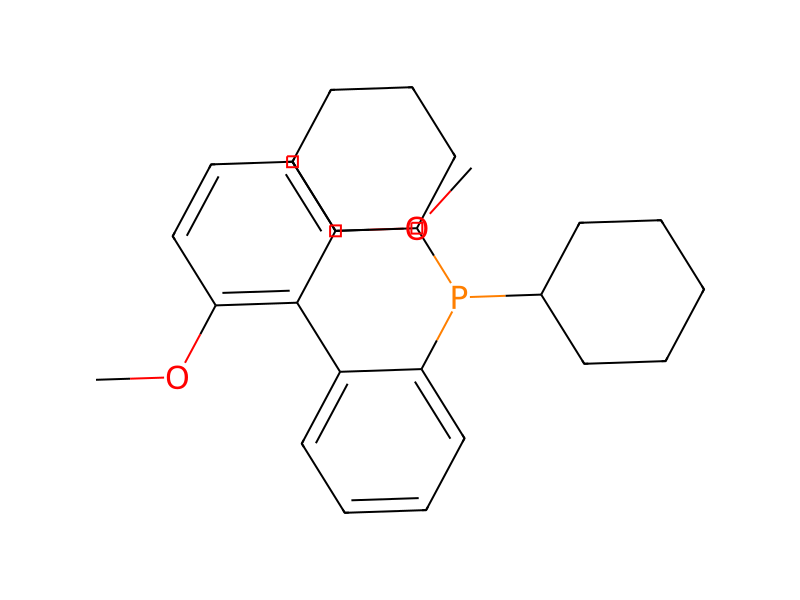
HCID 62657Potassium Phosphate, TribasicHCID 2734323(3-Chlorophenyl)boronic acidHCID 112698722-Dicyclohexylphosphino-2',6'-dimethoxybiphenylHCID 86663024methyl 2-bromo-7-(4-morpholinyl)-5H-pyrido[2',3':4,5]pyrrolo[2,3-b]pyridine-4-carboxylate

Produkt 1

HCID 66605303
methyl 2-(3-chlorophenyl)-7-(4-morpholinyl)-5H-pyrido[2',3':4,5]pyrrolo[2,3-b]pyridine-4-carboxylate
Ausbeute 51 %

Reagenzien, Katalysatoren, Lösungsmittel 1

HCID 167845palladium(II) acetateKatalysator

Reaktionsbedingungen

Temperatur
70 °C

Versuchsvorschrift

A mixture of 3-chlorophenylboronic acid (48.0 mg, 0.307 mmol), methyl 2-bromo-7-(4-morpholinyl)-5H-pyrido[2′,3′:4,5]pyrrolo[2,3-b]pyridine-4-carboxylate (100 mg, 0.256 mmol), finely powdered potassium phosphate tribasic (130 mg, 0.613 mmol), dicyclohexyl(2′,6′-dimethoxybiphenyl-2-yl)phosphine (21 mg, 0.051 mmol), and Pd(OAc)2 (5.7 mg, 0.026 mmol) in a microwave vial was flushed with nitrogen. THF (1.3 mL) was added, the vial was capped, and the reaction was heated in a 70° C. oil bath for 24 hr. After cooling, it was partitioned between EtOAc and water. The organic phase was extracted with brine and dried with sodium sulfate. The solvents were removed and radial chromatography (step gradient elution with DCM containing 0 to 50% EtOAc) afforded methyl 2-(3-chlorophenyl)-7-(4-morpholinyl)-5H-pyrido[2′,3′:4,5]pyrrolo[2,3-b]pyridine-4-carboxylate (55 mg, 0.130 mmol, 51% yield). MS (ESI) m/z 423.11 (M+H). 1H NMR (500 MHz, chloroform-d) δ ppm 9.51 (1H, s), 8.43 (1H, d, J=8.55 Hz), 8.16 (1H, t, J=1.83 Hz), 8.13 (1H, s), 7.99 (1H, d, J=7.93 Hz), 7.42 (1H, t, J=7.78 Hz), 7.33-7.38 (1H, m), 6.67 (1H, d, J=8.85 Hz), 4.08 (3H, s), 3.84-3.91 (4H, m), 3.67-3.75 (4H, m).

Aufarbeitung

  1. customwas flushed with nitrogen
  2. additionTHF (1.3 mL) was added
  3. customthe vial was capped
  4. temperatureAfter cooling
  5. customit was partitioned between EtOAc and water
  6. extractionThe organic phase was extracted with brine
  7. dry with materialdried with sodium sulfate
  8. customThe solvents were removed
  9. washradial chromatography (step gradient elution with DCM containing 0 to 50% EtOAc)

Quellen und Nachweise

ORD-Eintrag
ord-eafa3da4e8234bc1ae85e95a07984cd1
Quelldatensatz
uspto-grants-2014_08
DOI
10.6084/m9.figshare.5104873.v1
Patentnummer
US08815840B2

Notizen zur Reaktion

Auf dieser SeiteKomponentenReaktionsbedingungenVersuchsvorschriftAufarbeitungQuellen und NachweiseNotizen zur Reaktion