StartseiteMCPWorkbenchSkills
StartseiteWorkbenchBenachrichtigungenMein Bereich
llms.txt · MCP-AnleitungDatenschutz · Nutzungsbedingungen · Supportv1.8.0
  1. Startseite
  2. /Reaktion

Potassium Hydroxide → HCID 178463574, Verbindung

HRID 243427
Notizen
Druckvorschau

Reaktionsgleichung

Reaktionsgleichung von HRID 243427
Br[C:2]1[C:7]2[N:8]([C:29]3[CH:34]=[CH:33][CH:32]=[CH:31][CH:30]=3)[C:9]([C@@H:11]([NH:13][C:14]3[N:22]=[CH:21][N:20]=[C:19]4[C:15]=3[N:16]=[CH:17][N:18]4C3CCCCO3)[CH3:12])=[N:10][C:6]=2[CH:5]=[CH:4][C:3]=1[F:35].C(P(C(C)(C)C)C1C=CC=CC=1C1C(C(C)C)=CC(C(C)C)=CC=1C(C)C)(C)(C)C.[OH-:66].[K+]>O1CCOCC1.O.C1C=CC(/C=C/C(/C=C/C2C=CC=CC=2)=O)=CC=1.C1C=CC(/C=C/C(/C=C/C2C=CC=CC=2)=O)=CC=1.C1C=CC(/C=C/C(/C=C/C2C=CC=CC=2)=O)=CC=1.[Pd].[Pd]>[F:35][C:3]1[CH:4]=[CH:5][C:6]2[N:10]=[C:9]([CH:11]([NH:13][C:14]3[N:22]=[CH:21][N:20]=[C:19]4[C:15]=3[N:16]=[CH:17][NH:18]4)[CH3:12])[N:8]([C:29]3[CH:34]=[CH:33][CH:32]=[CH:31][CH:30]=3)[C:7]=2[C:2]=1[OH:66]
KomponentenReaktionsbedingungenVersuchsvorschriftAufarbeitungQuellen und NachweiseNotizen zur Reaktion

Komponenten

7

Edukt 3

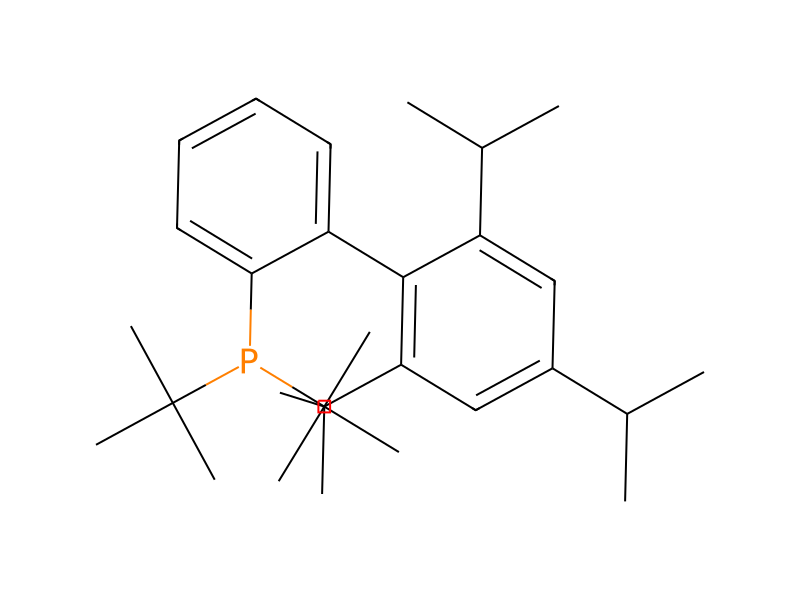
HCID 14797Potassium HydroxideHCID 11618717Di-tert-butyl(2',4',6'-tris(propan-2-yl)-(1,1'-biphenyl)-2-yl)phosphane2×HCID 68157939[(S)-1-(7-Bromo-6-fluoro-1-phenyl-1H-benzoimidazol-2-yl)ethyl]-[9-(tetrahydropyran-2-yl)-9H-purin-6-yl]amine

Produkt 1

HCID 178463574HCID 178463574, VerbindungAusbeute 7 %

Reagenzien, Katalysatoren, Lösungsmittel 3

HCID 9811564
Bis(dibenzylideneacetone)palladium
Katalysator
2×
HCID 962WaterLösungsmittel2×
HCID 312751,4-DioxaneLösungsmittel

Reaktionsbedingungen

Temperatur
150 °C

Versuchsvorschrift

A solution of [(S)-1-(7-bromo-6-fluoro-1-phenyl-1H-benzoimidazol-2-yl)ethyl]-[9-(tetrahydropyran-2-yl)-9H-purin-6-yl]amine (300 mg, 0.56 mmol), tris(dibenzylideneacetone)dipalladium (0) (10 mg, 11 μmol), 2-di-tert-butylphosphino-2′,4′,6′-triisopropylbiphenyl (19 mg, 45 μmol), potassium hydroxide (94 mg, 1.6 mmol) in dioxane (3 mL), and water (2 mL) in a sealed tube were degassed by bubbling argon through the solution then heated by microwave at 150° C. for 30 min. Further portions of tris(dibenzylideneacetone)dipalladium (0) (30 mg, 33 μmol), 2-di-tert-butylphosphino-2′,4′,6′-triisopropylbiphenyl (57 mg, 135 μmol) were added and the mixture heated by microwave at 180° C. for 1 hour. The reaction mixture was diluted with water and extracted with EtOAc (3×10 mL). The combined organic fractions were washed with brine, dried (MgSO4), concentrated in vacuo. The product was purified by prep HPLC (C18 phenomonix column, 10-90% MeCN in water 0.1% formic acid, 20 min gradient). The product was dissolved in HCl in methanol (1.25 M, 3 mL) and the reaction mixture stirred at RT for 10 min before being concentrated in vacuo. The product was purified by prep HPLC (C18 phenomonix column, 10-90% MeCN in water 0.1% formic acid, 20 min gradient) to give 327 as a white solid (15 mg, 7%). 1H NMR 400 MHz δ (d6-DMSO): 9.53-9.38 (1H, m), 8.10-7.99 (2H, m), 7.82-7.69 (1H, m), 7.62-7.27 (5H, m), 7.10-6.93 (2H, m), 5.37-5.17 (1H, m), 1.43 (3H, d, J=7.0 Hz), LCMS (Method K): RT=2.55 min, [M+H]+=390


Aufarbeitung

  1. customby bubbling argon through the solution
  2. temperaturethe mixture heated by microwave at 180° C. for 1 hour
  3. extractionextracted with EtOAc (3×10 mL)
  4. washThe combined organic fractions were washed with brine
  5. dry with materialdried (MgSO4)
  6. concentrationconcentrated in vacuo
  7. customThe product was purified by prep HPLC (C18 phenomonix column, 10-90% MeCN in water 0.1% formic acid, 20 min gradient)
  8. dissolutionThe product was dissolved in HCl in methanol (1.25 M, 3 mL)
  9. concentrationbefore being concentrated in vacuo
  10. customThe product was purified by prep HPLC (C18 phenomonix column, 10-90% MeCN in water 0.1% formic acid, 20 min gradient)

Quellen und Nachweise

ORD-Eintrag
ord-26a09a3326df40f4a3731916998f41fa
Quelldatensatz
uspto-grants-2014_02
DOI
10.6084/m9.figshare.5104873.v1
Patentnummer
US08653089B2

Notizen zur Reaktion

Wird geladen…

Auf dieser SeiteKomponentenReaktionsbedingungenVersuchsvorschriftAufarbeitungQuellen und NachweiseNotizen zur Reaktion