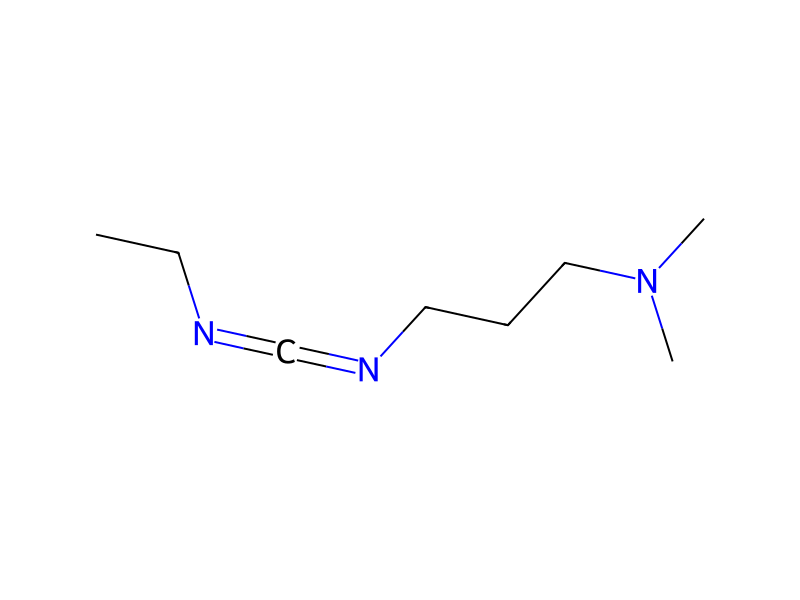
[CH3:1][N:2]1[C:10]2[C:5](=[CH:6][CH:7]=[C:8]([CH3:11])[CH:9]=2)[C:4]([C:12]2[N:17]=[C:16]3[C:18]([C:21](O)=[O:22])=[CH:19][NH:20][C:15]3=[N:14][CH:13]=2)=[N:3]1.[NH2:24][C:25]1([CH2:28][OH:29])[CH2:27][CH2:26]1.CCN=C=NCCCN(C)C.O>CN(C=O)C.CN(C1C=CN=CC=1)C>[CH3:1][N:2]1[C:10]2[C:5](=[CH:6][CH:7]=[C:8]([CH3:11])[CH:9]=2)[C:4]([C:12]2[N:17]=[C:16]3[C:18]([C:21]([NH:24][C:25]4([CH2:28][OH:29])[CH2:27][CH2:26]4)=[O:22])=[CH:19][NH:20][C:15]3=[N:14][CH:13]=2)=[N:3]1To a stirred mixture of 2-(1,6-dimethyl-1H-indazol-3-yl)-5H-pyrrolo[3,2-b]pyrazine-7-carboxylic acid (80 mg, 0.26 mmol) and (1-aminocyclopropyl)methanol (34 mg, 0.39 mmol) in DMF (3 mL), was added EDCI (100 mg, 0.52 mmol) followed by DMAP (63 mg, 0.52 mmol). The mixture was stirred at room temperature for 16 hours. Then the mixture was poured into water (5 mL) and filtered. The crude product was purified by preparative-HPLC (Gemini 5u C18 150×21.2 mm; inject volume: 3 mL/inj, flow rate: 20 mL/min; wavelength: 214 nm and 254 nm; the gradient conditions were: 35% acetonitrile/65% water (0.1% trifluoroacetic acid, v/v) initially, proceeding to 45% acetonitrile/55% water (0.1% trifluoroacetic acid, v/v) in a linear fashion over 9 min.) to give 2-(1,6-dimethyl-1H-indazol-3-yl)-N-(1-(hydroxymethyl)cyclopropyl)-5H-pyrrolo[3,2-b]pyrazine-7-carboxamide (35 mg, 36%) as a white solid. MS: (M+H)+=377; 1H NMR (300 MHz, DMSO): δ 13.84 (s, 1H), 9.12 (s, 1H), 8.74 (s, 1H), 8.43-8.40 (m, 2H), 7.56 (s, 1H), 7.21 (d, 1H, J=8.4 Hz), 4.89 (brs, 1H), 4.16 (s, 3H), 3.62 (s, 2H), 2.55 (s, 3H), 0.97-0.86 (m, 4H).