Reaktionsgleichung

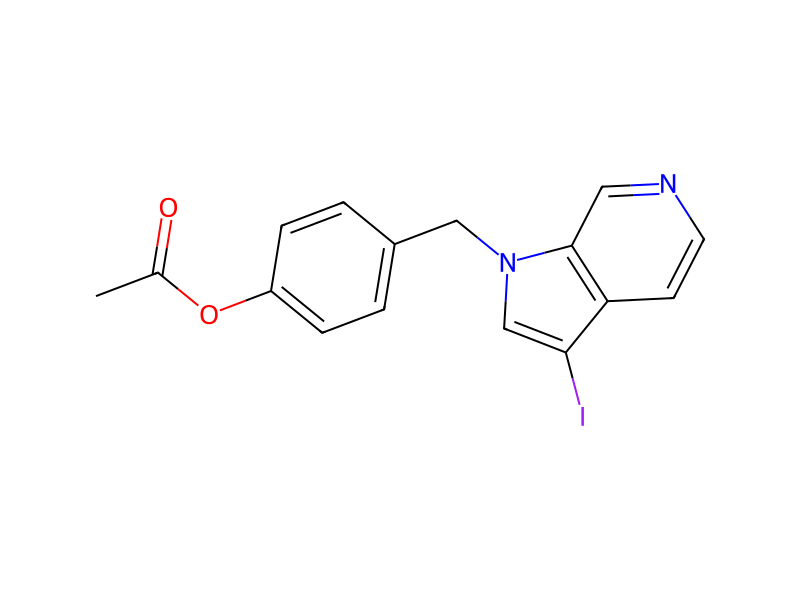
ClCC1C=CC(OC(=O)C)=CC=1.C(Br)C1C=CC=CC=1.[I:21][C:22]1[C:30]2[C:25](=[CH:26][N:27]=[CH:28][CH:29]=2)[N:24]([CH2:31][C:32]2[CH:37]=[CH:36][C:35]([O:38][C:39](=[O:41])[CH3:40])=[CH:34][CH:33]=2)[CH:23]=1.[Li+].[OH-]>C1COCC1.O>[I:21][C:22]1[C:30]2[C:25](=[CH:26][N:27]=[CH:28][CH:29]=2)[N:24]([CH2:31][C:32]2[CH:33]=[CH:34][C:35]([O:38][C:39](=[O:41])[CH3:40])=[CH:36][CH:37]=2)[CH:23]=1.[I:21][C:22]1[C:30]2[C:25](=[CH:26][N:27]=[CH:28][CH:29]=2)[N:24]([CH2:31][C:32]2[CH:37]=[CH:36][C:35]([OH:38])=[CH:34][CH:33]=2)[CH:23]=1Komponenten
8
Edukt 4



Produkt 2

Reagenzien, Katalysatoren, Lösungsmittel 2


Versuchsvorschrift
Acetic acid 4-(3-iodo-pyrrolo[2,3-c]pyridin-1-ylmethyl)-phenyl ester was prepared by substituting acetic acid 4-chloromethyl-phenyl ester and Example 717A for benzyl bromide and Example 695J, respectively, in Example 696A. Acetic acid 4-(3-iodo-pyrrolo[2,3-c]pyridin-1-ylmethyl)-phenyl ester was then slurried in a mixture of THF and water, and treated with LiOH to provide the desired product. MS (ESI) m/e 351 (M+H)+, 1H NMR (300 MHz, DMSO-d6): □ 9.44 (s, 1H), 8.87 (s, 1H), 8.20 (d, J=5.43 Hz, 1H), 7.93 (s, 1H), 7.24 (dd, J=5.43, 1.02 Hz, 1H), 7.18 (d, J=8.48 Hz, 2H), 6.68-6.72 (m, 2H), 5.40 (s, 2H).
Quellen und Nachweise
- ORD-Eintrag
- ord-6884e84bb4924fb297cbb938dafc6d1d
- Quelldatensatz
- uspto-grants-2008_11
- Patentnummer
- US07456169B2
Verknüpfte Notizen
Wird geladen…