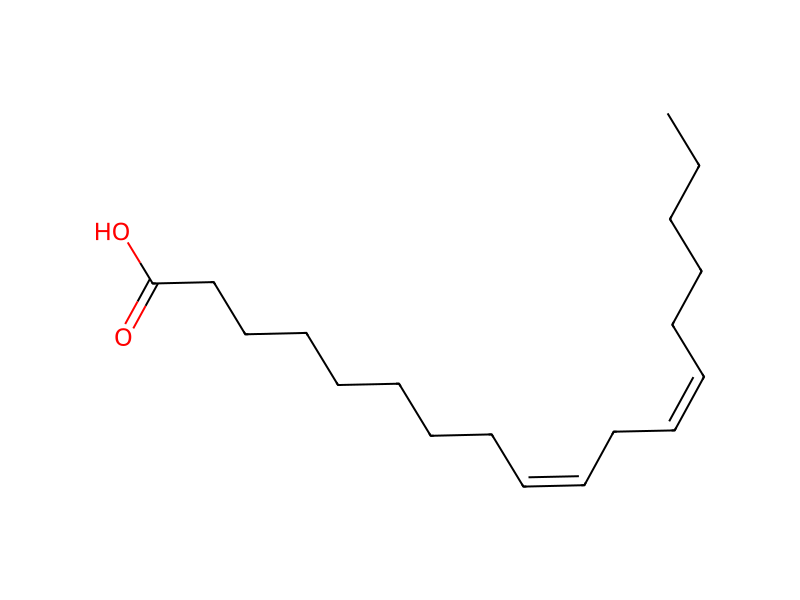
[CH3:1][C:2]1[N:6](CCO)[C:5]([N+:10]([O-:12])=[O:11])=[CH:4][N:3]=1.[CH:13]1(N=C=NC2CCCCC2)CCCC[CH2:14]1.[C:28]([OH:47])(=[O:46])[CH2:29][CH2:30][CH2:31][CH2:32][CH2:33][CH2:34][CH2:35]/[CH:36]=[CH:37]\[CH2:38]/[CH:39]=[CH:40]\[CH2:41][CH2:42][CH2:43][CH2:44][CH3:45].Cl>ClCCl.CN(C1C=CN=CC=1)C>[CH3:1][C:2]1[NH:6][C:5]([N+:10]([O-:12])=[O:11])=[C:4]([CH2:13][CH2:14][O:46][C:28](=[O:47])[CH2:29][CH2:30][CH2:31][CH2:32][CH2:33][CH2:34][CH2:35]/[CH:36]=[CH:37]\[CH2:38]/[CH:39]=[CH:40]\[CH2:41][CH2:42][CH2:43][CH2:44][CH3:45])[N:3]=1To a suspension of metronidazole (1.9 g) in dry dichloromethane (20 ml) was added successively 4-(N,N-dimethylamino)pyridine (1.22 g), 1,3-dicyclohexylcarbodiimide (2.2 g) and linoleic acid (2.8 g). The mixture was stirred at room temperature overnight. To the reaction was added 2M hydrochloric acid (20 ml) and stirring was continued. After filtration the organic layer was separated, washed with 50% saturated brine and finally with saturated aqueous sodium bicarbonate. The dichloromethane solution was dried (sodium sulfate) and evaporated in vacuo (30° C./20 mm Hg). To the resulting residue was added petrol (bp 30-60° C., 20 ml) and the mixture allowed to stand at room temperature for 2 hours, causing the precipitation of the remaining urea. This was removed by filtration and the filtrate was applied to a dry column giving 2-(2-methyl-5-nitroimidazolyl)ethyl-z,z-octadeca-9,12-dienoate as a pale yellow, non distillable oil.
Wird geladen…