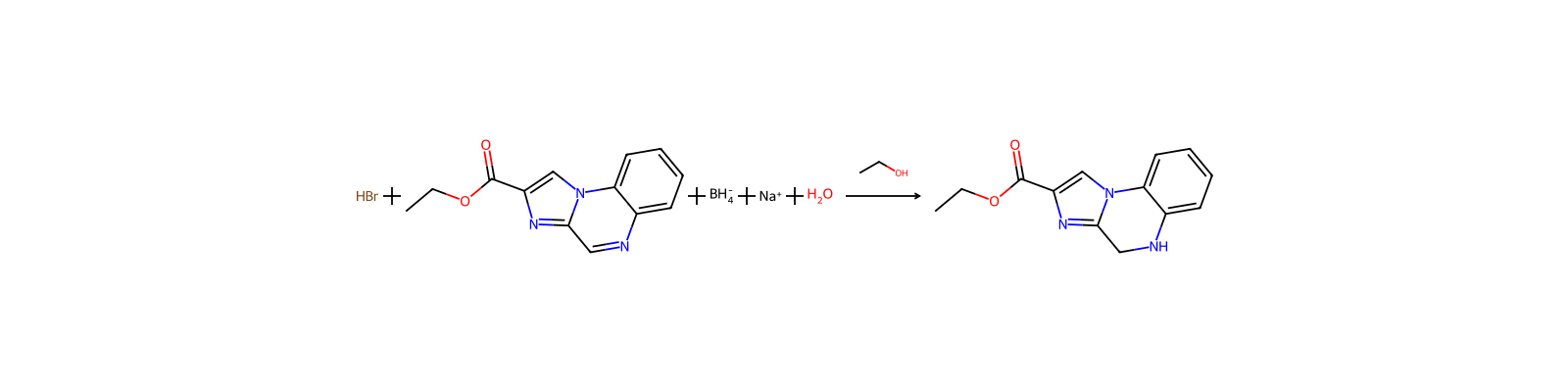
Br.[CH:2]1[N:6]2[C:7]3[C:12]([N:13]=[CH:14][C:5]2=[N:4][C:3]=1[C:15]([O:17][CH2:18][CH3:19])=[O:16])=[CH:11][CH:10]=[CH:9][CH:8]=3.[BH4-].[Na+].O>C(O)C>[CH:2]1[N:6]2[C:7]3[C:12]([NH:13][CH2:14][C:5]2=[N:4][C:3]=1[C:15]([O:17][CH2:18][CH3:19])=[O:16])=[CH:11][CH:10]=[CH:9][CH:8]=3To a stirred solution of 1.6 g of ethyl imidazo[1,2-a]quinoxaline-2-carboxylate hydrobromide (British patent application Ser. No. 79-26597, in 50 ml of ethanol was added portionwise 0.5 g of sodium borohydride and at the completion of the reaction (tlc), the mixture was poured into 250 ml of water. The mixture was extracted with ethyl acetate and the organic layer was washed with water, dried and evaporated to dryness to obtain 1.2 g (97% yield) of ethyl 4,5-dihydroimidazo[1,2-a]quinoxaline-2-carboxylate melting at 206°-8° C.