Reaktionsgleichung

[CH2:1]([N:4](CC=C)[CH2:5][CH:6]=[CH2:7])[CH:2]=[CH2:3]>CN1CCCC1=O.[Pd].C1(P(C2C=CC=CC=2)C2C=CC=CC=2)C=CC=CC=1.C1(P(C2C=CC=CC=2)C2C=CC=CC=2)C=CC=CC=1.C1(P(C2C=CC=CC=2)C2C=CC=CC=2)C=CC=CC=1.C1(P(C2C=CC=CC=2)C2C=CC=CC=2)C=CC=CC=1>[CH2:1]([NH2:4])[CH:2]=[CH2:3].[CH2:1]([NH:4][CH2:5][CH:6]=[CH2:7])[CH:2]=[CH2:3]Komponenten
5
Edukt 1

Produkt 2
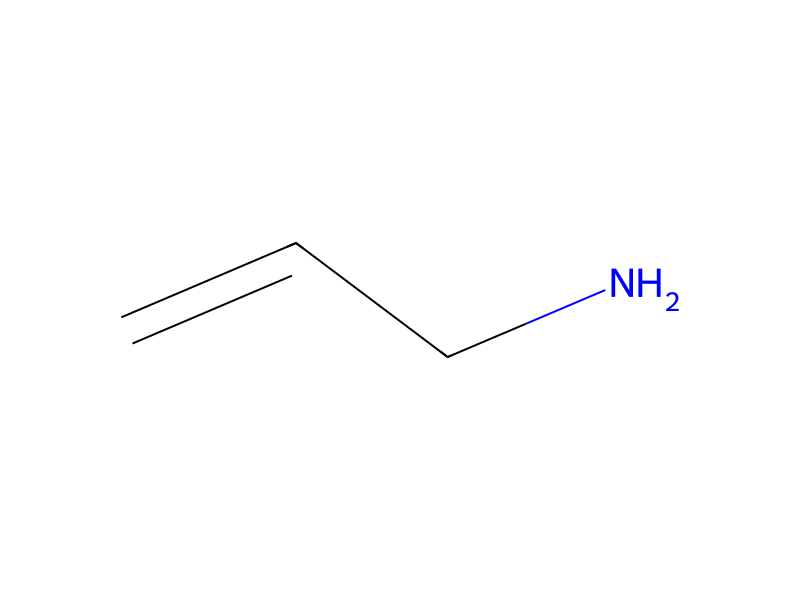

Reagenzien, Katalysatoren, Lösungsmittel 2


Versuchsvorschrift
A 300 ml autoclave was charged with 5.8g (5 millimoles) of tetrakis (triphenylphosphine) palladium, 1.8g (13.3 millimoles) of triallylamine and 80ml of N-methyl pyrrolidone as a solvent. Oxygen was removed from the autoclave by a nitrogen purge and then ammonia was added with stirring until the internal pressure reached 3.87 Kg/cm. The reactor was then heated with stirring to 100° C (pressure - 10.19 kg/cm) and subsequently to 130° C (pressure - 13.34 kg/cm). At 100° C the reaction was very slow but after 30 minutes at 130° C the triallylamine had reacted to form 5.2 millimoles of monoallylamine and 6.6 millimoles of diallylamine.
Aufarbeitung
- customOxygen was removed from the autoclave by a nitrogen
- custompurge
- additionammonia was added
- temperatureThe reactor was then heated
- stirringwith stirring to 100° C (pressure - 10.19 kg/cm)
- customsubsequently to 130° C
- customthe triallylamine had reacted
Quellen und Nachweise
- ORD-Eintrag
- ord-934c4deed45d45709edd83ebe79333bf
- Quelldatensatz
- uspto-grants-1978_05
- Patentnummer
- US04091019
Verknüpfte Notizen
Wird geladen…