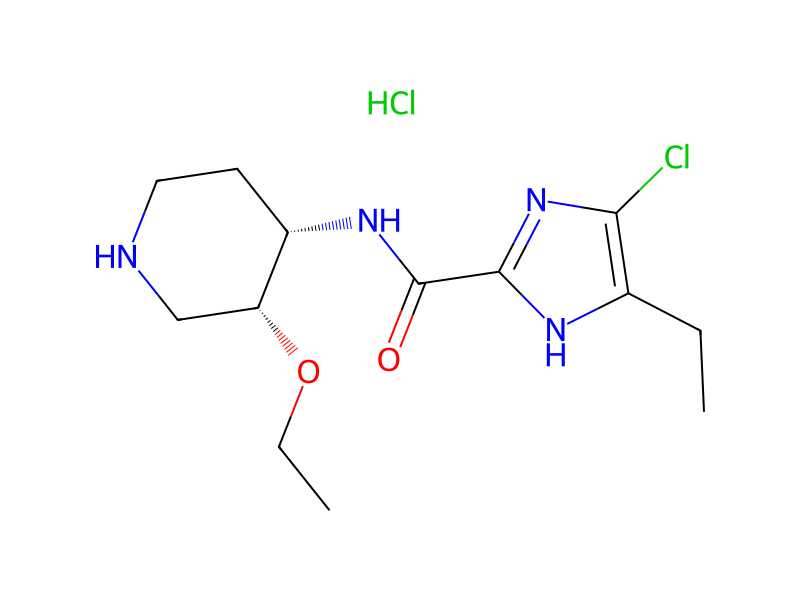
Cl.[Cl:2][C:3]1[N:4]=[C:5]([C:10]([NH:12][C@H:13]2[CH2:18][CH2:17][NH:16][CH2:15][C@H:14]2[O:19][CH2:20][CH3:21])=[O:11])[NH:6][C:7]=1[CH2:8][CH3:9].C(N(C(C)C)CC)(C)C.Br[C:32]1[S:33][CH:34]=[N:35][N:36]=1.C(=O)([O-])[O-].[Cs+].[Cs+]>CN1CCCC1=O.O.C(OCC)(=O)C>[Cl:2][C:3]1[N:4]=[C:5]([C:10]([NH:12][C@H:13]2[CH2:18][CH2:17][N:16]([C:32]3[S:33][CH:34]=[N:35][N:36]=3)[CH2:15][C@H:14]2[O:19][CH2:20][CH3:21])=[O:11])[NH:6][C:7]=1[CH2:8][CH3:9]cis(±)-4-Chloro-N-(3-ethoxypiperidin-4-yl)-5-ethyl-1H-imidazole-2-carboxamide hydrochloride obtained in Example (131a) (0.100 g, 0.296 mmol), diisopropylethylamine (0.0568 mL, 0.326 mmol), 2-bromo-1,3,4-thiadiazole (0.0587 g, 0.356 mmol) and cesium carbonate (0.106 g, 0.326 mmol) were suspended in N-methylpyrrolidone (2 mL). The suspension was heated using a microwave reactor at 180° C. for 30 minutes. Ethyl acetate and water were added to the reaction solution, and the aqueous layer was extracted with ethyl acetate. The organic layer was washed with water and brine, and then dried over anhydrous sodium sulfate. Following concentration under reduced pressure, the residue was purified by silica gel chromatography (elution solvent: hexane/ethyl acetate=1/1, then methanol/ethyl acetate=0/1, 1/9) to obtain 80 mg of the crude title compound. This was further purified by thin layer silica gel chromatography (developing solvent: methanol/dichloromethane=5/95) to obtain 43 mg of the title compound as a pale brown solid (36%).