Reaktionsgleichung

[N+]([O-])([O-])=O.[Ca+2:5].[N+]([O-])([O-])=O.O.N.[P:12]([O-:16])([O-:15])([OH:14])=[O:13].[NH4+].[NH4+]>O>[P:12]([O-:16])([O-:15])([O-:14])=[O:13].[Ca+2:5].[P:12]([O-:16])([O-:15])([O-:14])=[O:13].[Ca+2:5].[Ca+2:5]Komponenten
Edukt 4
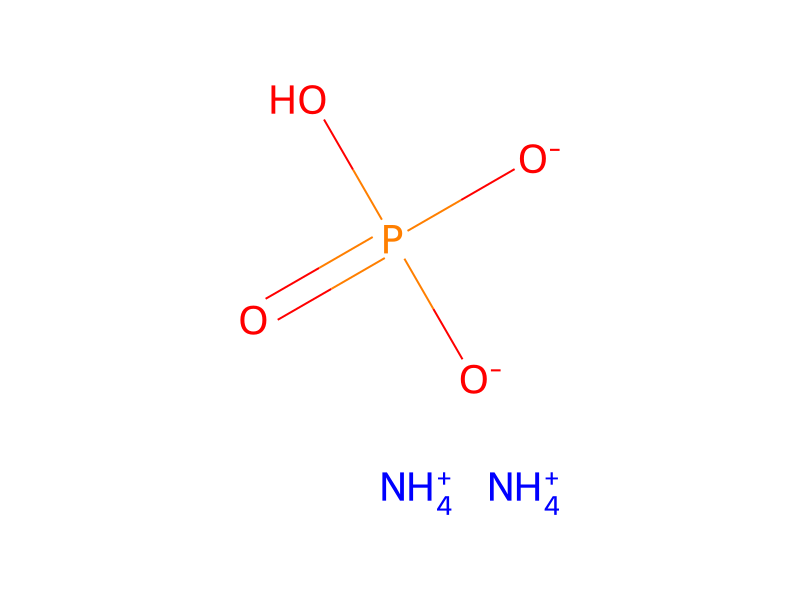


Produkt 1

Reagenzien, Katalysatoren, Lösungsmittel 1

Reaktionsbedingungen
- Temperatur
- 80 °C
Versuchsvorschrift
In 7.1 l. of distilled water there was dissolved 2500 g of commercially available calcium nitrate [Ca(No3)2. 4H2O], and 7.9 l. of 28% ammonia water was slowly added to the resultant solution. The thus obtained solution was then diluted with 3 1. l. of distilled water. Separately therefrom, 840 g of commercially available ammonium hydrogen-phosphate [NH4)2HPO4 ] was dissolved in 10 l. of distilled water. 4.8 l. of 28% ammonia water and 10 l. of distilled water were then added to this solution. While keeping the former calcium nitrate aqueous solution at 20° C., the latter ammonium hydrogenphosphate aqueous solution (20° C.) was added dropwise thereto with stirring to effect reaction therebetween. After completion of the dropwise addition, the mixture described above was heated to 80° C. and maintained for 20 minutes under reflux, while continuing stirring. After cooling, the reaction mixture was allowed to settle for 2 days. Subsequently, the solution was dehydrated (2000 g) with a centrifugal dehydrator equipped with a polypropylene-made filter cloth (1000 mesh) and washed with distilled water until the system showed no alkaline property. The thus obtained calcium phosphate filtered cake was dried and then ground into powders in a mortar. The powders were passed through a sieve of 140 mesh to give 920 g of calcium phosphate powders. The calcium phosphate powders were packed in 18 pieces of polyurethane foam "Everlightscott Filter" (HR-20; cell number, 17-25 cells/25 mm; porosity, 97%) manufactured by Bridgestone Corporation, which were then each inserted in a respective rubber form as in Example 1. Three pieces each in a group were pressed with a rubber press under 6 levels of pressure as shown in Table 1. They were put in an electric furnace and calcined for 2 hours at 1100° C., after elevating the temperature to 1100° C.
Aufarbeitung
- additionThe thus obtained solution was then diluted with 3 1
- customat 20° C.
- customreaction
- additionAfter completion of the dropwise addition
- temperaturemaintained for 20 minutes
- temperatureunder reflux
- stirringwhile continuing stirring
- temperatureAfter cooling
- filtrationmade filter cloth (1000 mesh)
- washwashed with distilled water until the system
- dry with materialThe thus obtained calcium phosphate filtered cake was dried
Quellen und Nachweise
- ORD-Eintrag
- ord-e3076b04655a4184a3c8065608cc7b05
- Quelldatensatz
- uspto-grants-1989_12
- Patentnummer
- US04889833
Verknüpfte Notizen
Wird geladen…