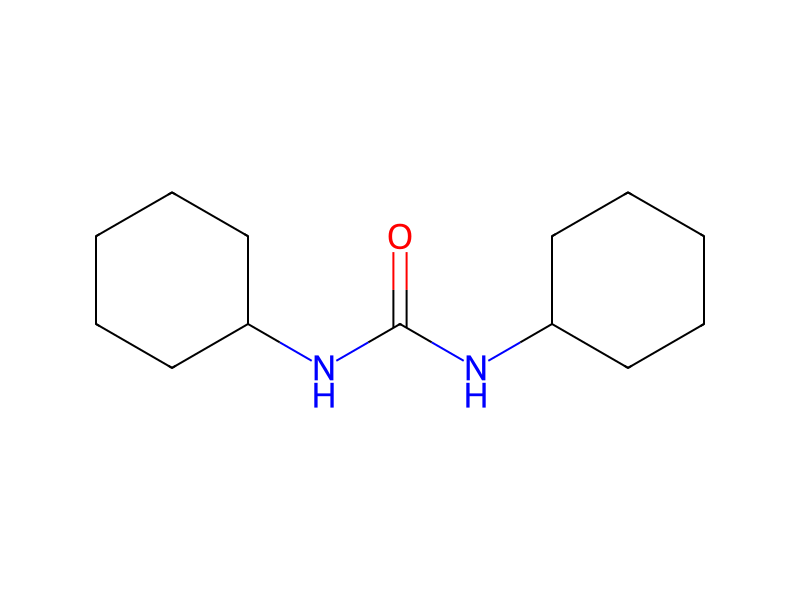
C1(N=C=NC2CCCCC2)CCCCC1.[OH:16][C:17]1[CH:18]=[C:19]([CH:23]=[CH:24][CH:25]=1)[C:20]([OH:22])=[O:21].O[N:27]1[C:31](=[O:32])[CH2:30][CH2:29][C:28]1=[O:33].C(NC1CCCCC1)(NC1CCCCC1)=O>C(OCC)(=O)C.C(O)(=O)C>[OH:16][C:17]1[CH:18]=[C:19]([CH:23]=[CH:24][CH:25]=1)[C:20]([O:22][N:27]1[C:31](=[O:32])[CH2:30][CH2:29][C:28]1=[O:33])=[O:21]As illustrated in Scheme 1 below, 1,3-dicyclohexylcarbodiimide (82 mg, 0.40 mmol) was added to a solution of 3-hydroxybenzoic acid (50 mg, 0.36 mmol) and N-hydroxysuccinimide (46 mg, 0.40 mmol) in ethyl acetate (1 mL). After 1 minute, crystals of dicyclohexylurea appeared. The next day, acetic acid (20 μL) was added. The mixture was filtered through glass wool, washed with dilute HCl (1N) and dried over Na2SO4. The solution was concentrated to a white solid. Thin layer chromatography on silica gel with 1:1 ethyl acetate:hexane showed complete conversion of the starting acid to a fluorescent, lower rf product. ##STR2##
Wird geladen…