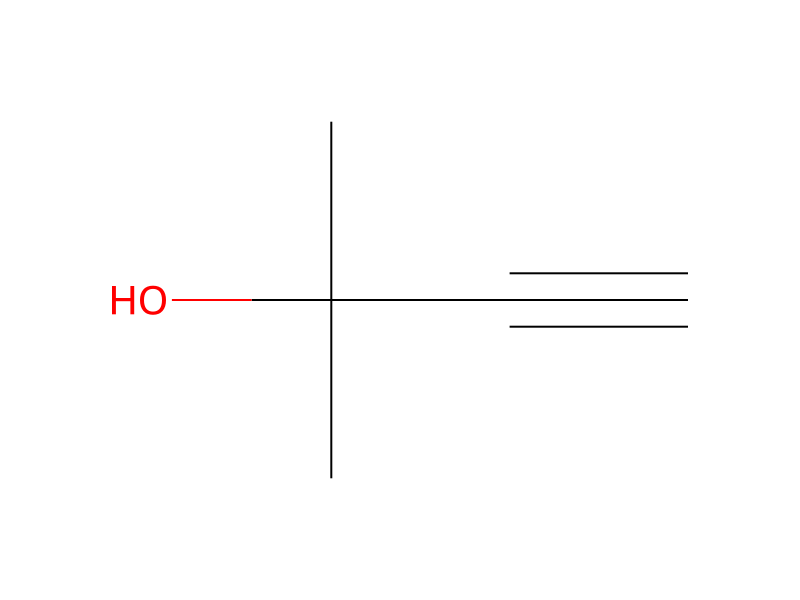
2-Methyl-3-butyn-2-ol → 6-Hepten-3-yn-2-ol, 2,6-dimethyl-
Reaktionsgleichung

[CH3:1][C:2]([OH:6])([C:4]#[CH:5])[CH3:3].Cl[CH2:8][C:9]([CH3:11])=[CH2:10].C(=O)([O-])[O-].[K+].[K+]>>[CH3:1][C:2]([OH:6])([C:4]#[C:5][CH2:10][C:9]([CH3:11])=[CH2:8])[CH3:3]Komponenten
4



Versuchsvorschrift
The coupling reaction was conducted in the manner described in the procedure of Example VI using the following reagents: 1.00 mL (10.3 mmoles) of 2-methyl-3-butyn-2-ol, 1.10 mL (11.1 mmoles) of 3-chloro-2-methylpropene, 2.40 g (17.3 mmoles) of anhydrous potassium carbonate, and 84 mg (0.85 mmoles) of cuprous chloride. Isolation of the product in the usual manner afforded 105 mg (7.4% yield) of the named alcohol. When this yield is compared with that reported in Example VII, it is evident that, in the absence of a polar solvent, the phase-transfer catalyst is desirable since it markedly accelerates the coupling. However, the presence of such a catalyst is not essential to achieve the desired transformation.