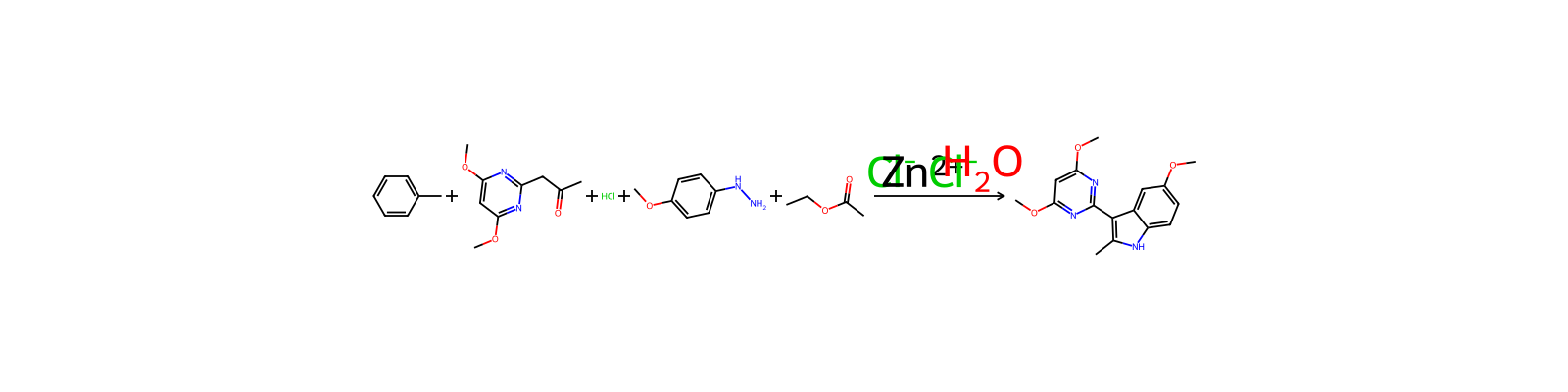
C1(C)C=CC=CC=1.[CH3:8][O:9][C:10]1[CH:15]=[C:14]([O:16][CH3:17])[N:13]=[C:12]([CH2:18][C:19](=O)[CH3:20])[N:11]=1.Cl.[CH3:23][O:24][C:25]1[CH:30]=[CH:29][C:28]([NH:31]N)=[CH:27][CH:26]=1.C(OCC)(=O)C>[Cl-].[Zn+2].[Cl-].O>[CH3:8][O:9][C:10]1[CH:15]=[C:14]([O:16][CH3:17])[N:13]=[C:12]([C:18]2[C:29]3[C:28](=[CH:27][CH:26]=[C:25]([O:24][CH3:23])[CH:30]=3)[NH:31][C:19]=2[CH3:20])[N:11]=1To 80 ml of toluene were added 8.0 g (40 m moles) of 1-(4,6-dimethoxypyrimidine-2-yl)-2-propanone and 7.7 g (44 m moles) of 4-metoxyphenylhydrazine hydrochloride. Thereto was added 6.0 g (44 m moles) of zinc chloride. Refluxing was made for 2 hours with heating. The reaction mixture was allowed to cool. Thereto were added ethyl acetate and water to dissolve the whole reaction mixture. The oily layer was washed with water, separated and dried over Glauber's salt. The resulting organic layer was concentrated under reduced pressure using an rotary evaporator to obtain, as an orange solid, 8.0 g (26.7 m moles) of 3-(4,6-dimethoxypyrimidine-2-yl)-5-methoxy-2-methylindole. Yield: 67% Recrystallization from toluene was made.