StartseiteMCPWorkbenchSkills
StartseiteWorkbenchBenachrichtigungenMein Bereich
llms.txt · MCP-AnleitungDatenschutz · Nutzungsbedingungen · Supportv1.8.3
  1. Startseite
  2. /Reaktion

Water → Ethyl 3-chloro-8-cyanonaphthalene-2-carboxylate

HRID 505245
Drucken

Reaktionsgleichung

Reaktionsgleichung von HRID 505245
[CH2:1]([O:3][C:4]([C:6]1[C:15]([Cl:16])=[CH:14][C:13]2[C:8](=[C:9](OS(C(F)(F)F)(=O)=O)[CH:10]=[CH:11][CH:12]=2)[CH:7]=1)=[O:5])[CH3:2].O.[CH3:26][N:27](C)C=O>[C-]#N.[C-]#N.[Zn+2].C1C=CC([P]([Pd]([P](C2C=CC=CC=2)(C2C=CC=CC=2)C2C=CC=CC=2)([P](C2C=CC=CC=2)(C2C=CC=CC=2)C2C=CC=CC=2)[P](C2C=CC=CC=2)(C2C=CC=CC=2)C2C=CC=CC=2)(C2C=CC=CC=2)C2C=CC=CC=2)=CC=1>[CH2:1]([O:3][C:4]([C:6]1[C:15]([Cl:16])=[CH:14][C:13]2[C:8](=[C:9]([C:26]#[N:27])[CH:10]=[CH:11][CH:12]=2)[CH:7]=1)=[O:5])[CH3:2]
KomponentenReaktionsbedingungenVersuchsvorschriftAufarbeitungQuellen und NachweiseNotizen zur Reaktion

Komponenten

6

Edukt 3

HCID 962WaterHCID 6228DimethylformamideHCID 866257923-Chloro-8-trifluoromethanesulfonyloxy-naphthalene-2-carboxylic acid ethyl ester

Produkt 1

HCID 66880747Ethyl 3-chloro-8-cyanonaphthalene-2-carboxylate

Reagenzien, Katalysatoren, Lösungsmittel 2

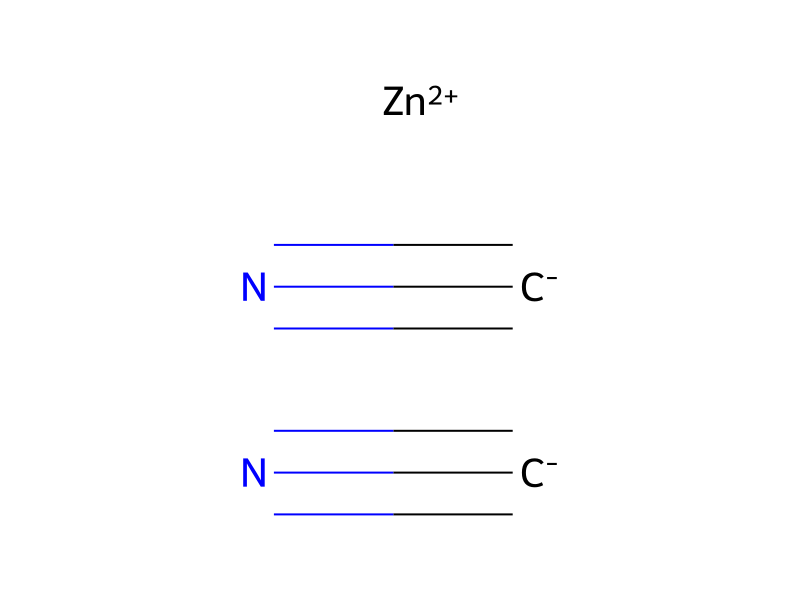
HCID 11186Zinc cyanide (Zn(CN)2)Katalysator
HCID 178418397
HCID 178418397, Verbindung
Katalysator

Reaktionsbedingungen

Temperatur
125 °C

Versuchsvorschrift

Zn(CN)2 (1.50 g, 12.80 mmol, 2.0 equiv) and Pd(PPh3)4 (296 mg, 0.26 mmol, 0.04 equiv) were added at room temperature under an atmosphere of argon to a degassed solution of 3-chloro-8-trifluoromethanesulfonyloxy-naphthalene-2-carboxylic acid ethyl ester (2.45 g, 6.40 mmol) in N,N-dimethylformamide (25 ml). The mixture was heated to 125° C. After 30 minutes, TLC analysis indicated complete conversion. After cooling, water was added, and the mixture was extracted with EtOAc. The combined organic layers were washed with brine, dried over Na2SO4, filtered and concentrated in vacuo. Purification via flash chromatography (gradient of hexane/EtOAc 100:0 to 90:10) afforded the title compound (1.43 g, 86%, 1:1.3 mixture of regioisomers A:B) as a white solid. For analytical purposes, the regioisomers could be separated by careful chromatography on silica gel. Regioisomer A: 1H NMR (400 MHz, CDCl3): δ=8.41 (s, 1H), 8.32 (s, 1H), 8.13 (br d, J=8.3 Hz, 1H), 8.01 (dd, J=7.1/1.0 Hz, 1H), 7.60 (dd, J=8.3/7.3 Hz, 1H), 4.47 (q, J=7.1 Hz, 2H), 1.45 (t, J=7.1 Hz, 3H). MS (ES+): 260 (M+H)+. Regioisomer B: 1H NMR (400 MHz, CDCl3): δ=8.65 (s, 1H), 8.02 (d, J=8.3 Hz, 1H), 8.02 (s, 1H), 7.96 (dd, J=7.4/1.3 Hz, 1H), 7.65 (dd, J=8.3/7.4 Hz, 1H), 4.49 (q, J=7.1 Hz, 2H), 1.46 (t, J=7.3 Hz, 3H). MS (ES+): 260 (M+H)+.


Aufarbeitung

  1. temperatureAfter cooling
  2. extractionthe mixture was extracted with EtOAc
  3. washThe combined organic layers were washed with brine
  4. dry with materialdried over Na2SO4
  5. filtrationfiltered
  6. concentrationconcentrated in vacuo
  7. customPurification via flash chromatography (gradient of hexane/EtOAc 100:0 to 90:10)

Quellen und Nachweise

ORD-Eintrag
ord-7ed6394bbd9040f195744714dcc6d114
Quelldatensatz
uspto-grants-2010_08
DOI
10.6084/m9.figshare.5104873.v1
Patentnummer
US07781438B2

Notizen zur Reaktion

Auf dieser SeiteKomponentenReaktionsbedingungenVersuchsvorschriftAufarbeitungQuellen und NachweiseNotizen zur Reaktion