StartseiteMCPWorkbenchSkills
StartseiteWorkbenchBenachrichtigungenMein Bereich
llms.txt · MCP-AnleitungDatenschutz · Nutzungsbedingungen · Supportv1.8.3
  1. Startseite
  2. /Reaktion

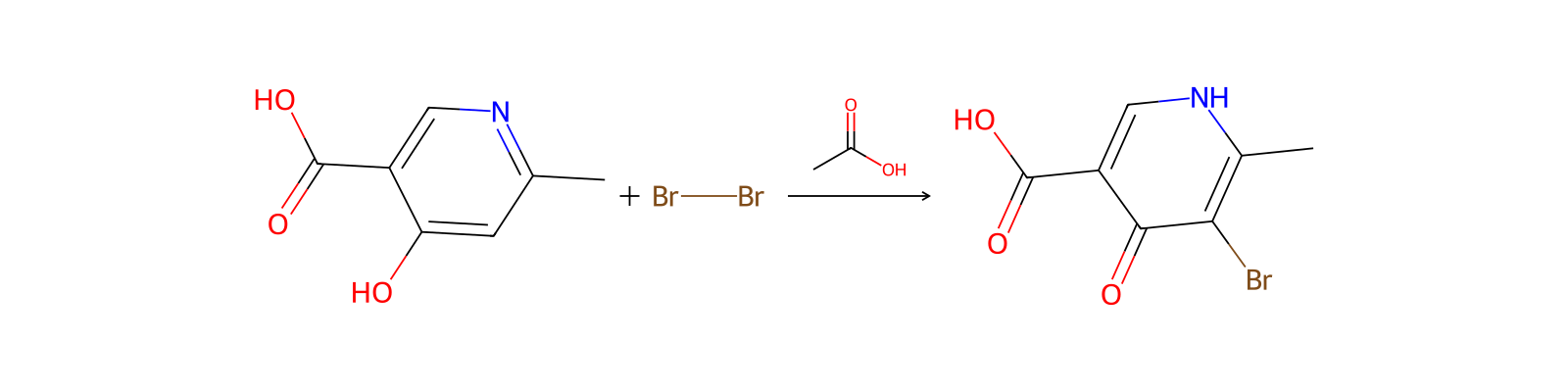
Bromine → 5-Bromo-4-hydroxy-6-methylpyridine-3-carboxylic acid

HRID 512489
Drucken

Reaktionsgleichung

Reaktionsgleichung von HRID 512489
[OH:1][C:2]1[C:7]([C:8]([OH:10])=[O:9])=[CH:6][N:5]=[C:4]([CH3:11])[CH:3]=1.[Br:12]Br>C(O)(=O)C>[Br:12][C:3]1[C:2](=[O:1])[C:7]([C:8]([OH:10])=[O:9])=[CH:6][NH:5][C:4]=1[CH3:11]
KomponentenVersuchsvorschriftAufarbeitungQuellen und NachweiseNotizen zur Reaktion

Komponenten

4

Edukt 2

HCID 24408Bromine2×HCID 178429106HCID 178429106, Verbindung

Produkt 1

HCID 183299675-Bromo-4-hydroxy-6-methylpyridine-3-carboxylic acid

Reagenzien, Katalysatoren, Lösungsmittel 1

HCID 176Acetic AcidLösungsmittel

Versuchsvorschrift

To a solution of 4-hydroxy-6-methyl-nicotinic acid (10.00 g, 65.3 mmol) in glacial acetic acid (35 mL) is added bromine (4.00 mL, 78.1 mmol). After stirring for 18 h at room temperature, additional bromine (0.5 mL) is added and the reaction mixture is stirred for an additional 24 h. The reaction mixture is evaporated under reduced pressure and the remaining residue is co-evaporated with toluene. The remaining residue is treated with a small amount of MeOH and then triturated with water. The precipitate is filtered off and dried. Yield: 13.8 g (92% of theory); ESI mass spectrum: [M+H]+=232 (bromine isotope pattern); Retention time HPLC: 0.61 min (Z002—002).

Aufarbeitung

  1. stirringthe reaction mixture is stirred for an additional 24 h
  2. customThe reaction mixture is evaporated under reduced pressure
  3. additionThe remaining residue is treated with a small amount of MeOH
  4. customtriturated with water
  5. filtrationThe precipitate is filtered off
  6. customdried
  7. custom0.61 min (Z002—002)

Quellen und Nachweise

ORD-Eintrag
ord-a23e429a2ce64895ad8904a0b98ef48a
Quelldatensatz
uspto-grants-2015_08
DOI
10.6084/m9.figshare.5104873.v1
Patentnummer
US09102624B2

Notizen zur Reaktion

Auf dieser SeiteKomponentenVersuchsvorschriftAufarbeitungQuellen und NachweiseNotizen zur Reaktion