StartseiteMCPWorkbenchSkills
StartseiteWorkbenchBenachrichtigungenMein Bereich
llms.txt · MCP-AnleitungDatenschutz · Nutzungsbedingungen · Supportv1.8.3
  1. Startseite
  2. /Reaktion

Cesium carbonate → 2-Bromo-4-fluoro-6-(9-oxo-4,4-dimethyl-1,10diazatricyclo[6.4.0.02,6]-dodeca-2(6),7-dien-10-yl)benzyl Acetate

HRID 519270
Drucken

Reaktionsgleichung

Reaktionsgleichung von HRID 519270
[CH3:1][C:2]1([CH3:15])[CH2:13][C:12]2[CH:11]=[C:10]3[N:5]([CH2:6][CH2:7][NH:8][C:9]3=[O:14])[C:4]=2[CH2:3]1.[C:16]([O:19][CH2:20][C:21]1[C:26]([Br:27])=[CH:25][C:24]([F:28])=[CH:23][C:22]=1Br)(=[O:18])[CH3:17].C(=O)([O-])[O-].[Cs+].[Cs+].CC1(C)C2C(=C(P(C3C=CC=CC=3)C3C=CC=CC=3)C=CC=2)OC2C(P(C3C=CC=CC=3)C3C=CC=CC=3)=CC=CC1=2>O1CCOCC1.[Pd].[Pd].C(=CC(C=CC1C=CC=CC=1)=O)C1C=CC=CC=1.C(=CC(C=CC1C=CC=CC=1)=O)C1C=CC=CC=1.C(=CC(C=CC1C=CC=CC=1)=O)C1C=CC=CC=1.C(OCC)(=O)C.O>[C:16]([O:19][CH2:20][C:21]1[C:22]([N:8]2[CH2:7][CH2:6][N:5]3[C:10](=[CH:11][C:12]4[CH2:13][C:2]([CH3:15])([CH3:1])[CH2:3][C:4]=43)[C:9]2=[O:14])=[CH:23][C:24]([F:28])=[CH:25][C:26]=1[Br:27])(=[O:18])[CH3:17]


KomponentenReaktionsbedingungenVersuchsvorschriftAufarbeitungQuellen und NachweiseNotizen zur Reaktion

Komponenten

9

Edukt 4

HCID 10796Cesium carbonateHCID 6360441,1'-(9,9-Dimethyl-9H-xanthene-4,5-diyl)bis(1,1-diphenylphosphine)HCID 580442027,7-dimethyl-3,4,7,8-tetrahydro-2H-cyclopenta[4,5]pyrrolo[1,2-a]pyrazin-1(6H)-oneHCID 670165932,6-Dibromo-4-fluorobenzyl acetate

Produkt 1

HCID 67016304
2-Bromo-4-fluoro-6-(9-oxo-4,4-dimethyl-1,10diazatricyclo[6.4.0.02,6]-dodeca-2(6),7-dien-10-yl)benzyl Acetate
Ausbeute 56,3 %

Reagenzien, Katalysatoren, Lösungsmittel 4

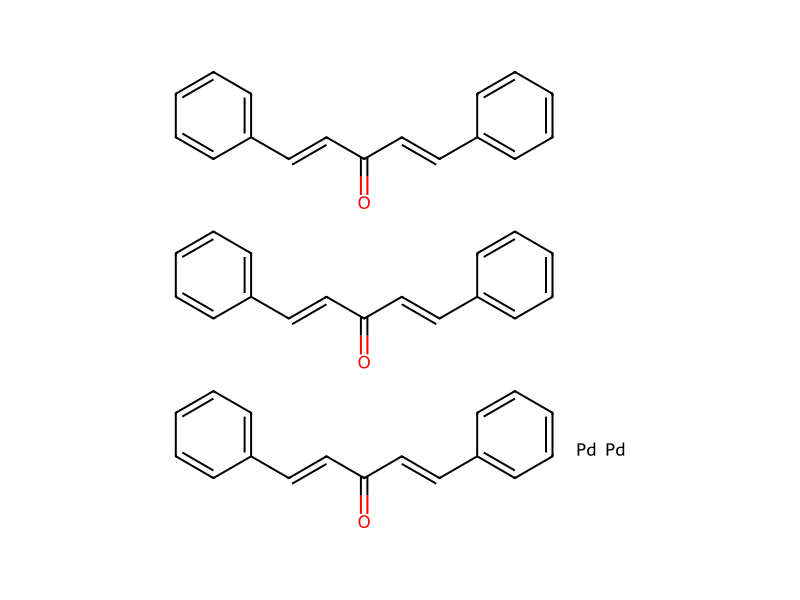
HCID 9832798Tris(dibenzylideneacetone) dipalladiumKatalysatorHCID 962WaterLösungsmittelHCID 8857Ethyl AcetateLösungsmittelHCID 312751,4-DioxaneLösungsmittel

Reaktionsbedingungen

Temperatur
100 °C

Versuchsvorschrift

A sealed tube was equipped with a magnetic stirrer and charged with 103e (740 mg, 3.6 mmol), 2,6-dibromo-4-fluorobenzyl acetate 101c (2.4 g, 7.2 mmol) and cesium carbonate (2.6 g, 7.9 mmol) in 1,4-dioxane (36 mL). After bubbling nitrogen through the solution for 30 min, Xantphos (250 mg, 0.43 mmol) and tris(dibenzylideneacetone) dipalladium(0) (260 mg, 0.29 mmol) were added, and the reaction mixture was heated to 100° C. for 16 h. After this time, H2O (50 mL) and ethyl acetate (50 mL) were added. The aqueous layer was separated and extracted with ethyl acetate (2×50 mL). The combined organic extracts were washed with brine (100 mL) and dried over sodium sulfate. The resulting residue was purified by column chromatography eluting with a gradient of 100% hexanes-100% Ethyl acetate to afford a 56% yield (910 mg) of 103f.

Aufarbeitung

  1. customA sealed tube was equipped with a magnetic stirrer
  2. customAfter bubbling nitrogen through the solution for 30 min
  3. customThe aqueous layer was separated
  4. extractionextracted with ethyl acetate (2×50 mL)
  5. washThe combined organic extracts were washed with brine (100 mL)
  6. dry with materialdried over sodium sulfate
  7. customThe resulting residue was purified by column chromatography
  8. washeluting with a gradient of 100% hexanes-100% Ethyl acetate

Quellen und Nachweise

ORD-Eintrag
ord-0b0a482a5dc14cf0bece9f08b437d1e4
Quelldatensatz
uspto-grants-2015_08
DOI
10.6084/m9.figshare.5104873.v1
Patentnummer
US09115152B2

Notizen zur Reaktion

Auf dieser SeiteKomponentenReaktionsbedingungenVersuchsvorschriftAufarbeitungQuellen und NachweiseNotizen zur Reaktion