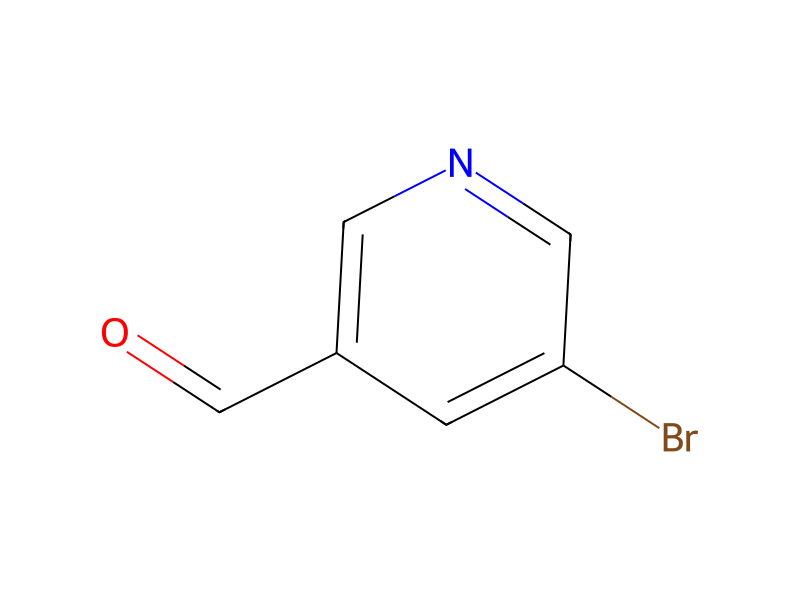
[Br:1][C:2]1[CH:3]=[C:4]([CH:8]=O)[CH:5]=[N:6][CH:7]=1.C(O[BH-](OC(=O)C)OC(=O)C)(=O)C.[Na+].[NH:24]1[CH2:28][CH2:27][CH2:26][CH2:25]1>ClCCCl>[Br:1][C:2]1[CH:7]=[N:6][CH:5]=[C:4]([CH2:8][N:24]2[CH2:28][CH2:27][CH2:26][CH2:25]2)[CH:3]=1To a solution of 5-bromo-3-pyridinecarboxaldehyde in 20 mL of 1,2-dichloroethane are successively added, under argon, 4.55 g of sodium triacetoxyborohydride and 0.94 mL of pyrrolidine. The reaction mixture is stirred at room temperature for 3 hours and then washed with saturated sodium hydrogen carbonate solution, with water and with saturated sodium chloride solution, dried over magnesium sulphate, filtered and concentrated under reduced pressure. The residue is purified by chromatography on a column of silica, eluting with a mixture of ethyl acetate and cyclohexane (80/20 by volume) to give 1.4 g of 3-Bromo-5-pyrrolidin-1-ylmethylpyridine in the form of a pale yellow oil.