StartseiteMCPWorkbenchSkills
StartseiteWorkbenchBenachrichtigungenMein Bereich
llms.txt · MCP-AnleitungDatenschutz · Nutzungsbedingungen · Supportv1.8.3
  1. Startseite
  2. /Reaktion

1,2-Dibromoethane → 4-Diphenylphosphorylbutyl(diphenyl)phosphane

HRID 581454
Drucken

Reaktionsgleichung

Reaktionsgleichung von HRID 581454
[CH:1]1[CH:6]=[CH:5][C:4]([P:7]([C:25]2[CH:30]=[CH:29][CH:28]=[CH:27][CH:26]=2)[CH2:8][CH2:9][CH2:10][CH2:11][P:12]([C:19]2[CH:24]=[CH:23][CH:22]=[CH:21][CH:20]=2)[C:13]2[CH:18]=[CH:17][CH:16]=[CH:15][CH:14]=2)=[CH:3][CH:2]=1.BrCCBr.[OH-:35].[Na+]>C([O-])(=O)C.[Pd+2].C([O-])(=O)C.ClCCl>[P:7]([CH2:8][CH2:9][CH2:10][CH2:11][P:12]([C:13]1[CH:14]=[CH:15][CH:16]=[CH:17][CH:18]=1)([C:19]1[CH:20]=[CH:21][CH:22]=[CH:23][CH:24]=1)=[O:35])([C:25]1[CH:30]=[CH:29][CH:28]=[CH:27][CH:26]=1)[C:4]1[CH:3]=[CH:2][CH:1]=[CH:6][CH:5]=1
KomponentenVersuchsvorschriftAufarbeitungQuellen und NachweiseNotizen zur Reaktion

Komponenten

6

Edukt 3

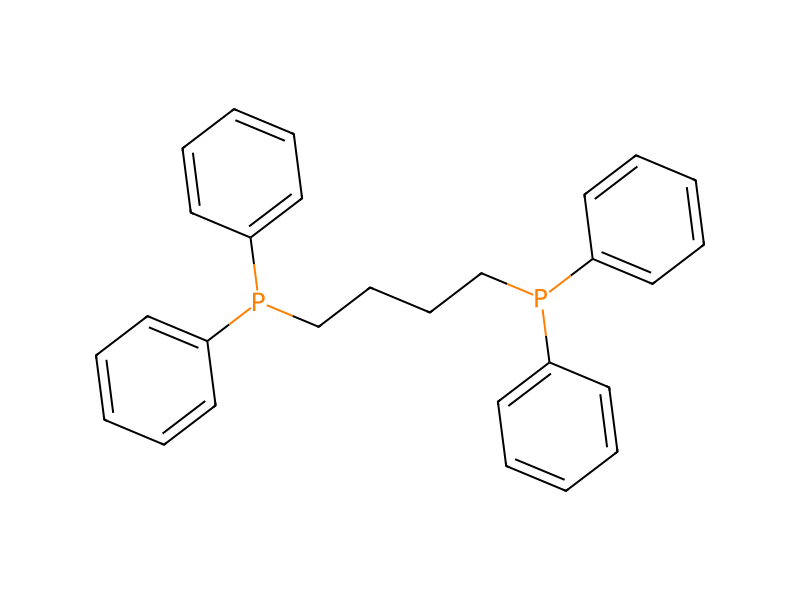
HCID 78391,2-DibromoethaneHCID 14798Sodium HydroxideHCID 821241,4-Bis(diphenylphosphino)butane

Produkt 1

HCID 43922904-Diphenylphosphorylbutyl(diphenyl)phosphane

Reagenzien, Katalysatoren, Lösungsmittel 2

HCID 167845palladium(II) acetateKatalysator
HCID 6344
Dichloromethane
Lösungsmittel
2×

Versuchsvorschrift

A mixture of palladium acetate (10 mg; 4.45×10⁻² mmol), dppb (4.00 g; 9.4 mmol), 1,2-dibromoethane (3.6 g; 19.15 mmol), and dichloromethane (10 mL) was stirred for 30 minutes. To this suspension, aqueous NaOH (20% by weight; 10 mL) was added and the mixture was vigorously stirred at room temperature for 3 days. Dichloromethane (30 mL) was added, the organic phase was filtered through a silica plug which was then washed with 80 mL of CH2Cl2 /AcOEt (5:3 by volume). The combined organic solutions were evaporated to dryness. The solid residue was dissolved in boiling CH2Cl2 (ca. 30 mL) and the solution was treated with ether (100 mL; portionwise) and left at room temperature for 2 hours. Well-shaped, colorless crystals were separated, washed with ether, and dried under vacuum. The yield was 3.33 g (80%). 1H NMR (CDCl3, 20° C.), δ: 1.5 (m, 2H, CH2); 1.7 (m, 2H, CH2); 2.0 (m, 2H, CH2); 2.2 (m, 2H, CH2); 7.2-7.8 (m, 20H, Ph). 31P NMR (CDCl3, 20° C.), δ: -15.5 (s, 1P, PPh2); 32.2 (s, 1P, P(O)Ph2).

Aufarbeitung

  1. stirringthe mixture was vigorously stirred at room temperature for 3 days
  2. filtrationthe organic phase was filtered through a silica plug which
  3. washwas then washed with 80 mL of CH2Cl2 /AcOEt (5:3 by volume)
  4. customThe combined organic solutions were evaporated to dryness
  5. dissolutionThe solid residue was dissolved
  6. additionthe solution was treated with ether (100 mL
  7. waitportionwise) and left at room temperature for 2 hours
  8. customWell-shaped, colorless crystals were separated
  9. washwashed with ether
  10. customdried under vacuum

Quellen und Nachweise

ORD-Eintrag
ord-21552b8f0eca4fcca247989035262044
Quelldatensatz
uspto-grants-1999_07
DOI
10.6084/m9.figshare.5104873.v1
Patentnummer
US05919984

Notizen zur Reaktion

Auf dieser SeiteKomponentenVersuchsvorschriftAufarbeitungQuellen und NachweiseNotizen zur Reaktion