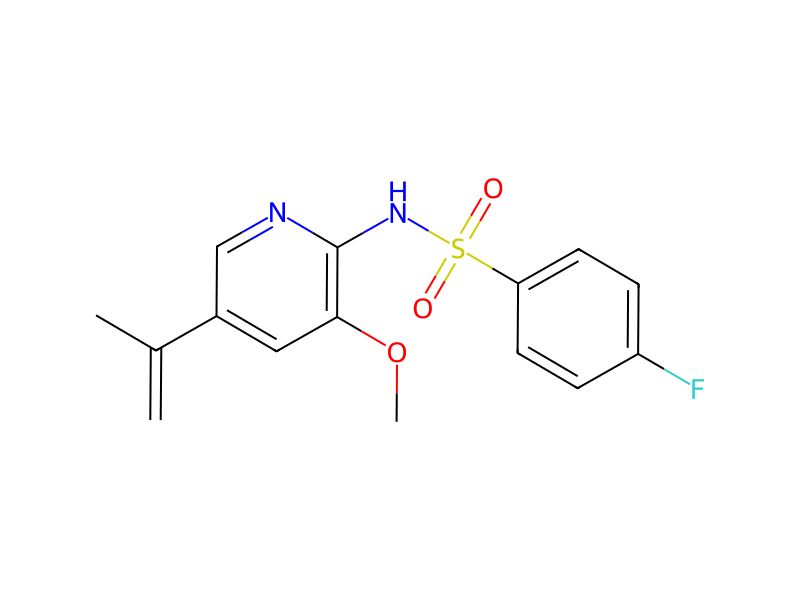
[B-](F)(F)(F)[C:2]([CH3:4])=[CH2:3].[K+].Br[C:10]1[CH:11]=[C:12]([O:27][CH3:28])[C:13]([NH:16][S:17]([C:20]2[CH:25]=[CH:24][C:23]([F:26])=[CH:22][CH:21]=2)(=[O:19])=[O:18])=[N:14][CH:15]=1.C(=O)([O-])[O-].[Cs+].[Cs+]>O1CCCC1.O.ClCCl.[Pd](Cl)Cl.C1(P(C2C=CC=CC=2)C2C=CC=CC=2)C=CC=CC=1>[F:26][C:23]1[CH:24]=[CH:25][C:20]([S:17]([NH:16][C:13]2[C:12]([O:27][CH3:28])=[CH:11][C:10]([C:2]([CH3:4])=[CH2:3])=[CH:15][N:14]=2)(=[O:19])=[O:18])=[CH:21][CH:22]=1Potassium trifluoro(prop-1-en-2-yl)borate (53.3 mg, 0.360 mmol), N-(5-bromo-3-methoxypyridin-2-yl)-4-fluorobenzenesulfonamide (130 mg, 0.360 mmol), caesium carbonate (352 mg, 1.080 mmol), palladium(II) chloride (1.276 mg, 7.20 μmol) and triphenylphosphine (5.66 mg, 0.022 mmol) were added to a microwave vial and suspended in tetrahydrofuran (THF) (2 mL) and water (0.2 mL). The reaction vessel was sealed and heated by microwaves to 140° C. for 30 minutes. After cooling, the mixture was diluted with dichloromethane (DCM) (5 mL) and water (5 mL), then passed through a celite column. The aqueous phase was washed with further DCM (5 mL) then the organics separated using a hydrophobic frit and concentrated in vacuo to give the crude product. This was purified by flash silica (Si) chromatography (0-50% ethyl acetate-cyclohexane gradient) to give the title product (75 mg). LCMS (2 min, formic) Rt 1.0 min, m/z (ES+) 323 (M+H).