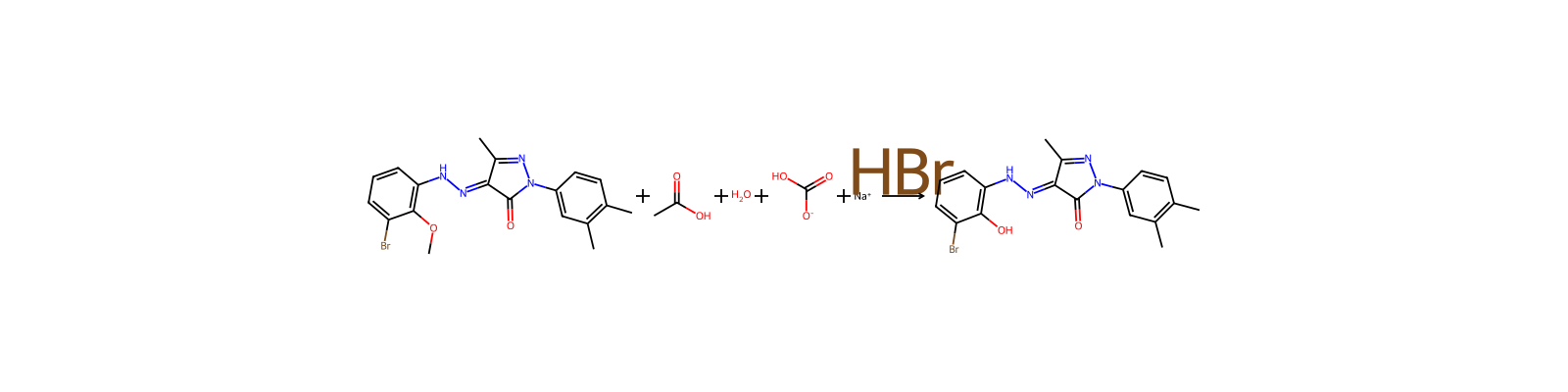
[CH3:1][C:2]1[CH:3]=[C:4]([N:9]2[C:13](=[O:14])[C:12](=[N:15][NH:16][C:17]3[CH:22]=[CH:21][CH:20]=[C:19]([Br:23])[C:18]=3[O:24]C)[C:11]([CH3:26])=[N:10]2)[CH:5]=[CH:6][C:7]=1[CH3:8].C(O)(=O)C.O.C(=O)(O)[O-].[Na+]>Br>[CH3:1][C:2]1[CH:3]=[C:4]([N:9]2[C:13](=[O:14])[C:12](=[N:15][NH:16][C:17]3[CH:22]=[CH:21][CH:20]=[C:19]([Br:23])[C:18]=3[OH:24])[C:11]([CH3:26])=[N:10]2)[CH:5]=[CH:6][C:7]=1[CH3:8]A solution of 1-(3,4-dimethylphenyl)-3-methyl-4-(3-bromo-2-methoxyphenyl)hydrazono-5-pyrazolone(5 g) prepared as in Example 2, in 48% aqueous hydrobromic acid (200 mL) and glacial acetic acid (50 mL) was stirred and heated under reflux for about 80 hours. The reaction mixture was concentrated under vacuum to obtain a thick residue. Water (40 mL) was added and basified to pH 7-8 using saturated solution of sodium bicarbonate (20 mL). The mixture was filtered to give an orange solid, which was washed with water (25 mL) and dried in an oven at about 55° C. to about 60° C. for about 12 hours. Yield: 3.5 g