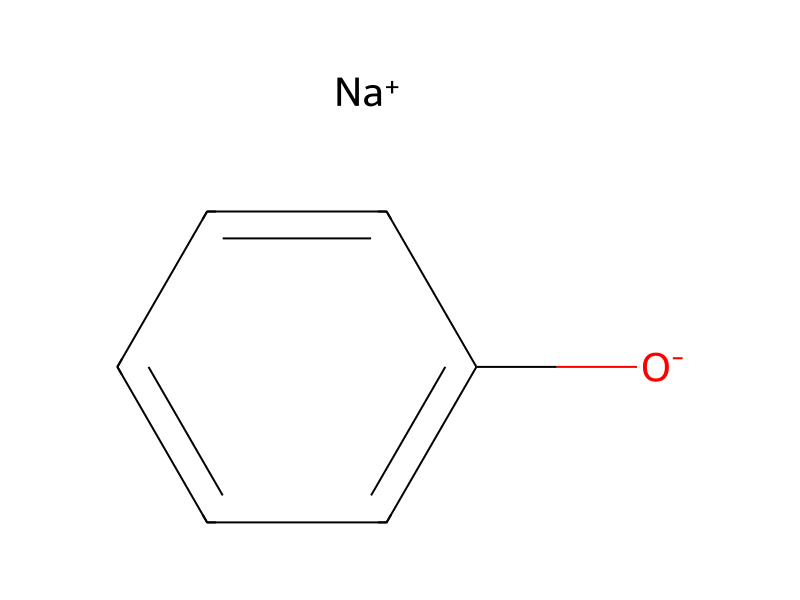
Cl[CH2:2][CH2:3][O:4][CH:5]=[CH2:6].[CH:7]1[CH:12]=[CH:11][C:10]([O-:13])=[CH:9][CH:8]=1.[Na+].C1(C2C(I=O)=C(S([O-])(=O)=O)C(C)=CC=2)C=CC=CC=1.[N-](S(C(F)(F)F)(=O)=O)S(C(F)(F)F)(=O)=O.[Na+]>ClCCl.Cl[Ti](Cl)(Cl)Cl.CC(CC)=O.C(O)(=O)C>[O:13]([CH2:6][CH2:5][O:4][CH:3]=[CH2:2])[C:10]1[CH:11]=[CH:12][CH:7]=[CH:8][CH:9]=1The compound phenoxyethylvinylether is prepared by reacting chloroethylvinylether with sodium phenate, followed by polymerization in dichloromethane initiated with TiCl4 at -10° C. By reacting 8.2 g of the polymer with 9.8 g of phenyliodosotoluene sulfonate in 40 mL of a mixture of an equal volume of acetic acid and dichloromethane. A polyiodonium is obtained which is precipitated with ether. The ionic exchange reaction is carried similarly to that of example 3 between 12 g of polymer and 7 g of sodium bis(trifluoromethanesulfonyl)imide. After precipitation and washing with water, there is obtained a sticky mass which is used in a 50% solution of methylethylketone.