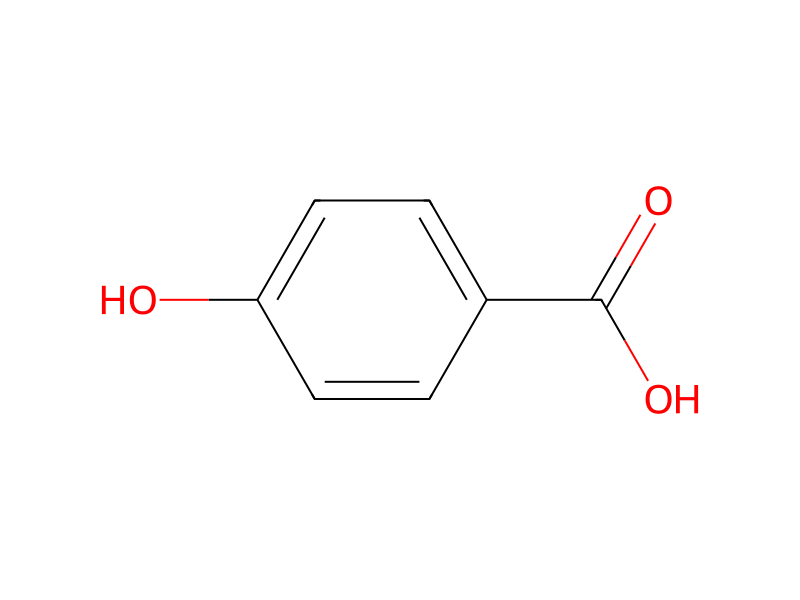
To prepare 22, a solution of 4-hydroxybenzoic acid (21, 1.52 g, 10 mmol) in DMF (7 ml) was treated with DIPEA (5.2 ml, 30 mmol) and tert-butyldimethylsilyl chloride (3.7 g, 24.5 mmol). After 12 hours, the mixture was brought to a pH of 4 by addition of 1 M H3PO4. The mixture was extracted twice with hexanes (15 ml). The organic phase was washed twice with water (15 ml), dried over Na2SO4, and concentrated in vacuum. The residue (3.7 g) was dissolved in THF (10 ml), and treated with water (7 ml) and glacial acetic acid (21 ml). After stirring for 90 minutes, the mixture was added to ice water and extracted twice with a 1:1 mixture (v/v) of diethyl ether and hexanes (30 ml). The organic phase was washed with water (30 ml), dried over Na2SO4, and concentrated in vacuum. Flash column chromatography on silica using a gradient of 5-20% methanol in DCM containing 0.2% acetic acid afforded 4-tert-butyldimethylsilyloxybenzoic acid (22, 1.42 g, 5.3 mol, 53%) as a white solid. 1H NMR (400 MHz, chloroform-d1): δ (ppm) 0.24 (s, 6H), 0.99 (s, 9H), 6.89 (d, J=8.8 Hz, 2H), 8.02 (d, J=8.8 Hz, 2H); 13C NMR (100 MHz, chloroform-d1): δ (ppm)-4.22, 18.40, 25.73, 120.08, 122.39, 132.46, 132.46, 161.01, 172.23. See FIGS. 33A-B.