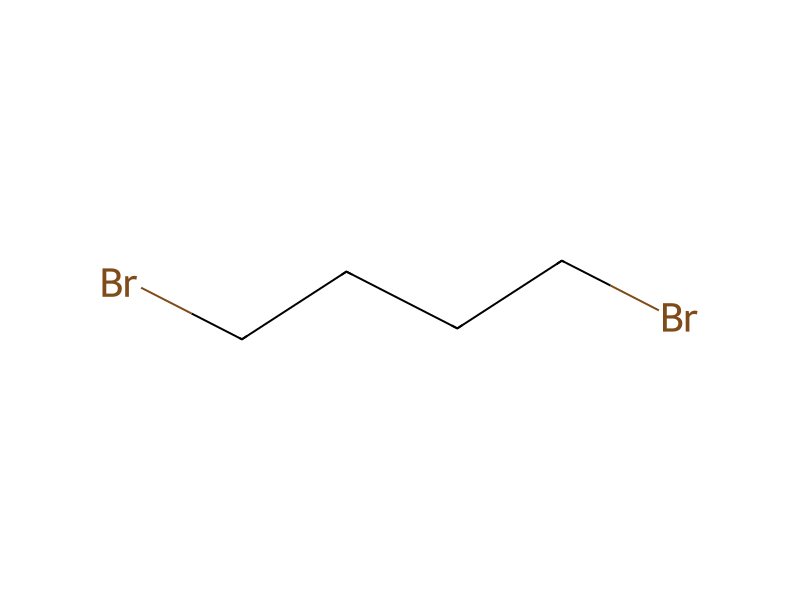
[OH:1][C:2]1[C:7]([CH2:8][CH2:9][CH3:10])=[C:6]([OH:11])[CH:5]=[CH:4][C:3]=1[C:12](=[O:14])[CH3:13].[Br:15][CH2:16][CH2:17][CH2:18][CH2:19]Br.C(=O)([O-])[O-].[K+].[K+]>CCC(C)=O.[I-].[K+]>[OH:1][C:2]1[C:7]([CH2:8][CH2:9][CH3:10])=[C:6]([O:11][CH2:19][CH2:18][CH2:17][CH2:16][Br:15])[CH:5]=[CH:4][C:3]=1[C:12](=[O:14])[CH3:13]2', 4'-dihydroxy-3'-(n-propyl)acetophenone (19.1 g), 1,4-dibromobutane (48 ml, 0.4 moles), potassium carbonate (13.8 g), and potassium iodide (50 mg) were combined in MEK (300 ml). The reaction mixture was stirred and heated to reflux temperature overnight then cooled to room temperature. The cooled solution was partitioned between ethyl acetate and water. The organic layer was separated, dried over magnesium sulfate, filtered and concentrated in vacuo. The concentrate was chromatographed on a preparatory-scale HPLC (silica column) eluted with a gradient of 1 to 20% ethyl acetate in hexane to yield 11.2 g of the title product: n.m.r. (300 MHz, CDCl3) δ: 12.8 (s, 1H); 7.6 (d, 1H); 6.45 (d, 1H); 4.1 (t, 2H); 3.55 (t, 2H); 2.7 (t, 2H); 2.65 (s, 3H); 2.25 (m, 2H); 2.05 (m, 2H); 1.58 (m, 2H); 0.98 (t, 3H).