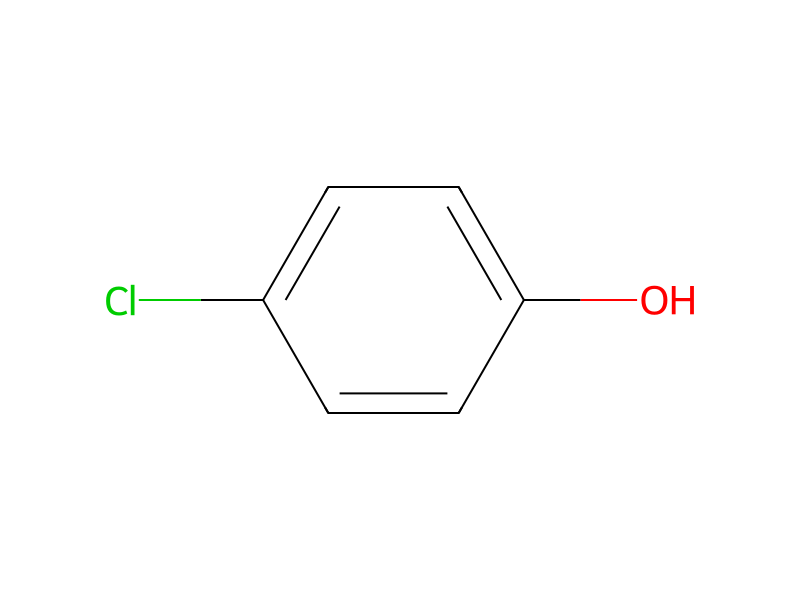
[Cl:1][C:2]1[CH:7]=[CH:6][C:5](O)=[CH:4][CH:3]=1.CS(C)=O.[OH-].[Na+].[N+]([C:18]1[CH:19]=[C:20]2[C:25](=[O:26])[N:24]([CH3:27])[C:22](=[O:23])[C:21]2=[CH:28][CH:29]=1)([O-])=O>O.ClC1C=CC=CC=1>[Cl:1][C:2]1[CH:7]=[CH:6][C:5]([C:18]2[CH:19]=[C:20]3[C:25](=[O:26])[N:24]([CH3:27])[C:22](=[O:23])[C:21]3=[CH:28][CH:29]=2)=[CH:4][CH:3]=1In a 500 ml three-necked flash equipped with a mechanical stirrer, Dean-Stark trap/condenser, nitrogen inlet, and thermometer was added 25.71 grams (0.20 moles) of p-chlorophenol, 100 ml dimethylsulfoxide, and 150 ml of chlorobenzene. After stirring and nitrogen purging the mixture for 30 min., 15.80 grams of aqueous sodium hydroxide (50.62 wt. %; 0.20 moles) was added. The mixture was heated up to 150° C. with the azeotropic removal of the water of reaction. After the removal of water was complete the temperature was lowered to 60° C. and 41.23 grams (0.20 moles) of 4-nitro-N-methyl phthalimide was added. The mixture was stirred overnight. Upon cooling to room temperature the product precipitated from solution. Filtration, washing the precipitate with water, and recrystallization from isopropanol yielded 50.8 grams of 4-(p-chlorophenyl)-N-methyl phthalimide. The melting point was 131°-132° C.