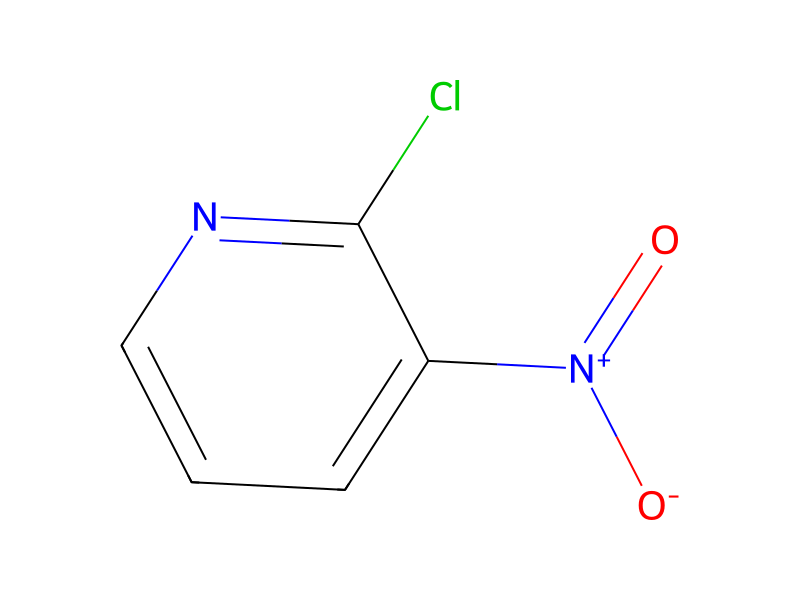
Cl[C:2]1[C:7]([N+:8]([O-:10])=[O:9])=[CH:6][CH:5]=[CH:4][N:3]=1.[Cl:11][C:12]1[CH:19]=[CH:18][C:15]([CH2:16][NH2:17])=[CH:14][CH:13]=1.CC1C=CC(CC)=CN=1.O>C1(C)C(C)=CC=CC=1.C(O)(=O)C>[Cl:11][C:12]1[CH:19]=[CH:18][C:15]([CH2:16][NH:17][C:2]2[C:7]([N+:8]([O-:10])=[O:9])=[CH:6][CH:5]=[CH:4][N:3]=2)=[CH:14][CH:13]=1A solution of 26.5 g of 2-chloro-3-nitropyridine, 23.7 g of 4-chlorobenzylamine and 25 ml of 2-methyl-5-ethylpyridine in 200 ml of xylene is refluxed for 12 hours. The reaction mixture is then cooled, water and acetic acid are added and the resulting mixture is then extracted with ether. The organic phase is dried over magnesium sulfate, filtered and then evaporated under vacuum to give an oil which crystallizes from isopropyl ether. The crystals are filtered off and then dried to give 27 of 2-(4-chlorophenylmethylamino)-3-nitropyridine in the form of crystals melting at 100° C.