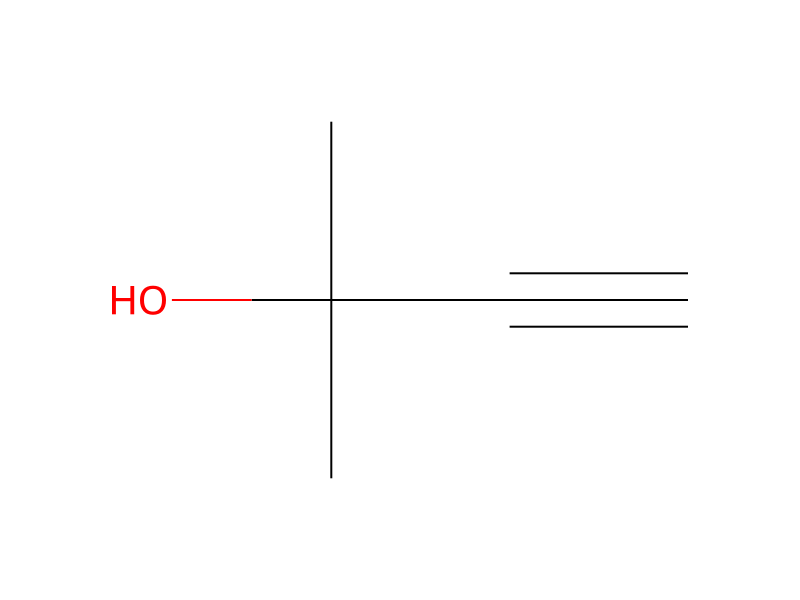
To a solution of 4,4'-dibromooctafluorobiphenyl (10 g, 21.9 mmol) in degassed diisopropylamine (350 mL) was added dichlorobis(triphenylphosphine) palladium (770 mg, 1.05 mmol, 5 mol %) and copper (1) acetate (219 mg, 1.05 mmol, 5 mol %). The solution was cooled to 0° C. and to this solution was added 2-methyl 3 butyn 2-ol (2.2 equivalents, 4.0 g, 4.7 mL). The solution was allowed to warm to room temperature and was subsequently heated at 50° C. for 12 hours. The solution was cooled and filtered to remove the pecipitate of diisopropylammonium bromide. The solvent was removed at reduced pressure and the residue was chromatographed on a column of silica gel (200 g) packed with ethel acetate. An oily yellow solid was removed from the column. The addition of a couple of drops of methanol caused the oil to solidify. The resulting solid was recrystallized from a mixture of ethyl acetate/hexane (1:2) to yield 4,4'-bis(3 hydroxy-3-methyl 1-butynyl)-octafluorobiphenyl as white crytals. The yield was 8.6 (92 %), mp 119°-121° C. IR (KBr) 3400, 2960, 1475, 1365, 1210, 1170, 990, 962 cm-1. 1H NMR (80 MHz, CDCl3) δ2.7 (s, 2H), 1.53 (s, 12H); Mass Spectrum (El)(rel. intensity 462 (3.7), 447 (44.0), 432 (1.5); Anal. Calcd for C22H14F8O2 : C, 57.14; H, 3.03. Found: C,60.60; H, 4.78