Reaktionsgleichung
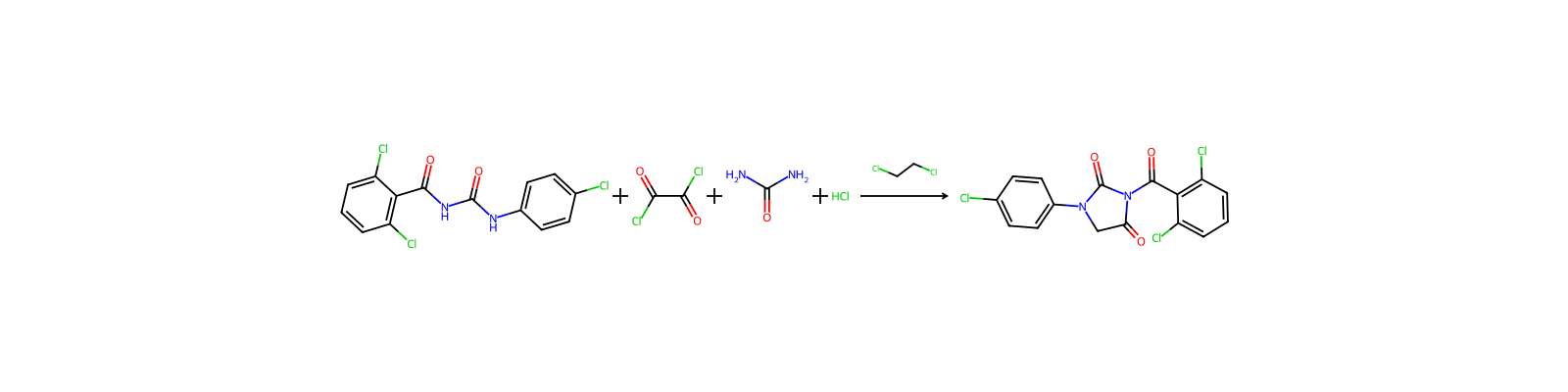
[Cl:1][C:2]1[CH:20]=[CH:19][CH:18]=[C:17]([Cl:21])[C:3]=1[C:4]([NH:6][C:7]([NH:9][C:10]1[CH:15]=[CH:14][C:13]([Cl:16])=[CH:12][CH:11]=1)=[O:8])=[O:5].[C:22](Cl)(=O)[C:23](Cl)=[O:24].NC(N)=O.Cl>ClCCCl>[Cl:1][C:2]1[CH:20]=[CH:19][CH:18]=[C:17]([Cl:21])[C:3]=1[C:4]([N:6]1[C:23](=[O:24])[CH2:22][N:9]([C:10]2[CH:11]=[CH:12][C:13]([Cl:16])=[CH:14][CH:15]=2)[C:7]1=[O:8])=[O:5]Komponenten
6






Versuchsvorschrift
10.3 g of N-(2,6-dichlorobenzoyl)-N'-(p-chlorophenyl)-urea are boiled in 100 ml of dry 1,2-dichloroethane containing 3 ml of oxalylchloride for 24 hours. The urea dissolves with the evolution of hydrochloric acid. After concentration by evaporation and after the addition of 25 ml of ligroin the residue becomes crystalline. The substance mauy be recrystallized from 30 mls of benzene. Melting point 157° C. Yield 8 g.
Aufarbeitung
- concentrationAfter concentration
- customby evaporation
- additionafter the addition of 25 ml of ligroin the residue
- customThe substance mauy be recrystallized from 30 mls of benzene
Quellen und Nachweise
- ORD-Eintrag
- ord-1d4e2ea2bb504f7b8f8c05fc2fff3709
- Quelldatensatz
- uspto-grants-1992_08
- Patentnummer
- US05142064
Verknüpfte Notizen
Wird geladen…