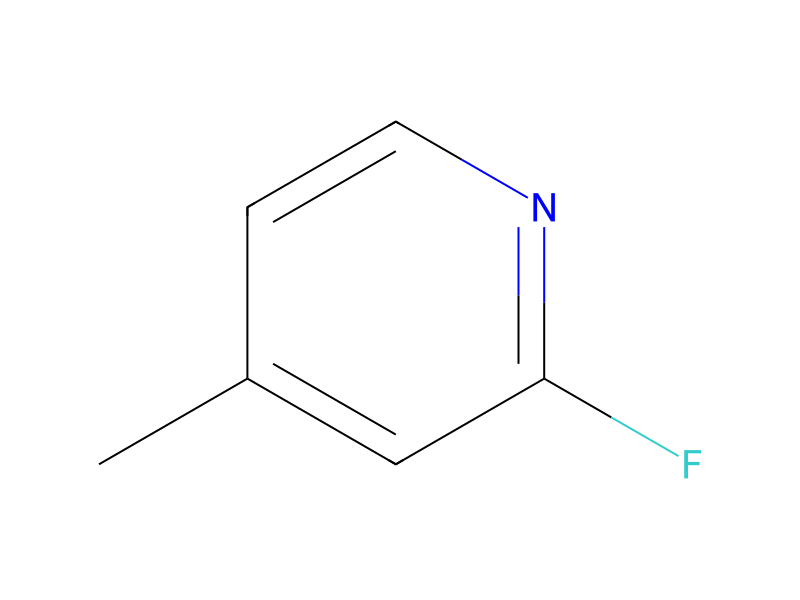
C(NC(C)C)(C)C.C([Li])CCC.[F:13][C:14]1[CH:19]=[C:18]([CH3:20])[CH:17]=[CH:16][N:15]=1.CON(C)[C:24](=[O:35])[C:25]1[CH:30]=[CH:29][CH:28]=[C:27]([C:31]([F:34])([F:33])[F:32])[CH:26]=1>C1COCC1>[F:13][C:14]1[CH:19]=[C:18]([CH2:20][C:24]([C:25]2[CH:30]=[CH:29][CH:28]=[C:27]([C:31]([F:32])([F:33])[F:34])[CH:26]=2)=[O:35])[CH:17]=[CH:16][N:15]=1To a solution of diisopropylamine (17.69 mL, 0.135 mole) in THF (200 mL) at -78° C., under argon, was added n-butyllithium (54.0 mL, 2.5M in hexane, 0.135 mole), followed after 5 min. by a solution of 2-fluoro-4-methylpyridine (Lancaster Synthesis Inc.) (10 g, 0.090 mole) in THF (20 mL). After stirring for 15 min. at -78° C., a solution of N-methoxy-N-methyl-3-trifluoromethylbenzamide (23.08 g, 0.099 mole) in THF (10 mL) was added. After stirring for 5 min, the reaction was allowed to warm to 0° C. and quenched by pouring into water (400 mL) and ethyl acetate (400 mL). The layers were separated, and the aqueous layer washed with ethyl acetate (200 mL). The ethyl acetate extracts were combined, dried over anhydrous sodium sulfate, filtered, and concentrated to an oil which was chromatographed on silica gel with 20% ethyl acetate in hexane to give 21.6 g of the title compound.