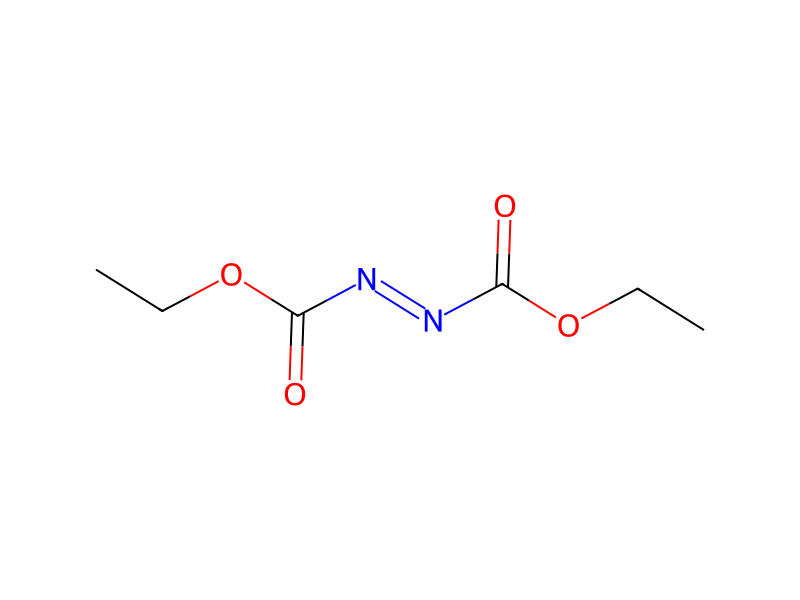
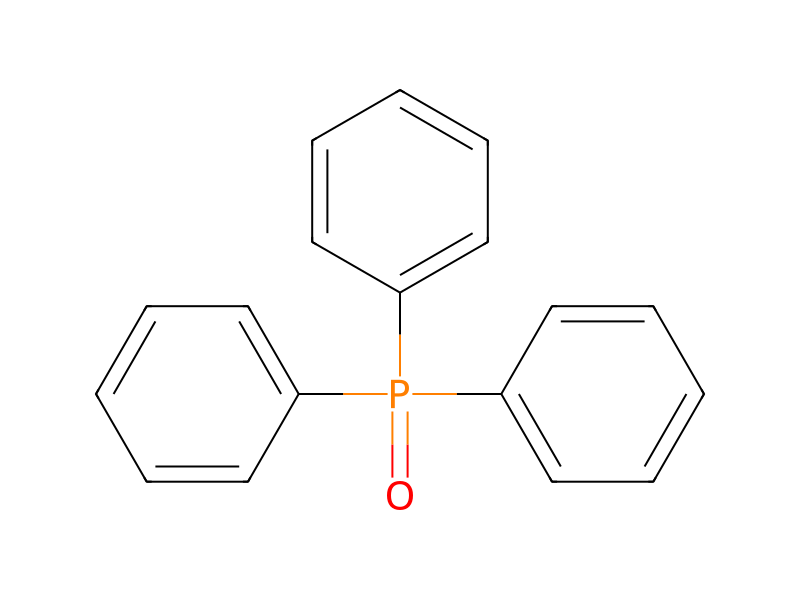
N1C2NCCCC=2C=CC=1CC(N)[OH:13].CCOC(/N=N/C(OCC)=O)=O.CC1(C)[C@H](C2C=CC(O)=CC=2)[C@@H]1CC(OCC)=O.[C:45]1([P:51]([C:58]2[CH:63]=[CH:62][CH:61]=[CH:60][CH:59]=2)[C:52]2[CH:57]=[CH:56][CH:55]=[CH:54][CH:53]=2)[CH:50]=[CH:49][CH:48]=[CH:47][CH:46]=1>CN(C=O)C>[C:58]1([P:51](=[O:13])([C:45]2[CH:46]=[CH:47][CH:48]=[CH:49][CH:50]=2)[C:52]2[CH:57]=[CH:56][CH:55]=[CH:54][CH:53]=2)[CH:59]=[CH:60][CH:61]=[CH:62][CH:63]=1A solution of 2-(5,6,7,8-tetrahydro-1,8-naphthyridyl)-aminoethanol (0.832 g, 4.8 mmol) and DEAD (0.835 g, 4.8 mmol) in DMF (10 mL) was added to a solution of ethyl (cis)2,2-dimethyl-3-(p-hydroxyphenyl)cyclopropaneacetate (0.560 g, 0.2.39 mmol) and triphenylphosphine (0.1.26 g, 4.8 mmol) in dimethylformamide (10 mL) and was stirred for 4 h at rt. The solvent was removed and the residue was purified by hplc to afford the desired ester along with some triphenylphosphine oxide. The residue in ethanol (20 mL) water (20 mL) was added lithium hydroxide (1 g) and was stirred for 18 h. The reaction mixture was concentrated and the residue in water was added trifluoroacetic acid (2 mL) and was purified on hplc to afford the desired product as a solid. 1H NMR (CD3OD) δ 7.58 (d, 1H, J=7.4 Hz), 7.06 (m, 2H), 6.80(m, 2H), 6.70 (d, 1H, J=7.3 Hz), 4.24 (t, 2H, J=5.9 Hz), 3.48 (m, 2H), 3.13 (t, 2H, J=5.9 Hz), 2.8 (m, 2H), 1.99-2.02 and 2.27-2.33 (m, 2H), 1.93 (m, 2H), 1.83 (d, 1H, J=9 Hz), 1.23 (s, 3H), 1.18 (m, 1H), 0.89 (s, 3H). Anal. Calcd for C23H28N2O3: Mol. Wt, 380.2100. Found: 379.2036 (M−H, HRMS).