
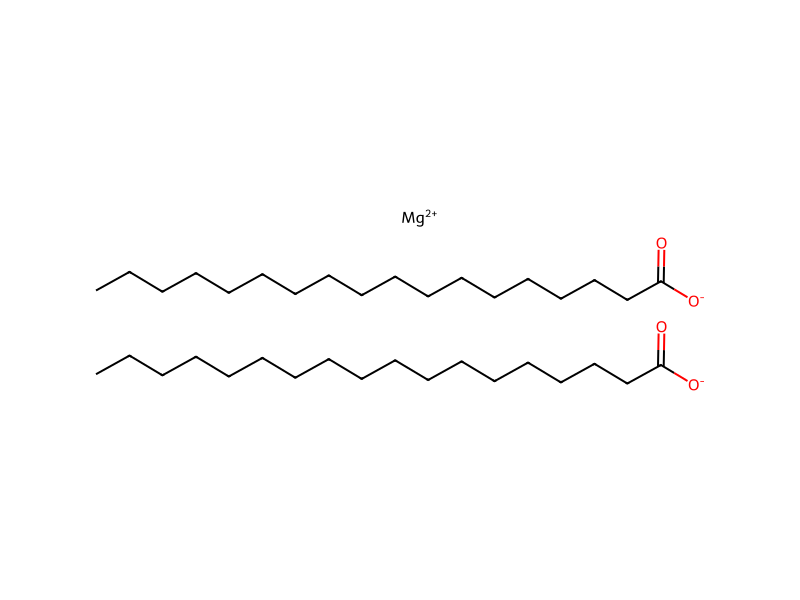
Basic information
- Standard SMILES
CCCCCCCCCCCCCCCCCC(=O)[O-].CCCCCCCCCCCCCCCCCC(=O)[O-].[Mg+2]- InChIKey
HQKMJHAJHXVSDF-UHFFFAOYSA-L- Molecular formula
- C36H70MgO4
- Average molar mass
- 591.2 g/mol
- Monoisotopic mass
- 590.5124524
Names & identifiers
- Preferred name
- Magnesium Stearate
- IUPAC
- magnesium bis(octadecanoate)
- English name
- Magnesium stearate
- Molecular formula
- C36H70MgO4
- Molecular weight
- 591.24
Names & synonyms
MAGNESIUM STEARATE557-04-0Magnesium distearateMagnesium octadecanoateDibasic magnesium stearateOctadecanoic acid, magnesium saltSynpro 90Stearic acid, magnesium saltPetrac MG 20NFMagnesium stearate gSynpro Magnesium Stearate 90Magnesii stearas
Show more names
stearatedemagnesiumMagnesium Stearate BpMAGNESIUM STEARATE N.F.Magnesium Stearate Veg. NFC4d-ADolomolAnti-C4d-Apetracmg20nfnesium stearate
NP 1500SM 1000Octadecanoic acid, magnesium salt (2:1)CHEBI:925470097M6I30DTXSID2027208DAYCLINGRefChem:5973
Database identifiers
- CAS
557-04-0- PubChem CID
- 11177
- DTXSID
DTXSID2027208- ChEMBL
CHEMBL2106633- ChEBI
CHEBI:9254- UNII
- 70097M6I30
- EC Number
- 209-150-3
- Nikkaji
- J43.178H
Properties
Computed structural properties
- Topological polar surface area
- 80.3 Ų
- Hydrogen bond donors
- 0
- Hydrogen bond acceptors
- 4
- Rotatable bonds
- 30
- Heavy atoms
- 41
- Formal charge
- 0
- Complexity
- 196
Physicochemical properties
- Melting point
- 200 °C · 200 °C (lit.)
- Density
- 1.028 g/cm3 · 1.028g/cm3
- storage temp.
- Inert atmosphere,Room Temperature
- solubility
- alcohol: insoluble
- form
- Fine Powder
- color
- White
- PH
- 7 · 7 (H2O) (slurry)
- Odor
- wh. soft oily powd., tasteless, odorless
- Water Solubility
- Insoluble
- Merck
- 14 · 14,5690
- BRN
- 3919702 · 3919702
- Exposure limits
- 10 mg/m3; · ACGIH: TWA 10 mg/m3; TWA 3 mg/m3
- Stability
- Stable. Incompatible with strong oxidizing agents.
- Major Application
- pharmaceutical (small molecule)
- Cosmetics Ingredients Functions
- MOISTURISINGANTICAKINGBULKINGCOLORANT
- Cosmetic Ingredient Review (CIR)
- Magnesium stearate (557-04-0)
- InChI
- 1S/2C18H36O2.Mg/c2*1-2-3-4-5-6-7-8-9-10-11-12-13-14-15-16-17-18(19)20;/h2*2-17H2,1H3,(H,19,20);/q;;+2/p-2
- InChIKey
- DRJIJXNWSSRTTE-UHFFFAOYSA-M
- SMILES
- CCCCCCCCCCCCCCCCCC(=O)O[Mg]OC(=O)CCCCCCCCCCCCCCCCC
- LogP
- 8.216 · 8.216 (est)
- CAS DataBase Reference
- 557 · 557-04-0(CAS DataBase Reference)
- SCOGS (Select Committee on GRAS Substances)
- Magnesium stearate
- Substances Added to Food (formerly EAFUS)
- MAGNESIUM STEARATE
- FDA 21 CFR
- 173.34 · 173.340; 175.300; 179.45;181.29
- EWG's Food Scores
- 1 · 1
- FDA UNII
- 70097 M6I30 · 70097M6I30
- EPA Substance Registry System
- Magnesium stearate (557-04-0)
- Cosmetics Info
- Magnesium Stearate
- UNSPSC Code
- 41116107 · 41116107
- NACRES
- 24 · NA.24
- Hazard statements
- 413 · H413
- PPE
- 95 · dust mask type N95 (US), Eyeshields, Gloves
- Hazard Codes
- Xi
- Risk Statements
- 36 · 36/37/38
- Safety Statements
- 26 · 26-37/39
- WGK Germany
- -
- RTECS
- 4390000 · WI4390000
- TSCA
- TSCA listed
- HS Code
- 29157030 · 29157030
- Storage Class
- 11 · 11 - Combustible Solids
- Hazardous Substances Data
- 557 · 557-04-0(Hazardous Substances Data)
- Toxicity
- 50 orally · LD50 orally in Rabbit: > 2000 mg/kg
Safety & regulation
Safety data
- PPE
- dust mask type N95 (US), Eyeshields, Gloves
- wgk
- -
- tsca
- TSCA listed
- rtecs
- WI4390000
- hs_code
- 29157030
- Toxicity
- LD50 orally in Rabbit: > 2000 mg/kg
- risk_code
- 36/37/38
- hazard_code
- Xi
- safety_code
- 26-37/39
- Storage Class
- 11 - Combustible Solids
- Hazard statements
- H413
- Hazardous Substances Data
- 557-04-0(Hazardous Substances Data)
Chemistry & industry
Applications
UsesMagnesium stearate has been widely used for many decades in the food industry as an emulsifier, binder and thickener, as well as an anticaking, lubricant, release, and antifoaming agent. It is present in many food supplements, confectionery, chewing gum, herbs and spices, and baking ingredients. Magnesium stearate is also commonly used as an inactive ingredient in the production of pharmaceutical tablets, capsules and powders. The main reason for its good lubricating properties is its hydrophobic nature and an ability to reduce friction between tablets and die wall during the ejection process. Magnesium stearate can be regarded as being non-toxic, the United States, Germany and Japan allow it to be applied to products being contact with food. However, it doesn’t have wide application to be applied as PVC heat stabilizers. In China and some other countries Pharmacopoeia, there are always records of this specie. The pharmacopeia has also made provisions on the magnesium content, moisture, heavy metals, iron, sulfate and chloride content.
DescriptionMagnesium stearate, also called octa decanoic acid, magnesium salt, is a white substance, powder which becomes solid at room temperature. It has the chemical formula Mg(C18H35O2)2. It is a salt containing two equivalents of stearate (the anion of stearic acid) and one magnesium cation (Mg2+). Magnesium stearate melts at about 120 °C, is not soluble in water, and is generally considered safe for human consumption at levels below 2500 mg/kg per day.In 1979, the FDA's Subcommittee on GRAS (generally recognized as safe) Substances (SCOGS) reported, "There is no evidence in the available information on ... magnesium stearate ... that demonstrates, or suggests reasonable grounds to suspect, a hazard to the public when they are used at levels that are now current and in the manner now practiced, or which might reasonably be expected in the future.".
Useswidely used in the fields of the plastic, mold-releasing agent for tablets (need meeting the medicine criterion), emulsifying agents of cosmetics. It also can conjugate with Ca Soap as stabilizer of PVC.
UsesMagnesium Stearate is the magnesium salt of stearic acid which functions as a lubricant, binder, emulsifier, and anticaking agent. it is a white powder that is insoluble in water. it is used as a lubricant or die release in tableting pressed candies and is also used in sugar- less gum and mints.
UsesMagnesium stearate is often used as a anti-adherent in the manufacture of medical tablets, capsules and powders. In this regard, the substance is also useful, because it has lubricating properties, preventing ingredients from sticking to manufacturing equipment during the compression of chemical powders into solid tablets; magnesium stearate is the most commonly used lubricant for tablets. Studies have shown that magnesium stearate may affect the release time of the active ingredients in tablets, etc., but not that it reduces the overall bioavailability of those ingredients. As a food additive or pharmaceutical excipient, its E number is E470b. Magnesium stearate is also used to bind sugar in hard candies like mints, and is a common ingredient in baby formulas. In pure powder form, the substance can be a dust explosion hazard, although this issue is effectively insignificant beyond the manufacturing plants using it. Magnesium stearate is manufactured from both animal and vegetable oils. Some nutritional supplements specify that the magnesium stearate used is sourced from vegetables. Magnesium stearate is a major component of "bathtub rings." When produced by soap and hard water, magnesium stearate and calcium stearate both form a white solid insoluble in water, and are collectively known as "soap scum.".
General DescriptionMagnesium stearate (Mg-St) is the magnesium salt of stearic acid. Its anhydrate, dihydrate and trihydrate forms have been prepared. The tabletting of the blends of magnesium stearate and lactose granules has been described. The influence of mixing time on hardness, disintegration time and ejection force on the compressed tablets was examined. Mg-St is widely used lubricant in pharmaceutical industry. It also plays a role in delaying the process of dissolution. Its detection in tablets by laser-induced breakdown spectroscopy has been proposed.
Preparation methods
PreparationMagnesium stearate is created by the reaction of sodium stearate with magnesium sulfate.
Upstream & downstream products
Upstream raw materials
Downstream products
Suppliers50 total
国药集团化学试剂有限公司86-21-63210123 · [email protected]
北京华美互利生物化工010-56205725 · [email protected]
梯希爱(上海)化成工业发展有限公司021-67121386 · [email protected]
山东旭晨化工科技有限公司0533-15715337262 15715337262 · [email protected]
上海阿拉丁生化科技股份有限公司400-6206333 13167063860 · [email protected]
山东冠庆食品配料有限公司15138924569 15138924569 · [email protected]
陕西唐尧生物科技有限公司18092657875 18091843347 · [email protected]
Jai Radhe Sales+(91)-(79)-26431096/65255722 · [email protected]
上海将来实业股份有限公司400-0066400 13621662912 · [email protected]
上海迈瑞尔生化科技有限公司4006356688 18621169109 · [email protected]
武汉易泰科技有限公司上海分公司18930552037 · [email protected]
大连美仑生物技术有限公司0411-62910999 13889544652 · [email protected]
阿法埃莎(中国)化学有限公司400-6106006 · [email protected]
安耐吉化学&3A(安徽泽升科技股份有限公司)400-0056266 · [email protected]
北京绿百草科技发展有限公司010-61136123 · [email protected]
上海景颜化工科技有限公司13817811078 · [email protected]
上海泰坦科技股份有限公司400-6009262 15618770481 · [email protected]
合肥天健化工有限公司551-65418679 15856988503;15837135945 · [email protected]
天津金汇太亚化学试剂有限公司022-59582624 18622766592 · [email protected]
山东西亚化学有限公司13355009207 13355009207 · [email protected]
四川库利南科技有限公司400-1166-196 18981987031 · [email protected]
天津希恩思生化科技有限公司400 638 7771 · [email protected]
Connect Chemicals GmbH+49 2102 2077 19 · [email protected]
斯百全化学(上海)有限公司021-021-021-67601398-809-809-809 15221380277 · [email protected]
上海源叶生物科技有限公司13636370518 · [email protected]
赛默飞世尔科技(中国)有限公司800-810-5118 · [email protected]
TOKYO CHEMICAL INDUSTRY CO., LTD.03-36680489 · [email protected]
潍坊沃腾进出口有限公司0536-2456718
南京生利德生物科技有限公司025-57798810 18652991625 · [email protected]
北京环宇世纪化学科技有限公司hysj_bj.com
上海将来实业股份有限公司400-0066400 13621662912 · [email protected]
安徽科迪达化工有限公司0554-2106669 · [email protected]
HBCChem, Inc.+1-510-219-6317 · [email protected]
日照力德士化工有限公司010-51268198 · [email protected]
重庆星灿医药科技有限公司13594048950 19923294409 · [email protected]
上海爱蝶实业有限公司021-58957966 18930537195 · [email protected]
成都零六生物科技有限公司400-1166-196 13458535857 · [email protected]
上海麦克林生化科技股份有限公司15221275939 15221275939 · [email protected]
成都润泽本土化工有限公司13096311329 028-88469284 616445927 · [email protected]
厦门康奥克科技有限公司0086-592-7270133 612 · [email protected]
湖北巨胜科技有限公司027-59599241 18871490274 · [email protected]
池州凯隆进出口贸易有限公司[email protected]
Sigma-Aldrich西格玛奥德里奇(上海)贸易有限公司021-61415566 800-8193336 · [email protected]
桦特昇生物科技(武汉)有限公司027-59207879 1972026995 18140587686 · [email protected]
Alfa Chemistry1-516-6625404 · [email protected]
九鼎化学(上海)科技有限公司4009209199 · [email protected]
尤尼威尔化学品(上海)有限公司021-61932772 13012862996 · [email protected]
成都润泽本土化工有限公司028-88469284 18000562381 · [email protected]
上海思言生物科技有限公司021-50908862,442785678,326799392 18721037013 · [email protected]
北京华威锐科化工科技有限公司89508211 18501085097 · [email protected]
Additional notes
DefinitionMg(C18H35O2)2 or with one H2O. Technical grade contains small amounts of the oleate and 7% magnesium oxide, MgO.
Related reactions
19 records




Linked notes
Loading…