HomeMCPWorkbenchSkills
HomeWorkbenchNotificationsMe
llms.txt · MCP GuidePrivacy Policy · Terms of Service · Supportv1.8.3
  1. Home
  2. /Compound

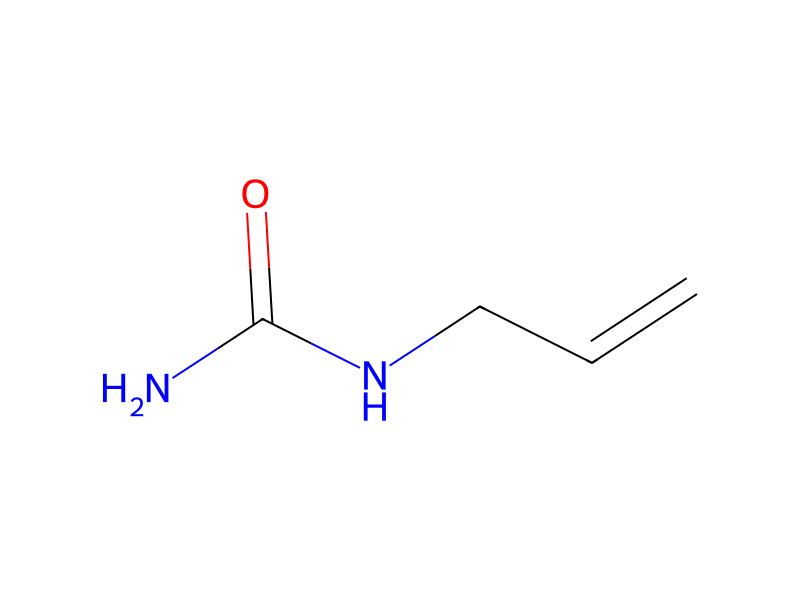
Allylurea

HCID 11181
New reaction
Print

Completing data — refresh the page later to see the latest
Basic informationOverviewNames & identifiersPropertiesSafety & regulationChemistry & industryRelated reactionsCompound notes
Substructure searchFind similar structures

Basic information

CAS
557-11-9
Standard SMILES
C=CCNC(N)=O
InChIKey
VPJDULFXCAQHRC-UHFFFAOYSA-N
Molecular formula
C4H8N2O
Average molar mass
100.12 g/mol
Monoisotopic mass
100.06366288

Overview

Allyl urea is a cream colored powder. (NTP, 1992)

Names & identifiers

Preferred name
Allylurea
IUPAC
prop-2-enylurea
English name
Allylurea
Molecular formula
C4H8N2O
Molecular weight
100.12

Names & synonyms

Allylurea557-11-9N-Allylurea1-AllylureaAllylcarbamideMonoallylureaN-2-PropenylureaUrea, allyl-2-PropenylureaALLYL UREA0CZM19WLK8NSC-7607
Show more names
NSC 7607allyl-ureNSC 136617Allylurea,95%Allylurea >
DTXSID2024450RefChem:110924DTXCID704450209-157-1prop-2-enylureaUrea, 2-propenyl-(prop-2-en-1-yl)ureaAllyl carbamide

Database identifiers

CAS
557-11-9
PubChem CID
11181
DTXSID
DTXSID2024450
UNII
0CZM19WLK8
EC Number
209-157-1
Nikkaji
J5.213B

Properties

Computed structural propertiesFilling in

XLogP
-0.4
Topological polar surface area
55.1 Ų
Hydrogen bond donors
2
Hydrogen bond acceptors
1
Rotatable bonds
2
Heavy atoms
7
Formal charge
0
Complexity
79.8

Experimental & physicochemical properties

Solubilitygreater than or equal to 100 mg/mL at 67.1 °F (NTP, 1992)
Melting Point162 to 165 °F (NTP, 1992)
Physical DescriptionAllyl urea is a cream colored powder. (NTP, 1992)

Physicochemical properties

Melting point
84 · 84-86 °C(lit.)
Boiling point
168 ℃ · 168℃
Density
1.008 · 1.008
refractive index
1.4487 · 1.4487 (estimate)
Flash point
55 ℃ · 55℃
storage temp.
2 · 2-8°C
pka
13.94 · 13.94±0.46(Predicted)
form
powder to crystal
color
White to Almost white
Merck
14 · 14,298

Safety & regulation

Safety information is for reference only and does not replace the supplier’s Safety Data Sheet (SDS), applicable regulations, or professional assessment.

GHS classification

GHS Classification · 4 items

Warning

H302 (100%): Harmful if swallowed [Warning Acute toxicity, oral]

P261, P264, P270, P271, P280, P301+P317, P302+P352, P304+P340, P317, P321, P330, P362+P364, and P501 (click each P-code to see the statement)

Aggregated GHS information provided per 40 reports by companies from 3 notifications to the ECHA C&L Inventory. Each notification may be associated with multiple companies.

Hazard information

Regulatory InformationUrea, 2-propenyl-: Does not have an individual approval but may be used under an appropriate group standard
Fire HazardsFlash point data for this chemical are not available; however, it is probably combustible. (NTP, 1992)
Health HazardsSYMPTOMS: Symptoms of exposure to this chemical include irritation.
Reactive GroupAmides and Imides
Reactivity ProfileReacts with strong oxidizing and strong reducing agents (NTP, 1992).
Air and Water ReactionsSoluble in water.
Hazard Classes and CategoriesAcute Tox. 4 (100%)

Safety & protection

Fire Fighting

Chemistry & industry

Uses & manufacturing

General Manufacturing InformationUrea, N-2-propen-1-yl-: INACTIVE

Applications

Usesmanufacture of allylthiourea; corrosion inhibitors.

General DescriptionCream colored powder.

Upstream & downstream products

Upstream raw materials

UreaAllylaminecyanic acid5-Bromomethyl-4,5-dihydro-oxazol-2-ylamineN-AllylthioureaDL-HistidineALLYL ISOCYANATEWaterHydrogen peroxideAllyl alcoholPotassium cyanateOxalyl chloride

Downstream products

1-Allyl-3-(2-chloro-acetyl)-urea1-Allyl-1-nitrosourea

Related reactions

12 records
New reaction record
HRID 349288 reaction equation
HRID 349288As reactant
HRID 359277 reaction equation
HRID 359277As reactant
HRID 396998 reaction equation
HRID 396998As reactant
HRID 962314 reaction equation
HRID 962314UNKNOWN
HRID 962329 reaction equation
HRID 962329UNKNOWN
HRID 985463 reaction equation
HRID 985463As reactant
HRID 1583814 reaction equation
HRID 1583814As reactant
HRID 1607381 reaction equation
HRID 1607381As reactant
PreviousPage 1 of 2

Compound notes

On this pageBasic informationOverviewNames & identifiersPropertiesSafety & regulationChemistry & industryRelated reactionsCompound notes
BRN
1745068 · 1745068
InChI
1S/C4H8N2O/c1-2-3-6-4(5)7/h2H,1,3H2,(H3,5,6,7)
InChIKey
VPJDULFXCAQHRC-UHFFFAOYSA-N
SMILES
NC(=O)NCC=C
CAS DataBase Reference
557 · 557-11-9(CAS DataBase Reference)
FDA UNII
0 CZM19WLK8 · 0CZM19WLK8
EPA Substance Registry System
Allyl urea (557-11-9)
UNSPSC Code
12352100 · 12352100
NACRES
22 · NA.22
Symbol(GHS)
7 · GHS07
Signal word
Warning
Hazard statements
302 · H302+H312+H332-H335
Precautionary statements
261 · P261-P264-P270-P271-P280-P301+P312+P330-P302+P352+P312+P362+P364-P304+P340+P312-P403+P233-P405-P501
PPE
95 · dust mask type N95 (US), Eyeshields, Gloves
Hazard Codes
Xn
Risk Statements
20 · 20/21/22-37
Safety Statements
36 · 36/37
WGK Germany
3 · 3
RTECS
7875000 · YR7875000
TSCA
TSCA listed
HS Code
29241900 · 29241900
Storage Class
11 · 11 - Combustible Solids
Fires involving this material can be controlled with a dry chemical, carbon dioxide or Halon extinguisher. (NTP, 1992)
First Aid · 1 item

EYES: First check the victim for contact lenses and remove if present. Flush victim's eyes with water or normal saline solution for 20 to 30 minutes while simultaneously calling a hospital or poison control center. Do not put any ointments, oils, or medication in the victim's eyes without specific instructions from a physician. IMMEDIATELY transport the victim after flushing eyes to a hospital even if no symptoms (such as redness or irritation) develop.

Nonfire Spill Response · 1 item

SMALL SPILLS AND LEAKAGE: If you spill this chemical, you should dampen the solid spill material with water, then transfer the dampened material to a suitable container. Use absorbent paper dampened with water to pick up any remaining material. Seal your contaminated clothing and the absorbent paper in a vapor-tight plastic bag for eventual disposal. Wash all contaminated surfaces with a soap and water solution. Do not reenter the contaminated area until the Safety Officer (or other responsible person) has verified that the area has been properly cleaned.

Personal Protective Equipment (PPE) · 1 item

RECOMMENDED RESPIRATOR: Where the neat test chemical is weighed and diluted, wear a NIOSH-approved half face respirator equipped with an organic vapor/acid gas cartridge (specific for organic vapors, HCl, acid gas and SO2) with a dust/mist filter. (NTP, 1992)

Safety data

PPE
dust mask type N95 (US), Eyeshields, Gloves
wgk
3
tsca
TSCA listed
rtecs
YR7875000
hs_code
29241900
risk_code
20/21/22-37
Signal word
Warning
Symbol(GHS)
GHS07
hazard_code
Xn
safety_code
36/37
Storage Class
11 - Combustible Solids
Hazard statements
H302+H312+H332-H335
Precautionary statements
P261-P264-P270-P271-P280-P301+P312+P330-P302+P352+P312+P362+P364-P304+P340+P312-P403+P233-P405-P501