HomeMCPWorkbenchSkills
HomeWorkbenchNotificationsMe
llms.txt · MCP GuidePrivacy Policy · Terms of Service · Supportv1.8.3
  1. Home
  2. /Compound

Levulinic Acid

HCID 11579
New reaction
Print
Basic informationOverviewNames & identifiersPropertiesSafety & regulationChemistry & industryRelated reactionsCompound notes
Substructure searchFind similar structures

Basic information

CAS
123-76-2
Standard SMILES
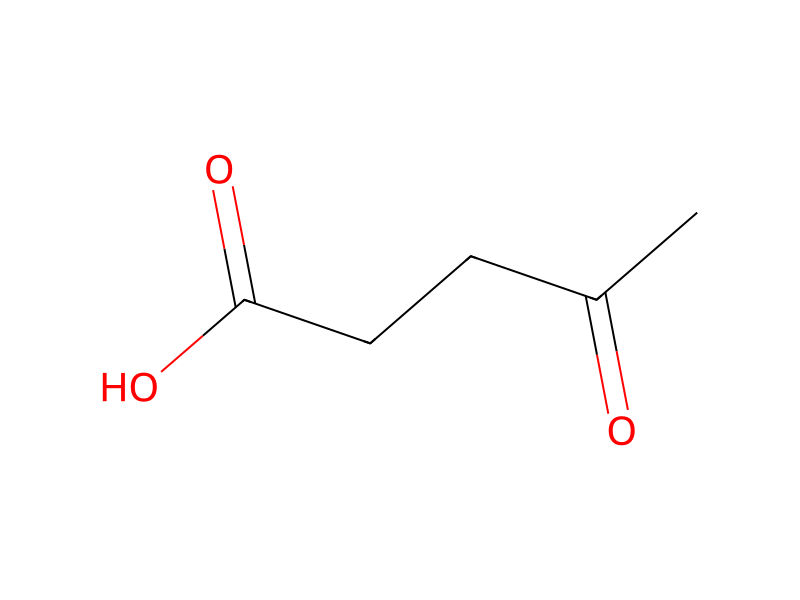
CC(=O)CCC(=O)O
InChIKey
JOOXCMJARBKPKM-UHFFFAOYSA-N
Molecular formula
C5H8O3
Average molar mass
116.11 g/mol
Monoisotopic mass
116.04734411

Overview

4-oxopentanoic acid is an oxopentanoic acid with the oxo group in the 4-position. It has a role as a plant metabolite. It is an oxopentanoic acid and a straight-chain saturated fatty acid. It is a conjugate acid of a 4-oxopentanoate.

Names & identifiers

Preferred name
Levulinic Acid
IUPAC
4-oxopentanoic acid
English name
Levulinic acid
Molecular formula
C5H8O3
Molecular weight
116.12

Names & synonyms

LEVULINIC ACID4-Oxopentanoic acid123-76-2Laevulinic acidPentanoic acid, 4-oxo-4-Oxovaleric acidLevulic acid4-Ketovaleric acidgamma-Ketovaleric acidLEVALevulinsaeureAcetopropionic acid
Show more names
LAlevulinicAcetylpropionic acidFEMA 26272-KETOVALERIC ACID
Laevulic acidbeta-Acetylpropionic acidAcidum laevulinicumFEMA No. 2627DTXSID8021648RYX5QG61EINSC-3716DTXCID701648

Database identifiers

CAS
123-76-2
PubChem CID
11579
DTXSID
DTXSID8021648
ChEMBL
CHEMBL1235931
ChEBI
CHEBI:45630
UNII
RYX5QG61EI
EC Number
204-649-2
Nikkaji
J10.067F

Properties

Computed structural properties

XLogP
-0.5
Topological polar surface area
54.4 Ų
Hydrogen bond donors
1
Hydrogen bond acceptors
3
Rotatable bonds
3
Heavy atoms
8
Formal charge
0
Complexity
106

Experimental & physicochemical properties

Chemical ClassesOther Classes -> Organic Acids
DrugsPharmaceuticals -> Listed in ZINC15
LipidsFatty Acyls [FA] -> Fatty Acids and Conjugates [FA01] -> Oxo fatty acids [FA0106]
Cosmetics · 2 items

Cosmetic ingredients (Levulinic Acid) -> CIR (Cosmetic Ingredient Review)

Skin conditioning

SpringerMaterials PropertiesBoiling point
FragrancesFragrance Ingredient (Levulinic acid) -> IFRA transparency List
LogP · 2 items

-0.49

-0.49

Food AdditivesFLAVOR ENHANCER, FLAVORING AGENT OR ADJUVANT -> FDA Substance added to food
Density1.136-1.147 (20 °C)
Flavoring Agents

Safety & regulation

Safety information is for reference only and does not replace the supplier’s Safety Data Sheet (SDS), applicable regulations, or professional assessment.

GHS classification

GHS Classification · 4 items

Danger

H302 (99.9%): Harmful if swallowed [Warning Acute toxicity, oral]

P261, P264, P264+P265, P270, P272, P280, P301+P317, P302+P352, P305+P351+P338, P305+P354+P338, P317, P321, P330, P332+P317, P333+P317, P337+P317, P362+P364, and P501 (click each P-code to see the statement)

Aggregated GHS information provided per 1892 reports by companies from 16 notifications to the ECHA C&L Inventory. Each notification may be associated with multiple companies.

Hazard information

Regulatory Information · 5 items

Chemical: Pentanoic acid, 4-oxo-

Regulation (EC) No 1831/2003 (amended)

Pentanoic acid, 4-oxo- is listed on the EPA's Chemical Data Reporting (CDR) system. Manufacturers and importers of Pentanoic acid, 4-oxo- are required to report information about their production and use of this chemical to the EPA under the Toxic Substances Control Act (TSCA). (40 eCFR Part 711)

REACH registered substance: 4-oxovaleric acid (EC: 204-649-2)

Levulinic acid: Does not have an individual approval but may be used under an appropriate group standard

Other Safety InformationEvaluation - Chemicals that are unlikely to require further regulation to manage risks to environment
Hazards SummaryA moderate skin irritant; [RTECS] Safe when used as a flavoring agent in food; [JECFA] A skin and strong eye irritant; Harmful by ingestion; [Sigma-Aldrich MSDS]
Hazard Classes and CategoriesAcute Tox. 4 (99.9%)

Toxicology

Chemistry & industry

Pharmacology

MeSH Pharmacological ClassificationCompounds or agents that combine with an enzyme in such a manner as to prevent the normal substrate-enzyme combination and the catalytic reaction.
Tissue LocationsNeuron
Cellular LocationsCytoplasm

Uses & manufacturing

Uses · 3 items

CIR ingredient: Levulinic Acid

Used to make nylon, synthetic rubber, plastic, and medicinals; [Merck Index] Used as a flavoring agent; [FDA] Used to flavor animal feeds; [ExPub: EFSA - FEEDAP]

Farming (Feed Additives) [Category: Industry]

U.S. Production2023: 50,000 - <250,000 lb
Consumer UsesIntermediate
Industry UsesLaboratory chemicals
Household ProductsInformation on 1 consumer products that contain Levulinic Acid in the following categories is provided:
Use Classification · 6 items

Fragrance Ingredients

Flavouring Agent -> FLAVOURING_AGENT -> JECFA Functional Classes

Flavoring Agents -> JECFA Flavorings Index

Flavouring Agent -> FLAVOURING_AGENT -> JECFA Functional Classes

Flavouring Agent -> FLAVOURING_AGENT -> JECFA Functional Classes

Flavouring Agent -> FLAVOURING_AGENT -> JECFA Functional Classes

General Manufacturing Information · 2 items

Plastics Material and Resin Manufacturing

Pentanoic acid, 4-oxo-: ACTIVE

Related reactions

130 records
New reaction record
HRID 1516 reaction equation
HRID 1516As reactant
HRID 1585 reaction equation
HRID 1585As reactant
HRID 2090 reaction equation
HRID 2090As reactant
HRID 2131 reaction equation
HRID 2131As reactant
HRID 2189 reaction equation
HRID 2189As reactant
HRID 10756 reaction equation
HRID 10756As reactant
HRID 25892 reaction equation
HRID 25892As reactant
HRID 65892 reaction equation
HRID 65892As reactant
PreviousPage 1 of 17

Compound notes

On this pageBasic informationOverviewNames & identifiersPropertiesSafety & regulationChemistry & industryRelated reactionsCompound notes
EU Flavoring substances
Solubility · 2 items

soluble in water, alcohol, and oil

1 mL in 1 mL 95% alcohol (in ethanol)

Boiling Point · 2 items

245.00 to 246.00 °C. @ 760.00 mm Hg

245 °C

Physicochemical properties

Melting point
30 · 30-33 °C (lit.)
Boiling point
245 · 245-246 °C (lit.)
Density
1.134 g/mL · 1.134 g/mL at 25 °C (lit.)
vapor pressure
1 mm · 1 mm Hg ( 102 °C)
refractive index
20 · n20/D 1.439(lit.)
FEMA
2627 · 2627 | LEVULINIC ACID
FLAVIS Number
8.023 · 08.023 | 4-Oxovaleric acid
Flash point
280 °F · 280 °F
storage temp.
30 °C · Store below +30°C.
solubility
675 g/l · 675g/l
form
Liquid After Melting
pka
4.65 · pKa 4.65(H2O,t = 25,c=0.03-0.001) (Uncertain)
color
Clear yellow
Odor
100 % · at 100.00 %. sweet caramel acidic acetoin buttery
Odor Type
caramellic
biological source
synthetic
Water Solubility
Soluble in water ( 675g/L at 20°C).
Sensitive
Light Sensitive
Merck
14 · 14,5472
JECFA Number
606 · 606
BRN
506796 · 506796
Major Application
cleaning productscosmeticsflavors and fragrancesfood and beveragespersonal care
Cosmetics Ingredients Functions
PERFUMINGSKIN CONDITIONING
Cosmetic Ingredient Review (CIR)
Levulinic acid (123-76-2)
InChI
1S/C5H8O3/c1-4(6)2-3-5(7)8/h2-3H2,1H3,(H,7,8)
InChIKey
JOOXCMJARBKPKM-UHFFFAOYSA-N
SMILES
CC(=O)CCC(O)=O
LogP
-0.498 · -0.498
Surface tension
42.53 mN/m · 42.53mN/m at 298.15K
Substances Added to Food (formerly EAFUS)
LEVULINIC ACID
FDA 21 CFR
172.515 · 172.515
CAS DataBase Reference
123 · 123-76-2(CAS DataBase Reference)
EWG's Food Scores
1 · 1
FDA UNII
5 QG61EI · RYX5QG61EI
NIST Chemistry Reference
4 · Pentanoic acid, 4-oxo-(123-76-2)
EPA Substance Registry System
Levulinic acid (123-76-2)
UNSPSC Code
85151701 · 85151701
NACRES
24 · NA.24
Symbol(GHS)
5 · GHS05,GHS07
Signal word
Danger
Hazard statements
302 · H302-H317-H318
Precautionary statements
261 · P261-P264-P280-P301+P312-P302+P352-P305+P351+P338
Hazard Codes
Xn,C
Risk Statements
22 · 22-36/37/38-34-R34-R22
Safety Statements
26 · 26-45-36/37/39-S45-S36/37/39-S26
RIDADR
3261 · 3261
WGK Germany
3 · 3
RTECS
1575000 · OI1575000
TSCA
TSCA listed
HazardClass
8 · 8
PackingGroup
III
HS Code
2918300090 · 2918300090
Storage Class
13 · 13 - Non Combustible Solids
Hazard Classifications
4 OralEye · Acute Tox. 4 OralEye Dam. 1Skin Sens. 1
Toxicity
50 orally · LD50 orally in Rabbit: 1850 mg/kg LD50 dermal Rabbit > 5000 mg/kg
REACH Registrations
Active
Toxicity Summary
Safe in the present practices of use and concentration. Ingredient, concentration, and use information are available in documents discoverable at https://cir-reports.cir-safety.org

Safety data

wgk
3
tsca
TSCA listed
rtecs
OI1575000
ridadr
3261
hs_code
2918300090
Toxicity
LD50 orally in Rabbit: 1850 mg/kg LD50 dermal Rabbit > 5000 mg/kg
risk_code
22-36/37/38-34-R34-R22
Signal word
Danger
Symbol(GHS)
GHS05,GHS07
hazard_code
Xn,C
safety_code
26-45-36/37/39-S45-S36/37/39-S26
hazard_class
8
Storage Class
13 - Non Combustible Solids
packing_group
III
Hazard statements
H302-H317-H318
REACH Registrations
Active
Hazard Classifications
Acute Tox. 4 OralEye Dam. 1Skin Sens. 1
Precautionary statements
P261-P264-P280-P301+P312-P302+P352-P305+P351+P338
Applications · 7 items

UsesLevulinic acid is a biomass product and its derivatives, such as ethyl levulinate and alkyl levulinate, can be used as fuel additives. levulinic acid is used for calcium levulinate in pharmaceuticals, as esters in solvents and plasticizers, and for making valerolactone. As its uses expand, it will probably be made from cellulosic wastes. Mesitonic acid, a homolog of levulinic acid is obtained by boiing mesityl oxide with KCN. Hydrogenation of levulinic acid can produce other useful chemicals. Valeric-g-lactone, which is an effective solvent with extensive uses, can be obtained in very high yields. This compound may be hydrogenated to 1,4-pentandiol, which upon dehydration yields 1,3-pentadine (piperylene). Piperylene is known to polymerize to a rubbery mass and is therefore a source of synthetic rubber (Ghorpade and Hanna 1997). Levulinic acid is a precursor for the synthesis of useful intermediates such as γ-valerolactone, ethyl levulinate, pentanoic acid and 2-methyl-tetrahydrofuran. Derivatization and esterification of levulinic acid results in potential biofuels. It can also be used in: The preparation of catalytic composite to synthesize 5-hydroxymethylfurfural and furfural. The synthesis of a commercial fragrance, fraistone. The synthesis of pyrrolidone derivatives via reductive amination. The total synthesis of mycobacterial arabinogalactan.

DescriptionLevulinic acid has a tart, whiskey taste. It may be synthesized by the action of more or less concentrated HCL on sucrose, glucose, or fructose; hence, its reported presence in caramels.

OccurrenceReported found in papaya, wheat bread, rice, sake and Chinese quince.

UsesLevulinic acid may be used as an analytical reference standard for the quantification of the analyte in the following:Soy sauce using liquid chromatography coupled to mass spectrometry (LC–MS).Liquid food samples using gas chromatography with flame ionization detection (GC-FID).

UsesReplenisher (calcium).

UsesLevulinic acid is a precursor for the synthesis of useful intermediates such as γ-valerolactone, ethyl levulinate, pentanoic acid and 2-methyl-tetrahydrofuran. Derivatization and esterification of levulinic acid results in potential biofuels.It can also be used in:The preparation of catalytic composite to synthesize 5-hydroxymethylfurfural and furfural.The synthesis of a commercial fragrance, fraistone.The synthesis of pyrrolidone derivatives via reductive amination.The total synthesis of mycobacterial arabinogalactan.

General DescriptionLevulinic acid, an organic acid, is mainly used as a cigarette additive.

Preparation methods · 2 items

PreparationThe residue during the manufacturing of furfural with cotton seed shell or corncob sugar (furfural residue) or waste taro residue, through pressured hydrolysis with dilute acid, can be used to produce levulinic acid. The furfural residue was added to 10% dilute hydrochloric acid, the solidified solution was 1: 1.75, mixed and put into the hydrolysis pot, steamed at a pressure of 0.2MPa for 8-10 h. The diluted solution is then filtered and concentrated to a concentration of about 50%. It is further subject to vacuum distillation for collecting the fraction above 130 ℃ (2.67kPa) to obtain the finished product. Raw material consumption quota: potato tacar 7,000 kg/t, hydrochloric acid (fold 100%) 1800kg/t. Another method is manufacturing through the rearrangement and hydrolysis of sugar alcohol. 4% hydrochloric acid solution was added to the reaction pot, stir and heat to 97-100 ℃, slowly add the mixture of furfuryl alcohol, ethanol and water. After addition, stir 30 min. The filtrate was concentrated at 80 ° C (21.3 kPa) under reduced pressure to give crude levulinic acid. Then apply vacuum distillation, collect the fraction of 160-170 ° C (2.67kPa), and then re-distill once, to obtain the refined levulinic acid with the yield of about 75%.

PreparationBy action of more or less concentrated HCl on sucrose, glucose or fructose; hence, its reported presence in caramels.

Upstream & downstream products

Upstream raw materials

UraldehydeSugar alcoholFurfuryl alcoholDilute hydrochloric acidStarch

Downstream products

IndometacinDL-2-Methylglutamic acidDiphenolic acid(2,4-Dimethylquinolin-3-yl)acetic acid hydrochlorideγ-Valerolactone(6-Chloro-2-methyl-4-phenylquinolin-3-yl)acetic acidButyl levulinate(2-Methyl-4-phenylquinolin-3-yl)acetic acid hydrochloride3-Amino-6-methylpyridazineFormic acidSuccinic acidEthyl levulinate4,4'-Azobis(4-cyanovaleric acid)5-hydroxy-4-oxopentanoic acidPENTYL VALERATE2-Methylindole-3-acetic acid2-Mercapto-4-methyl-5-thiazoleacetic acid5-Aminolevulinic acid methyl ester hydrochloride1,4-Pentanediol

Additional notes

DefinitionChEBI: 4-oxopentanoic acid is an oxopentanoic acid with the oxo group in the 4-position. It has a role as a plant metabolite. It is a straight-chain saturated fatty acid and an oxopentanoic acid. It is a conjugate acid of a 4-oxopentanoate.