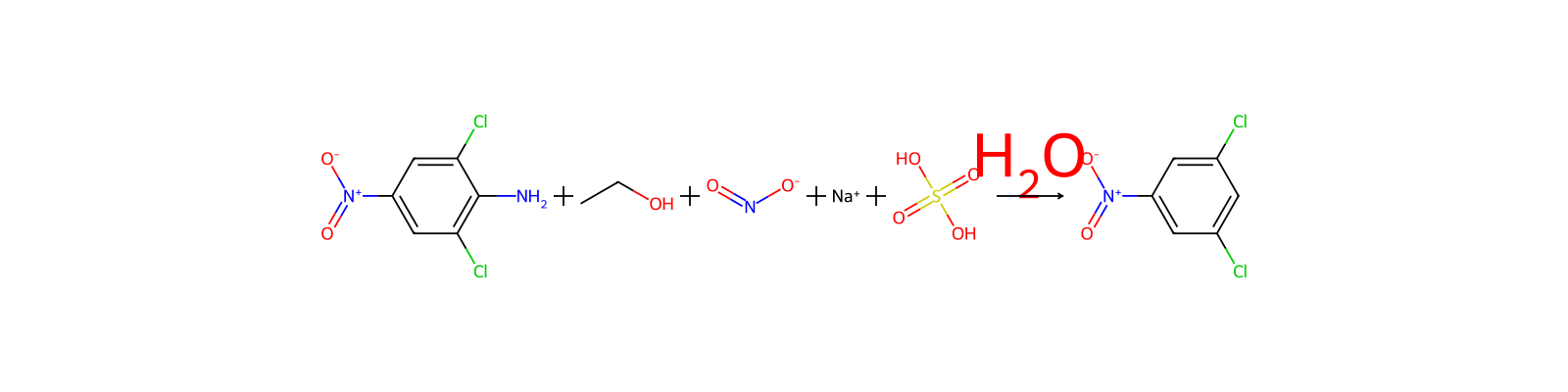
HRID 38550As reactant

618-62-2O=[N+]([O-])c1cc(Cl)cc(Cl)c1RNABGKOKSBUFHW-UHFFFAOYSA-N618-62-2DTXSID10606833.1 (calculated)
3.13
Safety information is for reference only and does not replace the supplier’s Safety Data Sheet (SDS), applicable regulations, or professional assessment.
Warning
H302 (52.3%): Harmful if swallowed [Warning Acute toxicity, oral]
P261, P264, P264+P265, P270, P271, P273, P280, P301+P317, P302+P352, P304+P340, P305+P351+P338, P319, P321, P330, P332+P317, P337+P317, P362+P364, P391, P403+P233, P405, and P501 (click each P-code to see the statement)
Aggregated GHS information provided per 86 reports by companies from 7 notifications to the ECHA C&L Inventory. Each notification may be associated with multiple companies.
Fresh air, rest.
Rinse and then wash skin with water and soap.
Rinse with plenty of water (remove contact lenses if easily possible).
Rinse mouth.
Personal protection: particulate filter respirator adapted to the airborne concentration of the substance. Sweep spilled substance into covered containers. If appropriate, moisten first to prevent dusting. Do NOT let this chemical enter the environment.
Cough.
Redness.
Uses1,3-Dichloro-5-nitrobenzene was used as an internal standard in the 1H nuclear magnetic resonance spectroscopic method for the assay of phenylbutazone and oxyphenbutazone.
General Description1,3-Dichloro-5-nitrobenzene was tested for fungitoxicity against Aspergillus niger, A. oryzae, Trichoderma viride, Myrothecium verrucaria and Trichophyton mentagrophytes.