
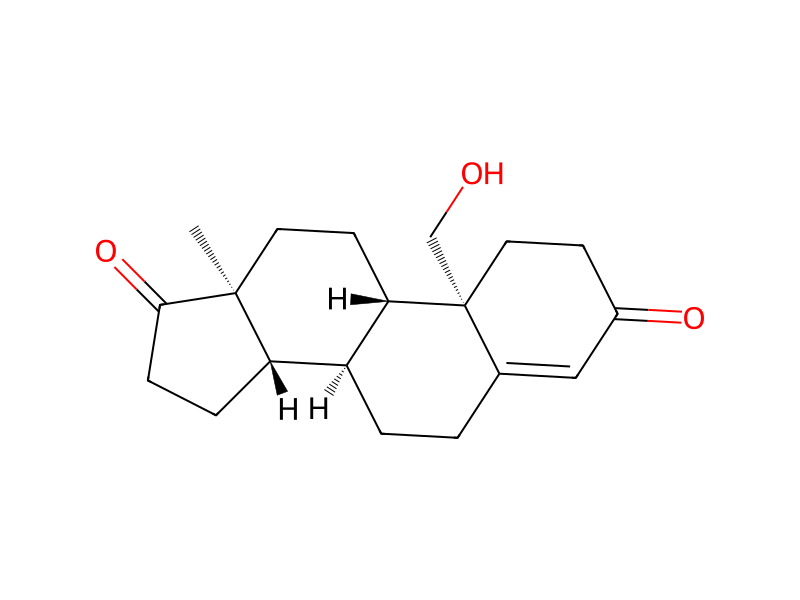
Basic information
- Standard SMILES
C[C@]12CC[C@H]3[C@@H](CCC4=CC(=O)CC[C@@]43CO)[C@@H]1CCC2=O- InChIKey
XGUHPTGEXRHMQQ-BGJMDTOESA-N- Molecular formula
- C19H26O3
- Average molar mass
- 302.4 g/mol
- Monoisotopic mass
- 302.18819469
Names & identifiers
- Preferred name
- 19-Hydroxyandrostenedione
- IUPAC
- (8R,9S,10S,13S,14S)-10-(hydroxymethyl)-13-methyl-2,6,7,8,9,11,12,14,15,16-decahydro-1H-cyclopenta[a]phenanthrene-3,17-dione
- English name
- 19-HYDROXY-4-ANDROSTENE-3,17-DIONE
- Molecular formula
- C19H26O3
- Molecular weight
- 302.41
Names & synonyms
19-Hydroxyandrost-4-ene-3,17-dione510-64-519-Hydroxy-4-androstene-3,17-dione19-HydroxyandrostenedioneAndrost-4-ene-3,17-dione, 19-hydroxy-NSC-74233A546CQ058419-HAEDJ117.011BCHEBI:27576DTXSID80199007C05290
Show more names
19-hydroxy-4-AndrostenedioneNSC 7423NSC 74233Dienogest Impurity 1Hydroxy-4-androsten-3Dienogest Impurity 16
RefChem:437595DTXCID70121498208-116-519-Hydroxyandrostendione4-Androsten-19-ol-3,17-dione(8R,9S,10S,13S,14S)-10-(hydroxymethyl)-13-methyl-2,6,7,8,9,11,12,14,15,16-decahydro-1H-cyclopenta[a]phenanthrene-3,17-dione4-Androstene-3,17-dione-19-ol19-Hydroxyandrost-4-enedione
Database identifiers
- CAS
510-64-5、61342-08-3- PubChem CID
- 252379
- ChEMBL
CHEMBL4517318- ChEBI
CHEBI:27576- UNII
- A546CQ0584
- EC Number
- 208-116-5
- Nikkaji
- J117.011B
Properties
Computed structural properties
- XLogP
- 1.5
- Topological polar surface area
- 54.4 Ų
- Hydrogen bond donors
- 1
- Hydrogen bond acceptors
- 3
- Rotatable bonds
- 1
- Heavy atoms
- 22
- Formal charge
- 0
- Complexity
- 563
Experimental & physicochemical properties
Physical DescriptionSolid
Physicochemical properties
- Melting point
- 168 · 168-169 °C(lit.)
- Boiling point
- 485.4 · 485.4±45.0 °C(Predicted)
- Density
- 1.19 · 1.19±0.1 g/cm3(Predicted)
- storage temp.
- -20 °C · Sealed in dry,Store in freezer, under -20°C
- solubility
- Chloroform (Slightly), Methanol (Slightly)
- form
- Solid
- pka
- 14.9 · 14.90±0.10(Predicted)
- color
- Off-White to Pale Yellow
- optical activity
- 190 · [α]/D +190±5°, c = 1 in chloroform
- BRN
- 2567249 · 2567249
- InChI
- InChI=1S/C19H26O3/c1-18-8-7-16-14(15(18)4-5-17(18)22)3-2-12-10-13(21)6-9-19(12,16)11-20/h10,14-16,20H,2-9,11H2,1H3/t14-,15-,16-,18-,19+/m0/s1
- InChIKey
- XGUHPTGEXRHMQQ-BGJMDTOESA-N
- SMILES
- C1(=O)C=C2[C@](CO)(CC1)[C@]1([H])[C@]([H])([C@@]3([H])[C@@](CC1)(C)C(=O)CC3)CC2
- CAS DataBase Reference
- 510 · 510-64-5(CAS DataBase Reference)
- FDA UNII
- 546 CQ0584 · A546CQ0584
- NIST Chemistry Reference
- 19 · 19-Hydroxyandrost-4-ene-3,17-dione(510-64-5)
- Symbol(GHS)
- 8 · GHS08
- Signal word
- Warning
- Hazard statements
- 361 · H361
- Precautionary statements
- 281 · P281
- Hazard Codes
- Xi,Xn
- Risk Statements
- 36 · 36/37/38-63
- Safety Statements
- 22 · 22-24/25-36/37/39-27-26-36/37
- WGK Germany
- 3 · 3
- HS Code
- 29372900 · 29372900
Safety & regulation
GHS classification
GHS Classification
Danger
H351 (15.2%): Suspected of causing cancer [Warning Carcinogenicity];H360 (15.2%): May damage fertility or the unborn child [Danger Reproductive toxicity];H361 (84.8%): Suspected of damaging fertility or the unborn child [Warning Reproductive toxicity];H362 (15.2%): May cause harm to breast-fed children [Reproductive toxicity, effects on or via lactation]
P203, P260, P263, P264, P270, P280, P318, P405, and P501 (click each P-code to see the statement)
Aggregated GHS information provided per 46 reports by companies from 4 notifications to the ECHA C&L Inventory. Each notification may be associated with multiple companies.;Information may vary between notifications depending on impurities, additives, and other factors. The percentage value in parenthesis indicates the notified classification ratio from companies that provide hazard codes. Only hazard codes with percentage values above 10% are shown. For more detailed information, please visit ECHA C&L website.
Hazard information
Hazard Classes and CategoriesCarc. 2 (15.2%);Repr. 1A (15.2%);Repr. 2 (84.8%);Lact. (15.2%)
Safety data
- wgk
- 3
- hs_code
- 29372900
- risk_code
- 36/37/38-63
- Signal word
- Warning
- Symbol(GHS)
- GHS08
- hazard_code
- Xi,Xn
- safety_code
- 22-24/25-36/37/39-27-26-36/37
- Hazard statements
- H361
- Precautionary statements
- P281
Chemistry & industry
Pharmacology
Tissue LocationsPlacenta;Testis
Cellular LocationsExtracellular;Membrane
Metabolite Pathways17-Beta Hydroxysteroid Dehydrogenase III Deficiency;Androgen and Estrogen Metabolism;Androstenedione Metabolism;Aromatase deficiency
Applications
Uses19-Hydroxyandrostendione is a novel substituted estrogen as aromatase inhibitor. It induces neuroendocrine trans-differentiation of prostate cancer cells via an ectopic olactory receptor.
Upstream & downstream products
Upstream raw materials
Downstream products
Suppliers50 total
湖北威德利化学试剂有限公司181-6332-1995 18062128043 · [email protected]
艾吉析科技(上海)有限公司17717235263 · [email protected]
上海麦克林生化科技股份有限公司021-50706066 15221275939 · [email protected]
江苏艾康生物医药研发有限公司025-58851090 19370895928 · [email protected]
山东海舟生物工程有限公司130-0567-0367 13006570367 · [email protected]
上海哲研生物科技有限公司021-18017610038 18017610038 · [email protected]
杭州品高化工有限公司0571-87658025 · [email protected]
湖北海克斯生化有限公司17362916295; 17362916295 · [email protected]
Hebei shuoxi biotechnology co. LTD+8613081092107
T&W GROUP021-61551611 13296011611 · [email protected]
湖北科乐精细化工有限公司027-59101668 19945030958 · [email protected]
Dayang Chem (Hangzhou) Co.,Ltd.+86-0571-88938639 17705817739 · [email protected]
南京兰亚化工贸易有限公司+86-25-8331-5620 · [email protected]
Hebei Yanxi Chemical Co., Ltd.+86-17531190177 · [email protected]
郑州鸿晟医药科技有限公司0371-55695890 15637198702 · [email protected]
江西瑞威尔生物科技有限公司400-880-2824 18107960669 · [email protected]
Syntechem Co.,Ltd[email protected]
湖南瑞威尔生物科技有限公司15608648206 13297919155 · [email protected]
江西瑞威尔生物科技有限公司18502728206 · [email protected]
安耐吉化学&3A(安徽泽升科技有限公司)021-58432009 400-005-6266 · [email protected]
安耐吉化学&3A(安徽泽升科技股份有限公司)400-0056266 · [email protected]
梯希爱(上海)化工贸易有限公司021-61109150 · [email protected]
湖北长耀生物科技有限公司17683887209 17683887209 · [email protected]
Cangzhou Wanyou New Material Technology Co.,Ltd18631714998 · [email protected]
上海维亦特生物科技有限公司15317051735 · [email protected]
上海景颜化工科技有限公司13817811078 · [email protected]
武汉丰泰威远科技有限公司+86-27-8746-5837 +86-18627785180 · [email protected]
武汉丰泰威远科技有限公司027-87465837 19945049750 · [email protected]
孝感深远化工有限公司15527621225; 15527621225 · [email protected]
天津希恩思生化科技有限公司400 638 7771 · [email protected]
Xiamen AmoyChem Co., Ltd+86-86-5926051114 · [email protected]
上海遐瑞医药科技有限公司+86 21 61551611
卡迪亚医药科技有限公司0371-86615086 18203638366 0371-86159066 13526786601
越林试剂021-62960152 · [email protected]
天成化工(江苏)有限公司0512-66387919 18662433356 · [email protected]
Xunteng International Trading Co.,Limited—
上海亚毓生物医药有限公司021-54370211 18051886391 · [email protected]
上海将来实业股份有限公司400-0066400 13621662912 · [email protected]
上海将来实业股份有限公司021-61552785 · [email protected]
上海悠宁资源化学科技有限公司021-50454025 18930054025
北京奥秘佳得医药科技有限公司+86-13522808617 · [email protected]
成都零六生物科技有限公司400-1166-196 13458535857 · [email protected]
上海永叶生物科技有限公司86-021-61559134 15921386130 · [email protected]
上海孚一生物科技有限公司+86 (21) 61124340
陕西缔都医药化工有限公司029-81024372 17792795018 · [email protected]
凯试(上海)科技有限公司021-50135380 · [email protected]
池州凯隆进出口贸易有限公司[email protected]
桦特昇生物科技(武汉)有限公司027-59207879 1972026995 18140587686 · [email protected]
天津阿尔塔科技有限公司022-6537-8550 15522853686 · [email protected]
上海皓之翔生物科技有限公司(原上海拓青化工有限公司)526763801 13301653310 · [email protected]
Additional notes
DefinitionChEBI: 19-hydroxyandrost-4-ene-3,17-dione is a 19-hydroxy steroid, a 3-oxo steroid, a 17-oxo steroid and an androstanoid. It has a role as a mouse metabolite.
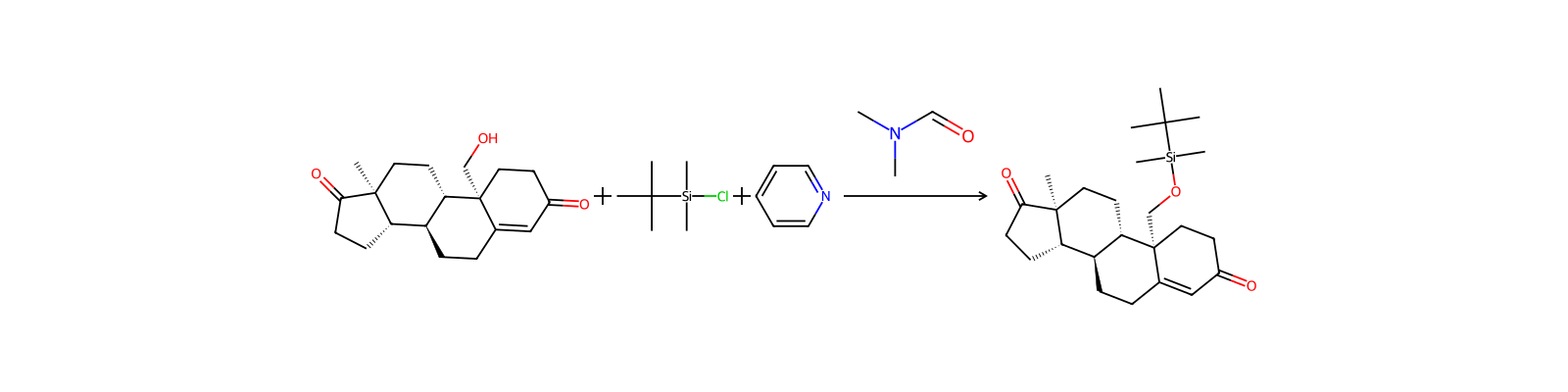
Related reactions
51 records




Linked notes
Loading…