
Nadh
HCID 439153
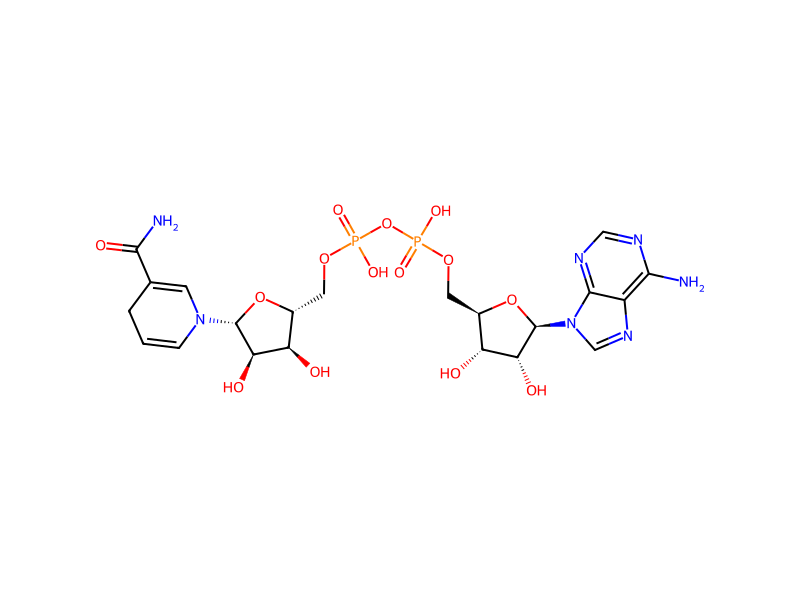
Basic information
- CAS
58-68-4- Standard SMILES
NC(=O)C1=CN([C@@H]2O[C@H](COP(=O)(O)OP(=O)(O)OC[C@H]3O[C@@H](n4cnc5c(N)ncnc54)[C@H](O)[C@@H]3O)[C@@H](O)[C@H]2O)C=CC1- InChIKey
BOPGDPNILDQYTO-NNYOXOHSSA-N- Molecular formula
- C21H29N7O14P2
- Average molar mass
- 665.4 g/mol
- Monoisotopic mass
- 665.12477262
Overview
NADH is a coenzyme found in all living cells; consists of two nucleotides joined through their 5'-phosphate groups, with one nucleotide containing an adenine base and the other containing nicotinamide. It has a role as a cofactor and a fundamental metabolite. It is a NAD and a NAD(P)H. It is a conjugate acid of a NADH(2-).
Names & identifiers
- Preferred name
- Nadh
- IUPAC
- [[(2R,3S,4R,5R)-5-(6-aminopurin-9-yl)-3,4-dihydroxyoxolan-2-yl]methoxy-hydroxyphosphoryl] [(2R,3S,4R,5R)-5-(3-carbamoyl-4H-pyridin-1-yl)-3,4-dihydroxyoxolan-2-yl]methyl hydrogen phosphate
- English name
- dihydrodiphosphopyridine nucleotide
- Molecular formula
- C21H29N7O14P2
- Molecular weight
- 665.44
Names & synonyms
NADHDPNH58-68-4beta-NADH1,4-Dihydronicotinamide adenine dinucleotideNADH2dihydronicotinamide adenine dinucleotideReduced nicotinamide adenine diphosphateReduced nicotinamide-adenine dinucleotideReduced Nicotinamide Adenine Dinucleotide[[(2R,3S,4R,5R)-5-(6-aminopurin-9-yl)-3,4-dihydroxyoxolan-2-yl]methoxy-hydroxyphosphoryl] [(2R,3S,4R,5R)-5-(3-carbamoyl-4H-pyridin-1-yl)-3,4-dihydroxyoxolan-2-yl]methyl hydrogen phosphate4J24DQ0916
Show more names
NICOTINAMIDE ADENINE DINUCLEOTIDEdihydrocozymaseReduced formβ-NADH, DPNH, NADHReduced codehydrase ITestosterone 17β-dehydrogenase
Nicotinamide-adenine dinucleotide, reducednicotinamide adenine dinucleotide (reduced)CHEBI:16908DTXSID30889320[({[(2R,3S,4R,5R)-5-(6-amino-9H-purin-9-yl)-3,4-dihydroxyoxolan-2-yl]methoxy}(hydroxy)phosphoryl)oxy]({[(2R,3S,4R,5R)-5-(3-carbamoyl-1,4-dihydropyridin-1-yl)-3,4-dihydroxyoxolan-2-yl]methoxy})phosphinic acidAdenosine 5'-(trihydrogen diphosphate), P'->5'-ester with 1,4-dihydro-1-beta-D-ribofuranosyl-3-pyridinecarboxamideNAD reduced(((((2R,3S,4R,5R)-5-(6-amino-9H-purin-9-yl)-3,4-dihydroxyoxolan-2-yl)methoxy)(hydroxy)phosphoryl)oxy)((((2R,3S,4R,5R)-5-(3-carbamoyl-1,4-dihydropyridin-1-yl)-3,4-dihydroxyoxolan-2-yl)methoxy))phosphinic acid
Properties
Computed structural properties
- XLogP
- -5.7
- Topological polar surface area
- 318 Ų
- Hydrogen bond donors
- 8
- Hydrogen bond acceptors
- 19
- Rotatable bonds
- 11
- Heavy atoms
- 44
- Formal charge
- 0
- Complexity
- 1,230
Experimental & physicochemical properties
DrugsPharmaceuticals -> Listed in ZINC15
Melting Point
140.0-142.0 °C
140.0 - 142.0 °C
Physical DescriptionSolid
Physicochemical properties
- Boiling point
- 1081.8 · 1081.8±75.0 °C(Predicted)
- Density
- 2.18 · 2.18±0.1 g/cm3(Predicted)
- solubility
- Water (Slightly)
- pka
- 1.13 · 1.13±0.50(Predicted)
- form
- Solid
- color
- White to Off-White
- ex/em
- 340 nm; · λex 340 nm; λem 466 nm
- Stability
- Light Sensitive, Temperature Sensitive
- InChIKey
- BOPGDPNILDQYTO-NNYOXOHSSA-N
- FDA UNII
- 4 J24DQ0916 · 4J24DQ0916
Safety & regulation
Safety information is for reference only and does not replace the supplier’s Safety Data Sheet (SDS), applicable regulations, or professional assessment.
Hazard information
Regulatory Information
Chemical: Adenosine 5â²-(trihydrogen diphosphate), Pâ².fwdarw.5â²-ester with 1,4-dihydro-1-.beta.-D-ribofuranosyl-3-pyridinecarboxamide
Adenosine 5'-(trihydrogen diphosphate), P'â5'-ester with 1,4-dihydro-1-.beta.-D-ribofuranosyl-3-pyridinecarboxamide, disodium salt: Does not have an individual approval but may be used under an appropriate group standard
Other Safety InformationEvaluation - Chemicals that are unlikely to require further regulation to manage risks to environment
Safety data
- tsca
- TSCA listed
Chemistry & industry
Pharmacology
Pharmacodynamics
A coenzyme composed of ribosylnicotinamide 5'-diphosphate coupled to adenosine 5'-phosphate by pyrophosphate linkage. It is found widely in nature and is involved in numerous enzymatic reactions in which it serves as an electron carrier by being alternately oxidized (NAD+) and reduced (NADH). The action of supplemental NADH is unclear. Oral NADH supplementation has been used to combat simple fatigue as well as such mysterious and energy-sapping disorders as chronic fatigue syndrome and fibromyalgia. Researchers are also studying the value of NADH supplements for improving mental function in people with Alzheimer's disease, and minimizing physical disability and relieving depression in people with Parkinson's disease. Some healthy individuals also take NADH supplements orally to improve concentration and memory capacity, as well as to increase athletic endurance. However, to date there have been no published studies to indicate that using NADH is in any way effective or safe for these purposes.
Mechanism of Action
NADH is synthesized by the body and thus is not an essential nutrient. It does require the essential nutrient nicotinamide for its synthesis, and its role in energy production is certainly an essential one. In addition to its role in the mitochondrial electron transport chain, NADH is produced in the cytosol. The mitochondrial membrane is impermeable to NADH, and this permeability barrier effectively separates the cytoplasmic from the mitochondrial NADH pools. However, cytoplasmic NADH can be used for biologic energy production. This occurs when the malate-aspartate shuttle introduces reducing equivalents from NADH in the cytosol to the electron transport chain of the mitochondria. This shuttle mainly occurs in the liver and heart.
Absorption, Distribution and ExcretionUnclear how much of an administered dose is absorbed.
Tissue LocationsBladder
Cellular LocationsEndoplasmic reticulum
Metabolite Pathways11-beta-hydroxylase deficiency (CYP11B1)
Related reactions
141 records

HRID 17763As reactant

HRID 27575As reactant

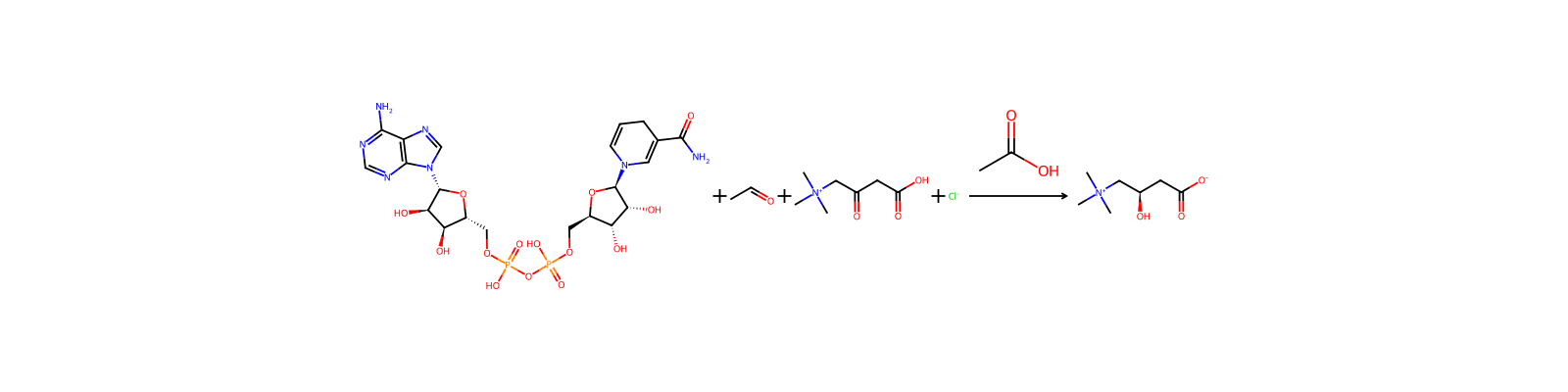
HRID 27577As reactant

HRID 27683As reactant

HRID 48903As reactant

HRID 58507As reactant