HomeMCPWorkbenchSkills
HomeWorkbenchNotificationsMe
llms.txt · MCP GuidePrivacy Policy · Terms of Service · Supportv1.8.3
  1. Home
  2. /Compound

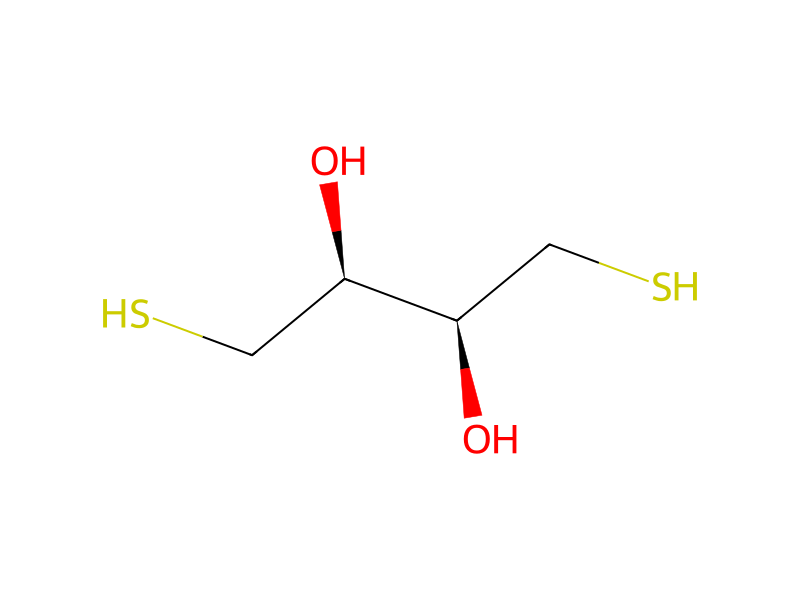
D-1,4-Dithiothreitol

HCID 446094
New reaction
Print
Basic informationOverviewNames & identifiersPropertiesSafety & regulationChemistry & industryRelated reactionsCompound notes
Substructure searchFind similar structures

Basic information

CAS
16096-97-2
Standard SMILES
O[C@H](CS)[C@H](O)CS
InChIKey
VHJLVAABSRFDPM-QWWZWVQMSA-N
Molecular formula
C4H10O2S2
Average molar mass
154.3 g/mol
Monoisotopic mass
154.0122219

Overview

D-1,4-dithiothreitol is a 1,4-dithiothreitol. It is an enantiomer of a L-1,4-dithiothreitol.

Names & identifiers

Preferred name
D-1,4-Dithiothreitol
IUPAC
(2S,3S)-1,4-bis(sulfanyl)butane-2,3-diol
English name
L-Dithiothreitol
Molecular formula
C4H10O2S2
Molecular weight
154.25

Names & synonyms

(2S,3S)-1,4-DIMERCAPTOBUTANE-2,3-DIOLD-1,4-DithiothreitolD-Dtt(2S,3S)-1,4-bis(sulfanyl)butane-2,3-diolCHEBI:42170RefChem:937663GlyTouCan:G52301ZXG52301ZXdl-DithiothreitolDL-1,4-Dithiothreitol27565-41-9(2S,3S)-1,4-disulfanylbutane-2,3-diol
Show more names
1,4-DITHIO-L-THREITOLL-DTTClelandsDTT (L-ISOMER)L-DithiothreitolDITHIOTHREITOL, L-L-CLELAND'S REAGENTL-1,4-DITHIOTHREITOLL-Dithiothreitol >DITHIOTHREITOL, L-(RG)
1,4-Dithio-dl-threitol35454-97-8MFCD00004877cis-2,3-Dihydroxy-1,4-butanedithiolDTT(+/-)-1,4-Dimercapto-2,3-butanediolDL-Dithiothreitol(DTT)M02712

Database identifiers

CAS
16096-97-2、27565-41-9、3483-12-3
PubChem CID
446094
DTXSID
DTXSID5041017
ChEMBL
CHEMBL1232392、CHEMBL47903
ChEBI
CHEBI:42170
EC Number
248-531-9
Nikkaji
J64.633D

Properties

Computed structural properties

XLogP
-0.4
Topological polar surface area
42.5 Ų
Hydrogen bond donors
4
Hydrogen bond acceptors
4
Rotatable bonds
3
Heavy atoms
8
Formal charge
0
Complexity
52

Experimental & physicochemical properties

Chemical ClassesOther Classes -> Sulfur Compounds (Alcohols)
DrugsPharmaceuticals -> Listed in ZINC15
Physical DescriptionWhite powder with an unpleasant odor; [Alfa Aesar MSDS]

Physicochemical properties

Melting point
51 °C · 51 °C
Boiling point
247.65 °C · 247.65°C (rough estimate)
Density
1.156 · 1.156 (estimate)
refractive index
26 ° · 26 ° (C=2.5, MeOH)
Flash point
110 °C · 110 °C
storage temp.
-20 °C · -20°C
solubility
2 O: · H2O: soluble50mg/mL, clear to hazy, colorless
form
solid
pka
9.28 · 9.28±0.10(Predicted)
color
White to Almost white
Water Solubility
2 O: · H2O: 50mg/mL, clear to hazy, colorless
BRN
2036371 · 2036371
InChI
1S/C4H10O2S2/c5-3(1-7)4(6)2-8/h3-8H,1-2H2/t3-,4-/m0/s1
InChIKey
VHJLVAABSRFDPM-IMJSIDKUSA-N
SMILES
O[C@@H](CS)[C@@H](O)CS
CAS DataBase Reference
16096 · 16096-97-2(CAS DataBase Reference)
UNSPSC Code
12352201 · 12352201
NACRES
25 · NA.25
Symbol(GHS)
7 · GHS07
Signal word
Warning
Hazard statements
302 · H302-H412
Precautionary statements
273 · P273-P301+P312+P330
PPE
95 · dust mask type N95 (US), Eyeshields, Gloves
Hazard Codes
Xn
Risk Statements
21 · 21/22-36/37/38
Safety Statements
26 · 26-36/37
RIDADR
3335 · UN 3335
WGK Germany
3 · 3
RTECS
1612000 · EK1612000
F
10 · 10-13-23
HS Code
2930.9 · 2930.90.9250
Storage Class
11 · 11 - Combustible Solids
Hazard Classifications
4 OralAquatic · Acute Tox. 4 OralAquatic Chronic 3

Safety & regulation

Safety information is for reference only and does not replace the supplier’s Safety Data Sheet (SDS), applicable regulations, or professional assessment.

GHS classification

GHS Classification · 6 items

Warning

H302 (98.1%): Harmful if swallowed [Warning Acute toxicity, oral]

P261, P264, P264+P265, P270, P271, P280, P301+P317, P302+P352, P304+P340, P305+P351+P338, P319, P321, P330, P332+P317, P337+P317, P362+P364, P403+P233, P405, and P501 (click each P-code to see the statement)

Aggregated GHS information provided per 106 reports by companies from 9 notifications to the ECHA C&L Inventory. Each notification may be associated with multiple companies.

Warning

H302 (97.5%): Harmful if swallowed [Warning Acute toxicity, oral]

Hazard information

Hazards Summary · 1 item

Causes change in righting reflex and alteration of operant conditioning in acute intraperitoneal studies of rats; Intraperitoneal LD50 (mouse) = 169 mg/kg; [RTECS] A skin and strong eye irritant; Toxic by ingestion; [Alfa Aesar MSDS] See 1,4-Dithiothreitol.

Hazard Classes and Categories · 2 items

Acute Tox. 4 (98.1%)

Acute Tox. 4 (97.5%)

Toxicology

Adverse EffectsNeurotoxin - Other CNS neurotoxin

Safety data

F
10-13-23
PPE
dust mask type N95 (US), Eyeshields, Gloves
wgk
3
rtecs
EK1612000
ridadr
UN 3335
hs_code
2930.90.9250
risk_code
21/22-36/37/38
Signal word
Warning
Symbol(GHS)
GHS07
hazard_code
Xn
safety_code
26-36/37
Storage Class
11 - Combustible Solids
Hazard statements
H302-H412
Hazard Classifications
Acute Tox. 4 OralAquatic Chronic 3
Precautionary statements
P273-P301+P312+P330

Chemistry & industry

Applications · 1 item

UsesL-DTT [(2R,3R)-1,4-dimercapto-2,3-butanediol; L-dithiothreitol], a chiral bidentate dithiol with two stereogenic centers, may be used in chiroptical response research. L-DDT is proposed as a stereoselective reducing agent for disulfide bridges in complex molecules.

Upstream & downstream products

Downstream products

4,5-dihydroxy-1,2-dithiane

Additional notes

DefinitionChEBI: L-1,4-dithiothreitol is a 1,4-dithiothreitol. It is an enantiomer of a D-1,4-dithiothreitol.

Related reactions

180 records
New reaction record
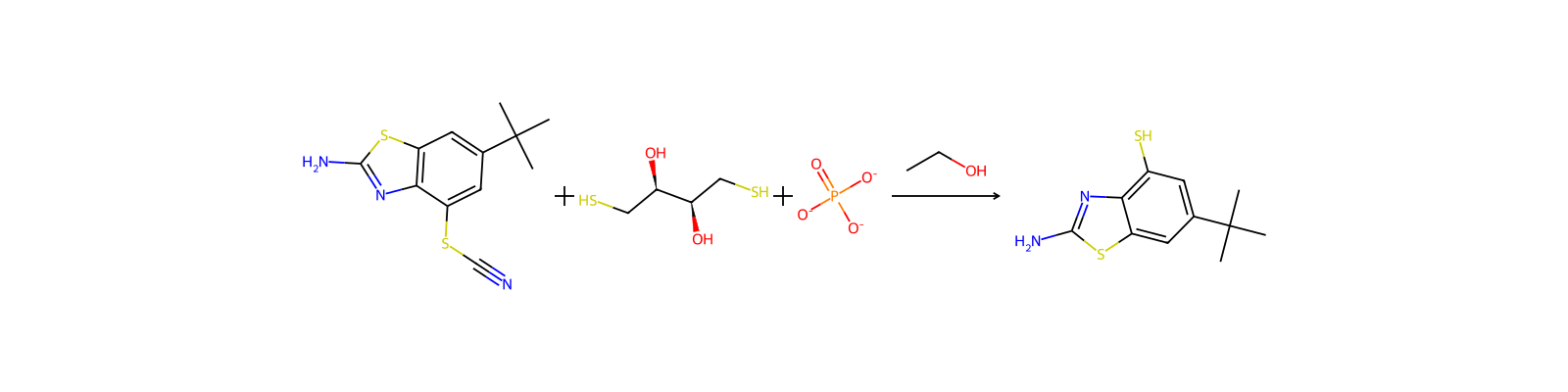
HRID 23459 reaction equation
HRID 23459As reactant
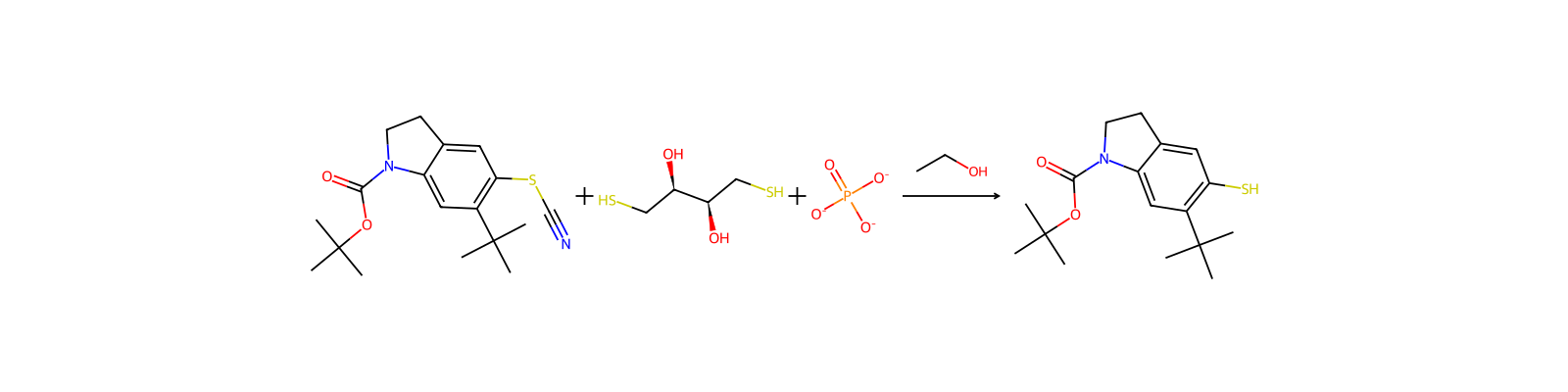
HRID 23460 reaction equation
HRID 23460As reactant
HRID 23461 reaction equation
HRID 23461As reactant
HRID 23463 reaction equation
HRID 23463As reactant
HRID 23478 reaction equation
HRID 23478As reactant
HRID 29134 reaction equation
HRID 29134As catalyst
HRID 36958 reaction equation
HRID 36958As reactant
HRID 37066 reaction equation
HRID 37066As reactant
PreviousPage 1 of 23

Compound notes

On this pageBasic informationOverviewNames & identifiersPropertiesSafety & regulationChemistry & industryRelated reactionsCompound notes