HomeMCPWorkbenchSkills
HomeWorkbenchNotificationsMe
llms.txt · MCP GuidePrivacy Policy · Terms of Service · Supportv1.8.0
  1. Home
  2. /Compound

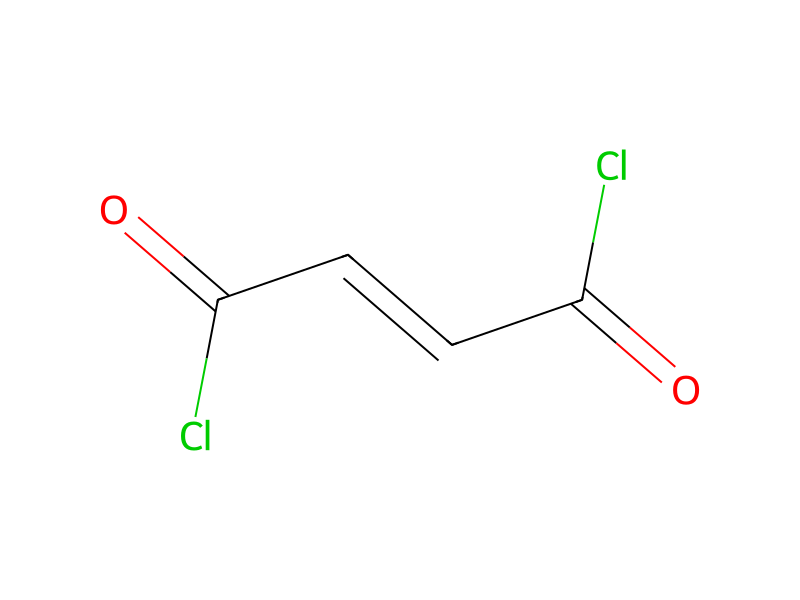
Fumaryl chloride

HCID 5325504
New noteNew reactionRequest quotes
Print preview

Completing data — refresh the page later to see the latest
Basic informationOverviewNames & identifiersPropertiesSafety & regulationChemistry & industryRelated reactionsCompound notes
Substructure searchFind similar structures

Basic information

CAS
627-63-4
Standard SMILES
O=C(Cl)/C=C/C(=O)Cl
InChIKey
ZLYYJUJDFKGVKB-OWOJBTEDSA-N
Molecular formula
C4H2Cl2O2
Average molar mass
152.96 g/mol
Monoisotopic mass
151.94318466

Overview

Fumaryl chloride appears as a straw colored fuming liquid with a pungent odor. Vapors irritate the eyes and mucous membranes. Corrosive to metals and tissue.

Names & identifiers

Preferred name
Fumaryl chloride
IUPAC
(E)-but-2-enedioyl dichloride
English name
Fumaryl chloride
Molecular formula
C4H2Cl2O2
Molecular weight
152.96

Names & synonyms

FUMARYL CHLORIDE627-63-4Fumaroyl dichlorideFumaroyl chlorideFumarylchloridfumaryl dichlorideChlorure de fumaryle2-Butenedioyl dichloride, (E)-2-Butenedioyl dichloride, (2E)-Dichlorid kyseliny fumaroveTL 189Fumaric acid dichloride
Show more names
trans-2-Butenedioyl dichloridetl189fumarylFumarylChoridefumaroylchloride
DTXSID3033519B95L4812RGFUMARIC DICHLORIDEFUMARIC ACID CHLORIDEDTXCID1013519RefChem:607705211-005-4(E)-but-2-enedioyl dichloride

Database identifiers

CAS
627-63-4
PubChem CID
5325504
DTXSID
DTXSID3033519
ChEMBL
CHEMBL2143883
UNII
B95L4812RG
EC Number
211-005-4
Nikkaji
J517G、J581.481B

Properties

Computed structural propertiesFilling in

XLogP
1.5
Topological polar surface area
34.1 Ų
Hydrogen bond donors
0
Hydrogen bond acceptors
2
Rotatable bonds
2
Heavy atoms
8
Formal charge
0
Complexity
123

Experimental & physicochemical properties

Chemical Classes · 2 items

Toxic Gases & Vapors -> Acid Halides

Corrosives

SpringerMaterials PropertiesSchoenflies notation
Vapor Pressure2.07 [mmHg]
Physical Description · 2 items

Fumaryl chloride appears as a straw colored fuming liquid with a pungent odor. Vapors irritate the eyes and mucous membranes. Corrosive to metals and tissue.

Fuming straw-colored liquid with a pungent odor; [CAMEO] Colorless liquid with an acrid odor; [Alfa Aesar MSDS]

Physicochemical properties

Melting point
-2 °C · -2 °C
Boiling point
164 °C · 164 °C
Density
1.41 · 1.41
refractive index
1.5 · 1.50
Flash point
77 °C · 77 °C
storage temp.
2 · 2-8°C

Safety & regulation

Safety information is for reference only and does not replace the supplier’s Safety Data Sheet (SDS), applicable regulations, or professional assessment.

GHS classification

GHS Classification · 4 items

Danger

H302 (100%): Harmful if swallowed [Warning Acute toxicity, oral]

P260, P261, P264, P270, P271, P280, P301+P317, P301+P330+P331, P302+P352, P302+P361+P354, P304+P340, P305+P354+P338, P316, P317, P321, P330, P362+P364, P363, P405, and P501 (click each P-code to see the statement)

Aggregated GHS information provided per 47 reports by companies from 5 notifications to the ECHA C&L Inventory. Each notification may be associated with multiple companies.

Hazard information

Regulatory Information · 2 items

Fumaryl chloride: Does not have an individual approval but may be used under an appropriate group standard

The New Jersey Worker and Community Right to Know Act requires public and private employers to provide information about hazardous substances at their workplaces. (N.J.S.A. 34:5A-1 et. seq.)

DOT LabelCorrosive
Fire Hazards · 2 items

Excerpt from ERG Guide 156 [Substances - Toxic and/or Corrosive (Combustible / Water-Sensitive)]:

· Combustible material: may burn but does not ignite readily.

Health Hazards · 2 items

Excerpt from ERG Guide 156 [Substances - Toxic and/or Corrosive (Combustible / Water-Sensitive)]:

· TOXIC and/or CORROSIVE; inhalation, ingestion or contact (skin, eyes) with vapors, dusts or substance may cause severe injury, burns or death.

Hazards Summary · 1 item

A severe skin and eye irritant; Causes musculoskeletal changes in inhalation lethal-concentration studies of mice; [RTECS] Corrosive to tissue; Vapor causes eye and mucous membrane irritation; [CAMEO] Reacts with water; Causes burns; Inhalation may cause corrosive injuries to upper respiratory tract and lungs; Harmful by ingestion, inhalation, and skin absorption; [Alfa Aesar MSDS]

Chemistry & industry

Uses & manufacturing

General Manufacturing Information2-Butenedioyl dichloride, (2E)-: ACTIVE
Applications · 3 items

UsesChemical intermediate for pharmaceuticals, dyestuffs, and insecticides.

UsesFumaryl chloride was used in the preparation of high molecular weight poly(propylene fumarate). The photodissociation dynamics of fumaryl chloride was studied. It is used in agrochemicals and pharmaceuticals manufacturing. Also used as an intermediate for dyes, textile auxiliaries and peroxide compounds. It is an acid halide building block.

General DescriptionFumaryl chloride appears as a straw colored fuming liquid with a pungent odor. Vapors irritate the eyes and mucous membranes. Corrosive to metals and tissue.

Preparation methods · 1 item

PreparationFumaryl chloride has been prepared from fumaric acid and phthaloyl chloride, from maleic acid by the action of thionyl chloride in the presence of zinc chloride, and from maleic anhydride by the use of phthaloyl chloride in the presence of zinc chloride.Org. Synth. 1940, 20, 51DOI: 10.15227/orgsyn.020.0051

Upstream & downstream products

Upstream raw materials

Maleic anhydrideZinc chlorideFumaric acidPhosphorus pentachloridePhthaloyl dichlorideThionyl chloride

Related reactions

16 records
New reaction record
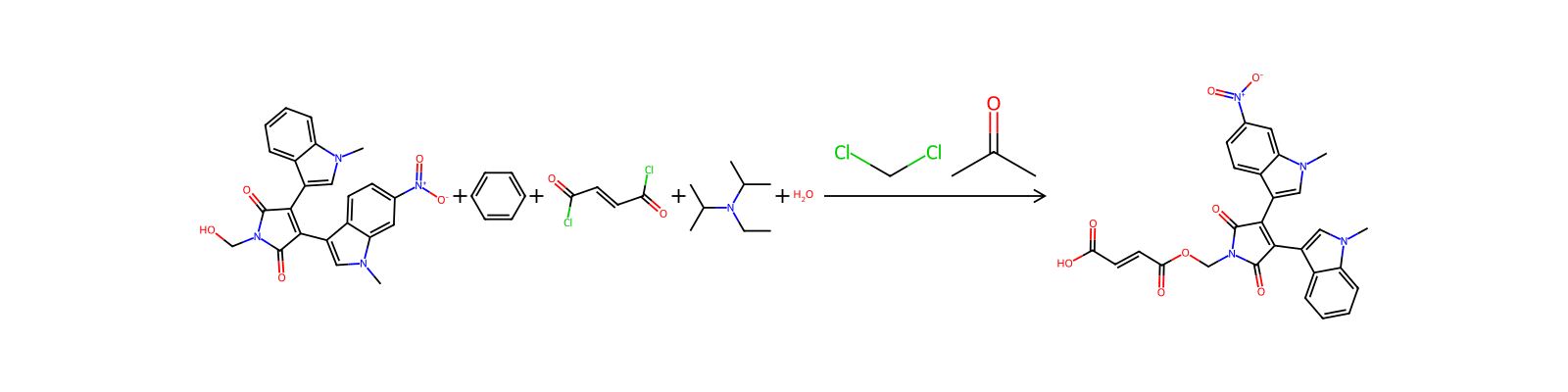
HRID 790 reaction equation
HRID 790As reactantuspto-grants-1998_03
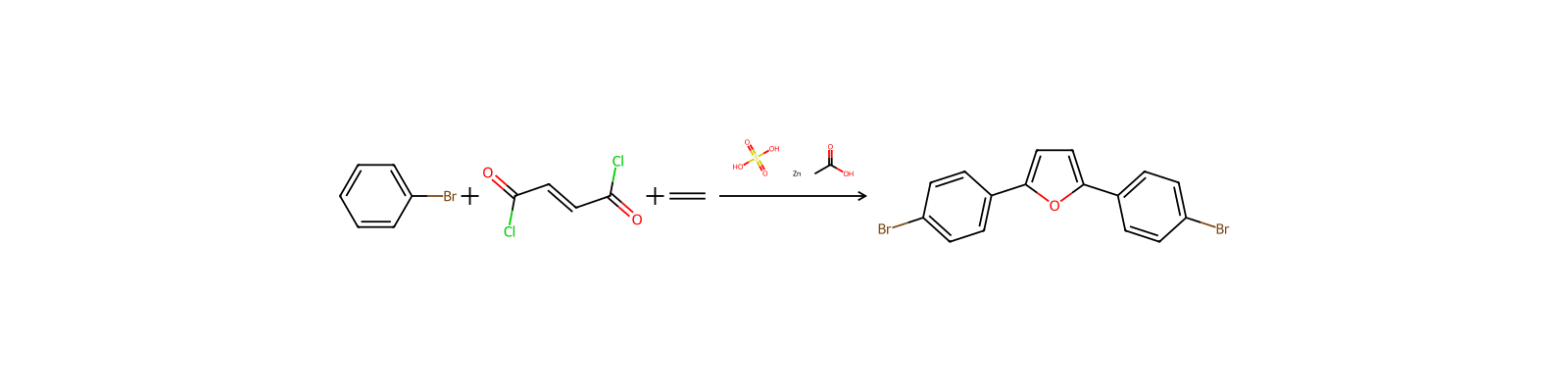
HRID 66047 reaction equation
HRID 66047As reactantuspto-grants-1978_12
HRID 84201 reaction equation
HRID 84201As reactantuspto-grants-2014_09
HRID 234112 reaction equation
HRID 234112As reactantuspto-grants-1997_01
HRID 263656 reaction equation
HRID 263656As reactantuspto-grants-1997_07
HRID 411770 reaction equation
HRID 411770As reactantuspto-grants-2003_05
HRID 1378285 reaction equation
HRID 1378285As reactantuspto-grants-1997_09
HRID 1404342 reaction equation
HRID 1404342As reactantuspto-grants-2014_12
Page 1 of 2

Compound notes

Loading…

On this pageBasic informationOverviewNames & identifiersPropertiesSafety & regulationChemistry & industryRelated reactionsCompound notes
More actions
New noteNew reactionRequest quotes
form
clear liquid
Specific Gravity
1.415 · 1.415 (20/4℃)
color
Colorless to Light orange to Yellow
Water Solubility
decomposes
Sensitive
Moisture Sensitive
BRN
1721342 · 1721342
InChI
1S/C4H2Cl2O2/c5-3(7)1-2-4(6)8/h1-2H/b2-1+
InChIKey
ZLYYJUJDFKGVKB-OWOJBTEDSA-N
SMILES
ClC(=O)\C=C\C(Cl)=O
CAS DataBase Reference
627 · 627-63-4(CAS DataBase Reference)
EWG's Food Scores
1 · 1
FDA UNII
95 L4812RG · B95L4812RG
NIST Chemistry Reference
Fumaryl chloride(627-63-4)
EPA Substance Registry System
2 · 2-Butenedioyl dichloride, (2E)- (627-63-4)
UNSPSC Code
12352100 · 12352100
NACRES
22 · NA.22
Symbol(GHS)
5 · GHS05,GHS07
Signal word
Danger
Hazard statements
302 · H302+H312-H314-H227-H290
Precautionary statements
501 · P501-P270-P210-P234-P264-P280-P370+P378-P390-P362+P364-P303+P361+P353-P301+P330+P331-P301+P312+P330-P304+P340+P310-P305+P351+P338+P310-P403+P235-P406-P405
PPE
Faceshields, Gloves, Goggles, type ABEK (EN14387) respirator filter
Hazard Codes
C
Risk Statements
20 · 20/21/22-34-37-29-36/37-14
Safety Statements
26 · 26-36/37/39-45-8-27
RIDADR
1780 · UN 1780
WGK Germany
3 · 3
RTECS
2800000 · LT2800000
F
21 · 21
TSCA
TSCA listed
HazardClass
8 · 8
PackingGroup
II
HS Code
2917190090 · 2917190090
Storage Class
8 A · 8A - Combustible corrosive hazardous materials
Hazard Classifications
4 DermalAcute · Acute Tox. 4 DermalAcute Tox. 4 OralSkin Corr. 1B
Limited Quantities
1 L · 1.0 L (0.3 gallons) (liquid) or 1 Kg (2.2 lbs) (solid)
Excepted Quantities
Max Inner Pack (30g or 30ml) and Max Outer Pack (500g or 500ml)
DOT ID and Guide1780 156
Reactive GroupHydrocarbons, Aliphatic Unsaturated
Reactivity AlertsAir-Reactive
Reactivity Profile · 1 item

FUMARYL CHLORIDE is incompatible with strong oxidizing agents, alcohols, amines and other bases. May react vigorously or explosively if mixed with diisopropyl ether or other ethers in the presence of trace amounts of metal salts [J. Haz. Mat., 1981, 4, 291].

DOT Hazard Classification · 4 items

Fumaryl chloride

UN1780

Class 8 Corrosive material (49 eCFR § 173.136)

PG II: the degree of danger presented by the material is medium

Air and Water ReactionsFumes in moist air. The liquid very slowly reacts exothermically with water to form hydrogen chloride.
Hazard Classes and Categories · 2 items

Acute Tox. 4 (100%)

Corrosives, Flammable agents - 2nd degree, Reactive agents - 2nd degree

Safety & protection

Fire FightingExcerpt from ERG Guide 156 [Substances - Toxic and/or Corrosive (Combustible / Water-Sensitive)]:
Accidental Release Measures · 2 items

· CALL 911. Then call emergency response telephone number on shipping paper. If shipping paper not available or no answer, refer to appropriate telephone number listed on the inside back cover.

· ELIMINATE all ignition sources (no smoking, flares, sparks or flames) from immediate area.

First Aid · 2 items

Excerpt from ERG Guide 156 [Substances - Toxic and/or Corrosive (Combustible / Water-Sensitive)]:

General First Aid:

Exposure Control and Personal Protection· Wear positive pressure self-contained breathing apparatus (SCBA).
Nonfire Spill ResponseExcerpt from ERG Guide 156 [Substances - Toxic and/or Corrosive (Combustible / Water-Sensitive)]:
Isolation and Evacuation · 2 items

Excerpt from ERG Guide 156 [Substances - Toxic and/or Corrosive (Combustible / Water-Sensitive)]:

Immediate precautionary measure

Personal Protective Equipment (PPE)Excerpt from ERG Guide 156 [Substances - Toxic and/or Corrosive (Combustible / Water-Sensitive)]:
Emergency Response Planning Guidelines· Note: Most foams will react with the material and release corrosive/toxic gases.

Toxicology

Adverse EffectsDermatotoxin - Skin burns.
Toxicity DataLCLo (rat) = 500 ppm/4hr

Safety data

F
21
PPE
Faceshields, Gloves, Goggles, type ABEK (EN14387) respirator filter
wgk
3
tsca
TSCA listed
rtecs
LT2800000
ridadr
UN 1780
hs_code
2917190090
risk_code
20/21/22-34-37-29-36/37-14
Signal word
Danger
Symbol(GHS)
GHS05,GHS07
hazard_code
C
safety_code
26-36/37/39-45-8-27
hazard_class
8
Storage Class
8A - Combustible corrosive hazardous materials
packing_group
II
Hazard statements
H302+H312-H314-H227-H290
Limited Quantities
1.0 L (0.3 gallons) (liquid) or 1 Kg (2.2 lbs) (solid)
Excepted Quantities
Max Inner Pack (30g or 30ml) and Max Outer Pack (500g or 500ml)
Hazard Classifications
Acute Tox. 4 DermalAcute Tox. 4 OralSkin Corr. 1B
Precautionary statements
P501-P270-P210-P234-P264-P280-P370+P378-P390-P362+P364-P303+P361+P353-P301+P330+P331-P301+P312+P330-P304+P340+P310-P305+P351+P338+P310-P403+P235-P406-P405

Downstream products

trans-1,2-Dibenzoylethylene2,4-Dibromomesitylene(E)-2,2'-vinylenebis[5-methylbenzoxazole]Bis(2,2,2-trifluoroethyl)maleate(Z)-4-((4-acetamidophenyl)amino)-4-oxobut-2-enoic acid2-Butene-1,4-dione,1,4-bis(4-chlorophenyl)-Dyclonine Impurity 3bis(2,4,6-tribromophenyl) fumarate