HomeMCPWorkbenchSkills
HomeWorkbenchNotificationsMe
llms.txt · MCP GuidePrivacy Policy · Terms of Service · Supportv1.8.0
  1. Home
  2. /Compound

Calcium Acetate

HCID 6116
New noteNew reactionRequest quotes
Print preview

Completing data — refresh the page later to see the latest
Basic informationOverviewNames & identifiersPropertiesSafety & regulationChemistry & industryRelated reactionsCompound notes
Substructure searchFind similar structures

Basic information

CAS
62-54-4
Standard SMILES
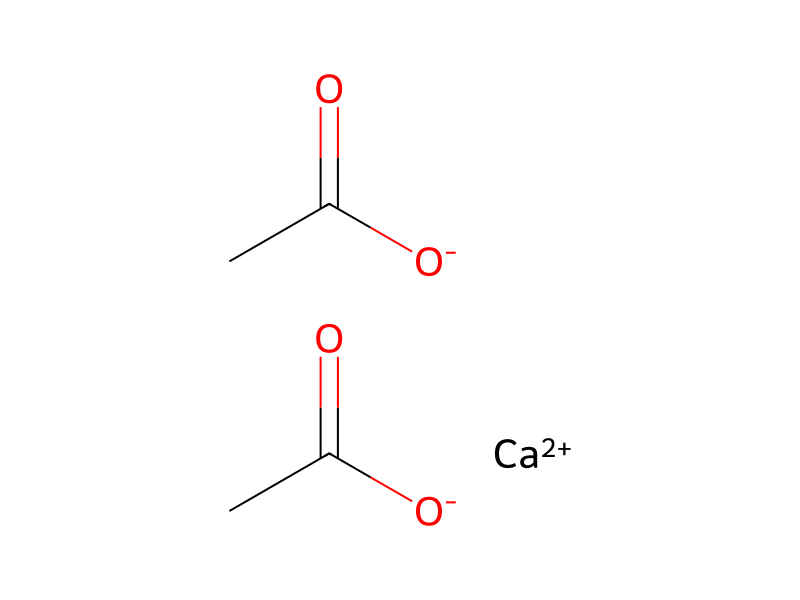
CC(=O)[O-].CC(=O)[O-].[Ca+2]
InChIKey
VSGNNIFQASZAOI-UHFFFAOYSA-L
Molecular formula
C4H6O4.Ca
Average molar mass
158.17 g/mol
Monoisotopic mass
157.98919965

Overview

Calcium acetate is the calcium salt of acetic acid. It is used, commonly as a hydrate, to treat hyperphosphataemia (excess phosphate in the blood) in patients with kidney disease: the calcium ion combines with dietary phosphate to form (insoluble) calcium phosphate, which is excreted in the faeces. It has a role as a chelator. It contains an acetate.

Names & identifiers

Preferred name
Calcium Acetate
IUPAC
calcium diacetate
English name
Calcium acetate
Molecular formula
C4H6CaO4
Molecular weight
158.17

Names & synonyms

Calcium acetate62-54-4Calcium diacetateAcetic acid, calcium saltLime acetatePhosLoLime pyroligniteAcetate of limeTeltozanBrown acetateGray Acetate of LimeBrown Acetate of Lime
Show more names
Calcium Acetate AnhydrousFEMA 2228grayacetatelimeacetatevinegarsaltsbrownacetateMAGGRAN(R) CA
PhoslyraSorbo-calcionGray acetatePhoslo Gelcapscalcium ethanoateFEMA No. 2228EliphosCalcarea acetica

Database identifiers

CAS
62-54-4
PubChem CID
6116
DTXSID
DTXSID0020234
ChEMBL
CHEMBL1200800
ChEBI
CHEBI:3310
UNII
Y882YXF34X
EC Number
200-540-9
Nikkaji
J4.823B

Properties

Computed structural propertiesFilling in

Topological polar surface area
80.3 Ų
Hydrogen bond donors
0
Hydrogen bond acceptors
4
Rotatable bonds
0
Heavy atoms
9
Formal charge
0
Complexity
25.5

Experimental & physicochemical properties

Chemical ClassesMetals -> Organic Acids, Metal Salts
Cosmetics · 2 items

Cosmetic ingredients (Calcium Acetate) -> CIR (Cosmetic Ingredient Review)

Viscosity controlling

pH · 2 items

6,0-9,0 (10 % aqueous solution)

0.2 molar aq soln: 7.6 /Monohydrate form/

OdorSLIGHT ODOR OF ACETIC ACID
Food AdditivesCOLOR OR COLORING ADJUNCT, FIRMING AGENT, FLAVORING AGENT OR ADJUVANT, PH CONTROL AGENT, PROCESSING AID, SEQUESTRANT, STABILIZER OR THICKENER, TEXTURIZER -> FDA Substance added to food
Density · 3 items

1.50 kg/l

1.5 g/cm³

1.5 @25 °C

Color/Form · 3 items

COLORLESS CRYSTALS

Rod-shaped crystals

White, hydrogroscopic, crystalline solid

Solubility · 3 items

37.4 G IN 100 CC OF WATER @ 0 °C; 29.7 G IN 100 CC OF WATER @ 100 °C; SLIGHTLY SOL IN ALCOHOL

Safety & regulation

Safety information is for reference only and does not replace the supplier’s Safety Data Sheet (SDS), applicable regulations, or professional assessment.

GHS classification

GHS Classification · 5 items

This chemical does not meet GHS hazard criteria for 88.9% (503 of 566) of all reports.

Warning

H315 (11%): Causes skin irritation [Warning Skin corrosion/irritation]

P264, P264+P265, P280, P302+P352, P305+P351+P338, P321, P332+P317, P337+P317, and P362+P364 (click each P-code to see the statement)

Aggregated GHS information provided per 566 reports by companies from 7 notifications to the ECHA C&L Inventory. Each notification may be associated with multiple companies.

Hazard information

Regulatory Information · 5 items

Chemical: Acetic acid, calcium salt (2:1)

Directive (EC) No 46/2002

Acetic acid, calcium salt (2:1) is listed on the EPA's Chemical Data Reporting (CDR) system. Manufacturers and importers of Acetic acid, calcium salt (2:1) are required to report information about their production and use of this chemical to the EPA under the Toxic Substances Control Act (TSCA). (40 eCFR Part 711)

Status: Active Update: 27-04-2023 https://echa.europa.eu/registration-dossier/-/registered-dossier/13608

Calcium acetate: Non hazardous

Other Safety InformationIMAP assessments - Acetic acid, calcium salt: Human health tier I assessment
Fire HazardsCombustible under specific conditions.
Hazards SummaryClassified as generally recognized as safe (GRAS) in food; [HSDB] Poisonous by intravenous route; IV LD50 (mouse) = 52 mg/kg; [Sax] A skin, eye, and respiratory tract irritant; [ICSC] An irritant; [MSDSonline] See Calcium.
FDA Requirements · 3 items

Substance added directly to human food affirmed as generally recognized as safe (GRAS).

Chemistry & industry

Pharmacology

ATC Code · 2 items

V - Various

QV - Various

Pharmacodynamics · 1 item

Patients with advanced renal insufficiency (creatinine clearance less than 30 ml/min) exhibit phosphate retention and some degree of hyperphosphatemia. The retention of phosphate plays a pivotal role in causing secondary hyperparathyroidism associated with osteodystrophy, and soft-tissue calcification. The mechanism by which phosphate retention leads to hyperparathyroidism is not clearly delineated. Therapeutic efforts directed toward the control of hyperphosphatemia include reduction in the dietary intake of phosphate, inhibition of absorption of phosphate in the intestine with phosphate binders, and removal of phosphate from the body by more efficient methods of dialysis. The rate of removal of phosphate by dietary manipulation or by dialysis is insufficient. Dialysis patients absorb 40% to 80% of dietary phosphorus. Therefore, the fraction of dietary phosphate absorbed from the diet needs to be reduced by using phosphate binders in most renal failure patients on maintenance dialysis. Calcium acetate when taken with meals combines with dietary phosphate to form insoluble calcium phosphate which is excreted in the feces. Maintenance of serum phosphorus below 6.0 mg/dl is generally considered as a clinically acceptable outcome of treatment with phosphate binders. Calcium acetate is highly soluble at neutral pH, making the calcium readily available for binding to phosphate in the proximal small intestine.

Mechanism of ActionCalcium acetate and other calcium salts are phosphate binders. They work by binding with the phosphate in the food you eat, so that it is eliminated from the body without being absorbed.
FDA Pharmacological Classification · 4 items

CALCAREA ACETICA

Increased Coagulation Factor Activity [PE]; Blood Coagulation Factor [EPC]; Cations, Divalent [CS]; Calcium [CS]

CALCIUM ACETATE

Blood Coagulation Factor [EPC]; Phosphate Binder [EPC]; Increased Coagulation Factor Activity [PE]; Phosphate Chelating Activity [MoA]; Calcium [CS]; Cations, Divalent [CS]

MeSH Pharmacological ClassificationChemicals that bind to and remove ions from solutions. Many chelating agents function through the formation of COORDINATION COMPLEXES with METALS.

Related reactions

58 records
New reaction record
HRID 258176 reaction equation
HRID 258176As productuspto-grants-1993_11
HRID 258177 reaction equation
HRID 258177As productuspto-grants-1993_11
HRID 321904 reaction equation
HRID 321904As reactantuspto-grants-2001_04
HRID 326947 reaction equation
HRID 326947As reactantuspto-grants-1993_12
HRID 326948 reaction equation
HRID 326948As reactantuspto-grants-1993_12
HRID 328303 reaction equation
HRID 328303As reactantuspto-grants-1977_04
HRID 359340 reaction equation
HRID 359340As reactantuspto-grants-1991_03
HRID 359651 reaction equation
HRID 359651As reactantuspto-grants-1991_03
Page 1 of 8

Compound notes

Loading…

On this pageBasic informationOverviewNames & identifiersPropertiesSafety & regulationChemistry & industryRelated reactionsCompound notes
More actions
New noteNew reactionRequest quotes

Practically insol in acetone and benzene

Solubility in water: very good

Human Drugs · 2 items

FDA approved drugs -> Active ingredient

FDA approved drugs -> Active ingredient

Decomposition · 2 items

When heated to decomposition ... emits acrid smoke and fumes.

160 °C

Melting Point> 160 °C
Food Contact SubstancesFCS -> FDA Inventory of Food Contact Substances Listed in 21 CFR

Physicochemical properties

Melting point
160 °C · 160°C (dec.)
Density
1 · 1,5 g/cm3
refractive index
1.55 · 1.5500
FEMA
2228 · 2228 | CALCIUM ACETATE
Flash point
160 °C · 160°C
storage temp.
Hygroscopic, Room Temperature, under inert atmosphere
solubility
2 O: · H2O: 1 M at 20 °C, clear, colorless
form
Powder
color
white
Specific Gravity
1.5 · 1.50
PH
8 · 8(1 mM solution);8.43(10 mM solution);8.77(100 mM solution);9.13(1000 mM solution)
Odor
mild acetic
Odor Type
acetic
Water Solubility
soluble
Decomposition
160 · 160 ºC
Stability
Stable. Non-flammable. Incompatible with strong oxidizing agents.
Major Application
pharmaceutical (small molecule)
Cosmetics Ingredients Functions
VISCOSITY CONTROLLINGFRAGRANCE
Cosmetic Ingredient Review (CIR)
Calcium acetate (62-54-4)
InChI
1S/2C2H4O2.Ca/c2*1-2(3)4;/h2*1H3,(H,3,4);/q;;+2/p-2
InChIKey
VSGNNIFQASZAOI-UHFFFAOYSA-L
SMILES
CC(=O)O[Ca]OC(C)=O
LogP
-0.29 · -0.29
CAS DataBase Reference
62 · 62-54-4(CAS DataBase Reference)
SCOGS (Select Committee on GRAS Substances)
Calcium acetate
Substances Added to Food (formerly EAFUS)
CALCIUM ACETATE
FDA 21 CFR
175.3 · 175.300; 181.29
EWG's Food Scores
1 · 1
FDA UNII
882 YXF34X · Y882YXF34X
ATC code
3 AE07 · V03AE07
EPA Substance Registry System
Calcium acetate (62-54-4)
UNSPSC Code
41116107 · 41116107
NACRES
24 · NA.24
Symbol(GHS)
7 · GHS07
Signal word
Warning
Hazard statements
315 · H315-H335-H319
Precautionary statements
264 · P264-P280-P305+P351+P338-P337+P313P-P264-P280-P302+P352-P321-P332+P313-P362
Hazard Codes
Xi
Risk Statements
36 · 36/37/38
Safety Statements
26 · 26-36
WGK Germany
1 · 1
RTECS
7525000 · AF7525000
TSCA
TSCA listed
HS Code
29152990 · 29152990
Storage Class
13 · 13 - Non Combustible Solids
Hazardous Substances Data
62 · 62-54-4(Hazardous Substances Data)
REACH Registrations
Active

Calcium acetate is an indirect food additive for use as a component of resinous and polymeric coatings.

Calcium acetate used as a sequestrant is generally recognized as safe when used in accordance with good manufacturing or feeding practice.

EPA Safer ChemicalChemical: Calcium acetate
Chemical DangersDecomposes above 160 °C . This produces acetone vapour and calcium carbonate. Reacts violently with strong acids. This produces acetic acid fumes.
Hazard Classes and CategoriesSkin Irrit. 2 (11%)

Safety & protection

Fire FightingUse water spray, powder.
First Aid Measures · 4 items

Fresh air, rest.

Rinse and then wash skin with water and soap.

First rinse with plenty of water for several minutes (remove contact lenses if easily possible), then refer for medical attention.

Rinse mouth. Give one or two glasses of water to drink. Refer for medical attention .

Safe StorageSeparated from strong acids. Dry. Well closed.
Storage ConditionsKEEP WELL CLOSED.
Disposal Methods · 1 item

SRP: At the time of review, criteria for land treatment or burial (sanitary landfill) disposal practices are subject to significant revision. Prior to implementing land disposal of waste residue (including waste sludge), consult with environmental regulatory agencies for guidance on acceptable disposal practices.

Spillage DisposalPersonal protection: particulate filter respirator adapted to the airborne concentration of the substance. Sweep spilled substance into covered containers. Wash away remainder with plenty of water.
Eye PreventionWear safety spectacles.
Fire PreventionNO open flames.
Inhalation RiskA nuisance-causing concentration of airborne particles can be reached quickly when dispersed.
Skin PreventionProtective gloves.
Exposure PreventionPREVENT DISPERSION OF DUST!
Ingestion PreventionDo not eat, drink, or smoke during work.

Toxicology

InteractionsConcurrent administration /of calcium acetate and oral tetracyclines/ may decrease the bioavailability of tetracyclines.
Exposure RoutesThe substance can be absorbed into the body by inhalation and by ingestion.
Toxicity SummarySafe in the present practices of use and concentration. Ingredient, concentration, and use information are available in documents discoverable at https://cir-reports.cir-safety.org
Signs and Symptoms · 4 items

Cough. Sore throat.

Redness.

Redness. Pain.

Diarrhoea. Vomiting.

Human Toxicity ExcerptsPoison by intravenous and intraperitoneal routes.
Drug Induced Liver Injury · 6 items

Drug Induced Liver Injury Rank (DILIrank 2.0)

Calcium acetate

vNo-DILI-concern

0

No match

DOI:10.1016/j.drudis.2016.02.015

Non-Human Toxicity Values · 2 items

LD50 Mouse ip 75 mg/kg

LD50 Mouse iv 52 mg/kg

Regulatory information

FDA Requirements · 3 items

Substance added directly to human food affirmed as generally recognized as safe (GRAS).

Calcium acetate is an indirect food additive for use as a component of resinous and polymeric coatings.

Calcium acetate used as a sequestrant is generally recognized as safe when used in accordance with good manufacturing or feeding practice.

Safety data

wgk
1
tsca
TSCA listed
rtecs
AF7525000
hs_code
29152990
risk_code
36/37/38
Signal word
Warning
Symbol(GHS)
GHS07
hazard_code
Xi
safety_code
26-36
Storage Class
13 - Non Combustible Solids
Hazard statements
H315-H335-H319
REACH Registrations
Active
Precautionary statements
P264-P280-P305+P351+P338-P337+P313P-P264-P280-P302+P352-P321-P332+P313-P362
Hazardous Substances Data
62-54-4(Hazardous Substances Data)
Absorption, Distribution and Excretion · 2 items

40% is absorbed in the fasting state and approximately 30% is absorbed in the nonfasting state following oral administration.

Calcium acetate when taken with meals, combines with dietary phosphate to form insoluble calcium phosphate which is excreted in the feces.

Uses & manufacturing

Uses · 6 items

CIR ingredient: Calcium Acetate

Used in dyeing, tanning, and curing skins; Also used in lubricants, food stabilizers, corrosion inhibitors, antifoam additives in antifreezes, and antiseptics ; Also used as a firming agent for potatoes, an esterification catalyst, and a drug to restrict phosphate absorption in patients with chronic renal failure and oxalate absorption in patients with inflammatory bowel disease; [HSDB]

Using Disinfectants or Biocides [Category: Clean]

Preparing and mounting animal skins (taxidermy) [Category: Hobbies]

Mfr of acetic acid, acetone; in dying, tanning and curing skins; in lubricants; as food stabilizer; as corrosion inhibitor.

One of the more commonly used antifoam additives in /modern/ formulated antifreezes

U.S. Imports(1984) 6.40X10+7 g
U.S. Production · 2 items

2023: 400,000 - <550,000 lb

(1984) 3.28X10+8 g

Consumer UsespH regulating agent
Industry UsespH regulating agent
Methods of Manufacturing · 3 items

Gmelin's, Calcium (8th ed) 28B, 162-164, 982-991 (1958); Electrolytic prepn: Schmidt, Z Anorg Allgem Chem 270, 188 (1952).

Action of pyroligneous acid on calcium hydroxide; the solution being filtered and evaporated to dryness yields gray acetate of lime. /Monohydrate/

Calcium acetate is produced by passing acetic acid vapor over heated lime

Formulations/Preparations · 2 items

Grades: Technical (80% basis); reagent; CP; pure; brown; gray; FCC /Monohydrate/

Powder: food, pharmaceutical grades; agglomerated, technical, USP, FCC grades; purified grade

Household ProductsInformation on 17 consumer products that contain Calcium Acetate in the following categories is provided:
Use Classification · 5 items

EPA Safer Chemical Functional Use Classes -> Processing Aids and Additives

Safer Chemical Classes -> Green circle - The chemical has been verified to be of low concern

Food additives

Food Additives -> ACIDITY_REGULATOR; PRESERVATIVE; STABILIZER -> JECFA Functional Classes

Cosmetics -> Viscosity controlling

General Manufacturing Information · 4 items

Pesticide, Fertilizer, and Other Agricultural Chemical Manufacturing

Acetic acid, calcium salt (2:1): ACTIVE

/EFFECTIVE LEVEL OF CALCIUM ACETATE AGAINST ROPE IS 0.4-1.0%./

FEMA NUMBER 2228

Applications · 6 items

UsesCalcium acetate [Ca(CH3COO)2.H2O] is used as a food additive and a mordant to fix dyes in the textile industry. It is used as an alkali (base) in the manufacture of soaps, to improve some lubricants, and as an antimold to preserve baked goods for a longer shelf life.

DescriptionCalcium acetate is a chemical compound which is calcium salt of acetic acid. It has the formula Ca(C2H3O2)2. Its standard name is calcium acetate, while calcium ethanoate is the systematic name. An older name is acetate of lime. The anhydrous form is very hygroscopic; therefore the monohydrate (Ca(CH3COO)2H2O) is the common form.

UsesCalcium Acetate is the calcium salt of acetic acid which functions as a sequestrant and mold control agent. it contains approximately 25% calcium. it is a white odorless powder which is readily soluble in water with a solubility of approximately 37 g in 100 g water at 0°c. its solubility decreases with increasing temperature, with a sol- ubility of approximately 29 g in 100 g of water at 100°c.

UsesCalcium Acetate is the salt of acetic acid which is used as a preservative and sequestrant.

UsesCalcium Acetate is a salt of acetic acid (A167640), a common chemical reagent used in a multitude of organic reactions. It is the primary constituent of vinegar, contributing to its distinct taste and odor. It is used in the synthesis of dye-sensitized solar cells.

General DescriptionCalcium Acetate belongs to the group of calcium salts, widely used as phosphorus binders in patients with chronic renal failure.Pharmaceutical secondary standards for application in quality control, provide pharma laboratories and manufacturers with a convenient and cost-effective alternative to the preparation of in-house working standards.

Preparation methods

PreparationProduced by calcium hydroxide neutralization of acetic acid.

Upstream & downstream products

Upstream raw materials

Anhydrous calcium acetateSodium molybdate dihydrateCalcium carbonateCalcium carbonateCalcium oxideCalcium acetate monohydrateAcetic acidPyroligneous acidCalcium hydroxideCalcium nitrate tetrahydrateAmyl acetate

Downstream products

Sodium acetateAcetoneCalcium fluorideAcetophenoneAcetaldehydeChorionic Gonadotropin2-Pentanone3-Acetylpyridine
Additional notes · 1 item

DefinitionChEBI: The calcium salt of acetic acid. It is used, commonly as a hydrate, to treat hyperphosphataemia (excess phosphate in the blood) in patients with kidney disease: the calcium ion combines with dietary phosphate to form (insoluble) calcium phosphate, which is excreted in the faeces.