
Basic information
- Standard SMILES
CC(C)(O)C(C)(C)O- InChIKey
IVDFJHOHABJVEH-UHFFFAOYSA-N- Molecular formula
- C6H14O2
- Average molar mass
- 118.17 g/mol
- Monoisotopic mass
- 118.09937969
Overview
Pinacol is a glycol that is ethylene glycol in which all four methylene hydrogens have been replaced by methyl groups.
Names & identifiers
- Preferred name
- Pinacol
- IUPAC
- 2,3-dimethylbutane-2,3-diol
- English name
- Pinacol
- Molecular formula
- C6H14O2
- Molecular weight
- 118.17
Names & synonyms
PINACOL76-09-52,3-Dimethylbutane-2,3-diol2,3-Dimethyl-2,3-butanediolPinaconeTetramethylethylene glycol2,3-Butanediol, 2,3-dimethyl-1,1,2,2-Tetramethylethylene glycol2,3-Dihydroxy-2,3-dimethylbutane2,3-Dimethyl-2,3-dihydroxybutane527QE7I5CONSC-25943
Show more names
PinakolPINACOL ANHYDROUSPicolPinatolPinacol,99%Pinacol 98%
DTXSID3058793CHEBI:131185RefChem:174293DTXCID5047825200-933-5MFCD000044622,3-Dimethyl-butane-2,3-diolEINECS 200-933-5
Database identifiers
- CAS
76-09-5- PubChem CID
- 6425
- DTXSID
DTXSID3058793- ChEMBL
CHEMBL3289669- ChEBI
CHEBI:131185- UNII
- 527QE7I5CO
- EC Number
- 200-933-5
- Nikkaji
- J4.440G
Properties
Computed structural properties
- XLogP
- 0.1
- Topological polar surface area
- 40.5 Ų
- Hydrogen bond donors
- 2
- Hydrogen bond acceptors
- 2
- Rotatable bonds
- 1
- Heavy atoms
- 8
- Formal charge
- 0
- Complexity
- 72.5
Experimental & physicochemical properties
PolymersOther Classes -> Alcohols and Polyols, Other
SpringerMaterials PropertiesBoiling point
LogP-0.05
Vapor Pressure0.5 [mmHg]
Physical DescriptionWhite crystalline solid; [Alfa Aesar MSDS]
Physicochemical properties
- Melting point
- 40 · 40-43 °C (lit.)
- Boiling point
- 171 · 171-172 °C/739 mmHg (lit.)
- Density
- 0.967 g/cm3 · 0.967 g/cm3 (20℃)
- refractive index
- 1.4347 · 1.4347 (estimate)
- Flash point
- 171 °F · 171 °F
- storage temp.
- Inert atmosphere,Room Temperature
- solubility
- alcohol: freely soluble
- pka
- 14.8 · 14.80±0.29(Predicted)
- form
- Crystalline Low Melting Solid
- color
- White
- Odor
- 100 % · at 100.00 %. woody earthy patchouli warm bread
- Odor Type
- woody
- Water Solubility
- Soluble in hot water, alcohol, and diethyl ether.
- Sensitive
- Hygroscopic
- Merck
- 14 · 14,7439
- BRN
- 1340501 · 1340501
- Henry's Law Constant
- 1 · 1.0×102 mol/(m3Pa) at 25℃, Wang et al. (2017)
- Dielectric constant
- 7.4 · 7.4(24℃)
- Stability
- Stable. Combustible. Incompatible with strong oxidizing agents, strong bases, strong acids.
- Cosmetics Ingredients Functions
- PERFUMING
- InChI
- 1S/C6H14O2/c1-5(2,7)6(3,4)8/h7-8H,1-4H3
- InChIKey
- IVDFJHOHABJVEH-UHFFFAOYSA-N
- SMILES
- CC(C)(O)C(C)(C)O
- LogP
- 0.54 · 0.540
- CAS DataBase Reference
- 76 · 76-09-5(CAS DataBase Reference)
- EWG's Food Scores
- 1 · 1
- FDA UNII
- 527 QE7I5CO · 527QE7I5CO
- NIST Chemistry Reference
- 2 · 2,3-Butanediol, 2,3-dimethyl-(76-09-5)
- EPA Substance Registry System
- 2 · 2,3-Butanediol, 2,3-dimethyl- (76-09-5)
- UNSPSC Code
- 12352104 · 12352104
- NACRES
- 22 · NA.22
- Symbol(GHS)
- 7 · GHS07
- Signal word
- Warning
- Hazard statements
- 320 · H320-H303-H319-H315
- Precautionary statements
- 280 a-P305+P351+P338-P321-P332+P313-P337+P313-P264-P280-P302+P352+P332+P313+P362+P364-P305+P351+P338+P337+P313 · P280a-P305+P351+P338-P321-P332+P313-P337+P313-P264-P280-P302+P352+P332+P313+P362+P364-P305+P351+P338+P337+P313
- PPE
- 95 · dust mask type N95 (US), Eyeshields, Gloves
- Hazard Codes
- Xi,F
- Risk Statements
- 38 · 38-36/37/38-11
- Safety Statements
- 37 · 37-37/39-26
- WGK Germany
- 2 · 2
- RTECS
- 1720000 · EK1720000
- F
- 3 · 3
- TSCA
- TSCA listed
- HS Code
- 29053990 · 29053990
- Storage Class
- 11 · 11 - Combustible Solids
- REACH Registrations
- Active
Safety & regulation
GHS classification
GHS Classification
Danger
H228 (74.2%): Flammable solid [Danger Flammable solids]
P210, P240, P241, P261, P264, P264+P265, P271, P280, P302+P352, P304+P340, P305+P351+P338, P319, P321, P332+P317, P337+P317, P362+P364, P370+P378, P403+P233, P405, and P501 (click each P-code to see the statement)
Aggregated GHS information provided per 66 reports by companies from 11 notifications to the ECHA C&L Inventory. Each notification may be associated with multiple companies.
Hazard information
Regulatory Information
Chemical: 2,3-Butanediol, 2,3-dimethyl-
Status: Active Update: 09-09-2021 https://echa.europa.eu/registration-dossier/-/registered-dossier/18466
2,3-Butanediol, 2,3-dimethyl-: Does not have an individual approval but may be used under an appropriate group standard
Hazards SummaryA moderate skin irritant; Causes anticonvulsant behavior in oral lethal-dose studies of mice; [RTECS] A skin and strong eye irritant; [Alfa Aesar MSDS] See 2,3-Butanediol.
Hazard Classes and CategoriesFlam. Sol. 1 (74.2%)
Toxicology
Adverse EffectsNeurotoxin - Acute solvent syndrome
Safety data
- F
- 3
- PPE
- dust mask type N95 (US), Eyeshields, Gloves
- wgk
- 2
- tsca
- TSCA listed
- rtecs
- EK1720000
- hs_code
- 29053990
- risk_code
- 38-36/37/38-11
- Signal word
- Warning
- Symbol(GHS)
- GHS07
- hazard_code
- Xi,F
- safety_code
- 37-37/39-26
- Storage Class
- 11 - Combustible Solids
- Hazard statements
- H320-H303-H319-H315
- REACH Registrations
- Active
- Precautionary statements
- P280a-P305+P351+P338-P321-P332+P313-P337+P313-P264-P280-P302+P352+P332+P313+P362+P364-P305+P351+P338+P337+P313
Chemistry & industry
Uses & manufacturing
General Manufacturing Information2,3-Butanediol, 2,3-dimethyl-: ACTIVE
Applications
OccurrenceHas apparently not been reported to occur in nature.
Usespinacol be used as organic intermediates.The pinacol coupling reaction with the inorganic electride [Ca2N](+)·e(−) as an electron donor in organic solvents was studied. Pinacol is used in the synthesis of organic reagents such as alkenylphenylphosphonates and alkenylboronates.
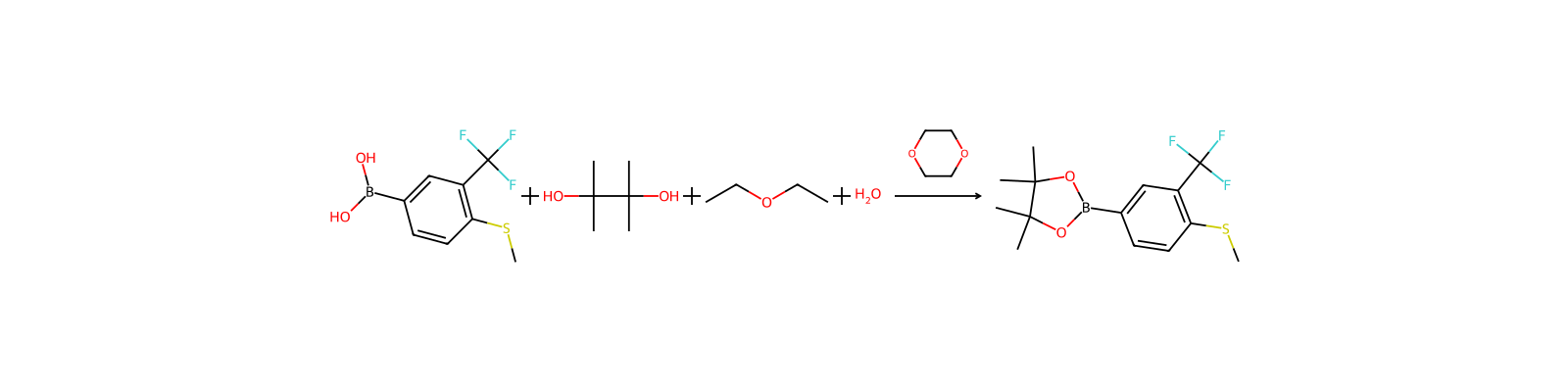
UsesPinacol is used in the preparation of synthetic intermediates like pinacolborane, bis(pinacolato)diboron and pinacolchloroborane by reaction with boron trichloride. Further, it plays an important role as an intermediate for biologically active compounds like antiviral, antibacterial, antifungal and antituberculous.
General DescriptionThe pinacol coupling reaction with the inorganic electride [Ca2N](+)·e() as an electron donor in organic solvents was studied.
Preparation methods
PreparationBy the bimolecular reduction of acetone.
Upstream & downstream products
Upstream raw materials
Downstream products
Suppliers50 total
梯希爱(上海)化成工业发展有限公司021-67121386 · [email protected]
衢州润东化工有限公司0570-8789886 18892685668 · [email protected]
上海阿拉丁生化科技股份有限公司400-6206333 13167063860 · [email protected]
INTATRADE GmbH+49 3493/605464 · [email protected]
爱斯特(成都)生物制药股份有限公司+86-28-85122536 85324413 · [email protected]
科瑞迪化学400-821-5857 021-64326257 · [email protected]
上海迈瑞尔生化科技有限公司4006356688 18621169109 · [email protected]
阿法埃莎(中国)化学有限公司400-6106006 · [email protected]
太原市瑞和丰科贸有限公司+86 351 7031519 · [email protected]
上海德默医药科技有限公司400-021-7337 2355568890 · [email protected]
安耐吉化学&3A(安徽泽升科技股份有限公司)400-0056266 · [email protected]
武汉凯威斯科技有限公司86-027-67849912 · [email protected]
上海瀚鸿科技股份有限公司021-54306202 13764082696 · [email protected]
上海柯维化学技术有限公司021-64609169 18901607656 · [email protected]
上海萃森医药科技有限公司13472757003
聊城金信达新材料有限公司13370978787
上海相辉医药科技有限公司13761987713 · [email protected]
上海景颜化工科技有限公司13817811078 · [email protected]
嘉兴市艾森化工有限公司0573-85285100 18627885956 · [email protected]
上海忆嵘生物科技有限公司18049974220 · [email protected]
Beckmann-Kenko GmbH+49 4241 9308 88 · [email protected]
玛雅试剂+86 (573) 82222445 (0)18006601000 452520369 · [email protected]
四川库利南科技有限公司400-1166-196 18981987031 · [email protected]
天津希恩思生化科技有限公司400 638 7771 · [email protected]
南京维奥化工有限公司Please Send Email 18652950785 · [email protected]
河南多贝化工有限公司0370-2785118 17550508557 · [email protected]
艾科试剂4008-755-333 18080918076 · [email protected]
上海思域化工科技有限公司86-21-34053660 · [email protected]
北京世纪裕立化学有限公司010-64446226 13146983882 · [email protected]
赛默飞世尔科技(中国)有限公司800-810-5118 · [email protected]
北京伊诺凯科技有限公司400-810-7969 010-59572699 · [email protected]
江苏艾康生物医药研发有限公司025-66113011 13913916777 · [email protected]
TCI AMERICA800-4238616 · [email protected]
TOKYO CHEMICAL INDUSTRY CO., LTD.03-36680489 · [email protected]
TCI Europe320-37350700 · [email protected]
深圳康特腾科技有限公司86-0755-86635001 · [email protected]
越林试剂021-62960152 · [email protected]
无锡中坤生化科技有限公司+86 0510-85629785
上海乐晨国际贸易有限公司021-67256163 · [email protected]
上海喀露蓝科技有限公司18149758185 18149758185 · [email protected]
上海将来实业股份有限公司400-0066400 13621662912 · [email protected]
上海将来实业股份有限公司021-61552785 · [email protected]
HBCChem, Inc.+1-510-219-6317 · [email protected]
上海笛柏生物科技有限公司400-008-9730,021-54359730 400-008-9730 · [email protected]
日照力德士化工有限公司010-51268198 · [email protected]
美岚实业(上海)有限公司021-58958189 · [email protected]
上海爱蝶实业有限公司021-58957966 18930537195 · [email protected]
成都零六生物科技有限公司400-1166-196 13458535857 · [email protected]
广拓化学(上海)有限公司021-60899189-8001 18918189673 · [email protected]
雷丁试剂0510-85629785 18013409632 · [email protected]
Additional notes
DefinitionChEBI: A glycol that is ethylene glycol in which all four methylene hydrogens have been replaced by methyl groups.
Related reactions
222 records


Linked notes
Loading…