
4-(Aminomethyl)Benzoic Acid
Completing data — refresh the page later to see the latest
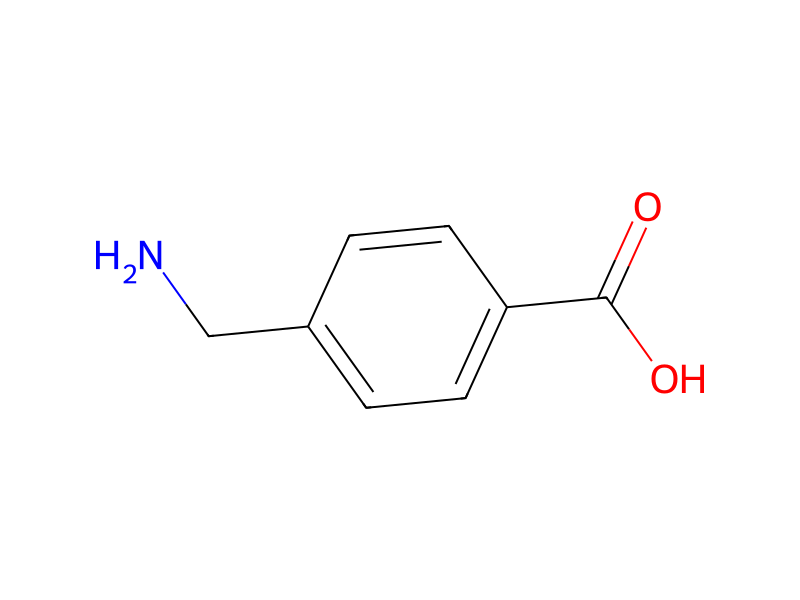
Basic information
- CAS
56-91-7- Standard SMILES
NCc1ccc(C(=O)O)cc1- InChIKey
QCTBMLYLENLHLA-UHFFFAOYSA-N- Molecular formula
- C8H9NO2
- Average molar mass
- 151.16 g/mol
- Monoisotopic mass
- 151.06332853
Overview
Aminomethylbenzoic acid is a member of benzoic acids.
Names & identifiers
- Preferred name
- 4-(Aminomethyl)Benzoic Acid
- IUPAC
- 4-(aminomethyl)benzoic acid
- English name
- 4-(Aminomethyl)benzoic acid
- Molecular formula
- C8H9NO2
- Molecular weight
- 151.16
Names & synonyms
4-(Aminomethyl)benzoic acid56-91-7Aminomethylbenzoic acidPamba4-Aminomethylbenzoic acidStyptopurGumbixp-Aminomethylbenzoic acidNSC-4162968WG9JKC7LDTXSID20204568para-aminomethylbenzoic acid
Show more names
Tranexamic EP Impurity DAMINOMETHYL BENZOIC ACIDH-(4)AMBZ-OHChrisma PereiraAminomethyl AcidAninomethylbenzoicacidAMinoMethyl benzoic acid onTranexamic Acid EP Impurity D
RefChem:518248DTXCID50127059200-297-94-CarboxybenzylamineBenzoic acid, 4-(aminomethyl)-Benzylamine-4-carboxylic acidalpha-Amino-p-toluic acidMFCD00010203
Database identifiers
- CAS
56-91-7- PubChem CID
- 65526
- DTXSID
DTXSID20204568- ChEMBL
CHEMBL328875- ChEBI
CHEBI:134774- UNII
- 68WG9JKC7L
- EC Number
- 200-297-9
- Nikkaji
- J36.120H
Properties
Computed structural propertiesFilling in
- XLogP
- -1.6
- Topological polar surface area
- 63.3 Ų
- Hydrogen bond donors
- 2
- Hydrogen bond acceptors
- 3
- Rotatable bonds
- 2
- Heavy atoms
- 11
- Formal charge
- 0
- Complexity
- 139
Experimental & physicochemical properties
Chemical ClassesNitrogen Compounds -> Aminobenzoic Acids
DrugsPharmaceuticals
Animal DrugsPharmaceuticals -> Animal Drugs -> Approved in Taiwan
Vapor Pressure0.000264 [mmHg]
Physical DescriptionBeige powder; [Sigma-Aldrich MSDS]
Physicochemical properties
- Melting point
- 300 °C · ≥300 °C (lit.)
- Boiling point
- 273.17 °C · 273.17°C (rough estimate)
- Density
- 1.2023 · 1.2023 (rough estimate)
- refractive index
- 1.581 · 1.5810 (estimate)
- storage temp.
- Keep in dark place,Sealed in dry,Room Temperature
- solubility
- Aqueous Base (Slightly), Water (Slightly, Heated, Sonicated)
- pka
- 3.75 · 3.75±0.10(Predicted)
- form
- Powder
- color
- White to almost white
- Water Solubility
- Slightly soluble in water. Insoluble in ethanol, benzene and chloroform.
- BRN
- 1100606 · 1100606
- Stability
- Stable. Incompatible with strong oxidizing agents.
- Major Application
- peptide synthesis
- InChI
- InChI=1S/C8H9NO2/c9-5-6-1-3-7(4-2-6)8(10)11/h1-4H,5,9H2,(H,10,11)
- InChIKey
- QCTBMLYLENLHLA-UHFFFAOYSA-N
- SMILES
- C(O)(=O)C1=CC=C(CN)C=C1
- CAS DataBase Reference
- 56 · 56-91-7(CAS DataBase Reference)
- FDA UNII
- 68 WG9JKC7L · 68WG9JKC7L
- ATC code
- 2 AA03 · B02AA03
- UNSPSC Code
- 41116107 · 41116107
- NACRES
- 24 · NA.24
- Symbol(GHS)
- 7 · GHS07
- Signal word
- Warning
- Hazard statements
- 315 · H315-H319-H335
- Precautionary statements
- 261 · P261-P264-P271-P280-P302+P352-P305+P351+P338
- target organs
- Respiratory system
- PPE
- 95 · dust mask type N95 (US), Eyeshields, Gloves
- Hazard Codes
- Xi
- Risk Statements
- 36 · 36/37/38
- Safety Statements
- 26 · 26-36-37/39-26,37/39
- WGK Germany
- 3 · 3
- HS Code
- 29224999 · 29224999
- Storage Class
- 11 · 11 - Combustible Solids
- Hazard Classifications
- 2 Skin · Eye Irrit. 2Skin Irrit. 2STOT SE 3
Safety & regulation
Safety information is for reference only and does not replace the supplier’s Safety Data Sheet (SDS), applicable regulations, or professional assessment.
GHS classification
GHS Classification
Warning
H315 (98%): Causes skin irritation [Warning Skin corrosion/irritation]
P261, P264, P264+P265, P271, P280, P302+P352, P304+P340, P305+P351+P338, P319, P321, P332+P317, P337+P317, P362+P364, P403+P233, P405, and P501 (click each P-code to see the statement)
Aggregated GHS information provided per 49 reports by companies from 9 notifications to the ECHA C&L Inventory. Each notification may be associated with multiple companies.
Hazard information
Hazards SummaryA skin and strong eye irritant; [Sigma-Aldrich MSDS] See p-Aminobenzoic acid.
Hazard Classes and CategoriesSkin Irrit. 2 (98%)
Safety data
- PPE
- dust mask type N95 (US), Eyeshields, Gloves
- wgk
- 3
- hs_code
- 29224999
- risk_code
- 36/37/38
- Signal word
- Warning
- Symbol(GHS)
- GHS07
- hazard_code
- Xi
- safety_code
- 26-36-37/39-26,37/39
- Storage Class
- 11 - Combustible Solids
- target organs
- Respiratory system
- Hazard statements
- H315-H319-H335
- Hazard Classifications
- Eye Irrit. 2Skin Irrit. 2STOT SE 3
- Precautionary statements
- P261-P264-P271-P280-P302+P352-P305+P351+P338
Chemistry & industry
Pharmacology
ATC Code
B - Blood and blood forming organs
QB - Blood and blood forming organs
MeSH Pharmacological Classification
Agents that prevent fibrinolysis or lysis of a blood clot or thrombus. Several endogenous antiplasmins are known. The drugs are used to control massive hemorrhage and in other coagulation disorders.
Compounds which inhibit or antagonize biosynthesis or actions of proteases (ENDOPEPTIDASES).
Uses & manufacturing
UsesUse (kg; approx.) in Germany (2009): >50
Use ClassificationPharmaceuticals -> Animal Drugs -> Approved in Taiwan
Applications
Description4-(Aminomethyl)benzoic acid is a organic compound that can serve as a type 2 antifibrinolytic agent used in the treatment of fibrotic skin disorders, such as Peyronie's disease. It is believed that 4-(Aminomethyl)benzoic acid is effective to increase the oxygen uptake at the tissue level and enhance activity of monoamine oxidase, thus to promote the degradation of serotonin, which in excess, may lead to fibrotic changes. It is also administrated by mouth to treat several skin conditions including vitiligo, pemphigus, dermatomyositis, morphea, lymphoblastoma cutis and scleroderma. It is sometimes used in pill form by patients suffering from irritable bowel syndrome to treat the relevant gastrointestinal symptoms and applied in nutritional epidemiological studies to assess the completeness of 24-hour urine collection for the determination of urinary sodium, potassium, or nitrogen levels. Besides, it can also serve as nutritional supplements to darken gray hair, prevent hair loss, make skin look younger and prevent sunburn and its benefits are claimed for people with fatigue, irritability, depression, weeping eczema, scleroderma, patchy pigment loss in skin, and premature grey hair.
Uses4-(Aminomethyl)benzoic acid acts as an unnatural amino acid derivative. It is also used as a type 2 antifibrinolytic agent. Further, it reacts with 2-methyl-isothiourea sulfate to prepare 4-guanidinomethylbenzoic acid.
Uses4-(Aminomethyl)benzoic acid (PAMBA) can be used in the synthesis of:Cobalt carboxy phosphonates.Apoptozole (Az), which has cellular potency to promote membrane trafficking of mutant cystic fibrosis transmembrane conductance regulator (CFTR) chloride channel activity.Cyclopeptide composed of L-glutamic acid and 3-aminobenzoic acid that can be used as receptors for a variety of cations and anions.A bioactive peptide which has potent GPR54 (a G protein-coupled receptor) agonistic activity.
Uses4-(Aminomethyl)benzoic Acid is a type 2 antifibrinolytic agent.
Upstream & downstream products
Upstream raw materials
Downstream products
Additional notes
DefinitionChEBI: Aminomethylbenzoic acid is a member of benzoic acids.
Related reactions
146 records


Compound notes
Loading…